


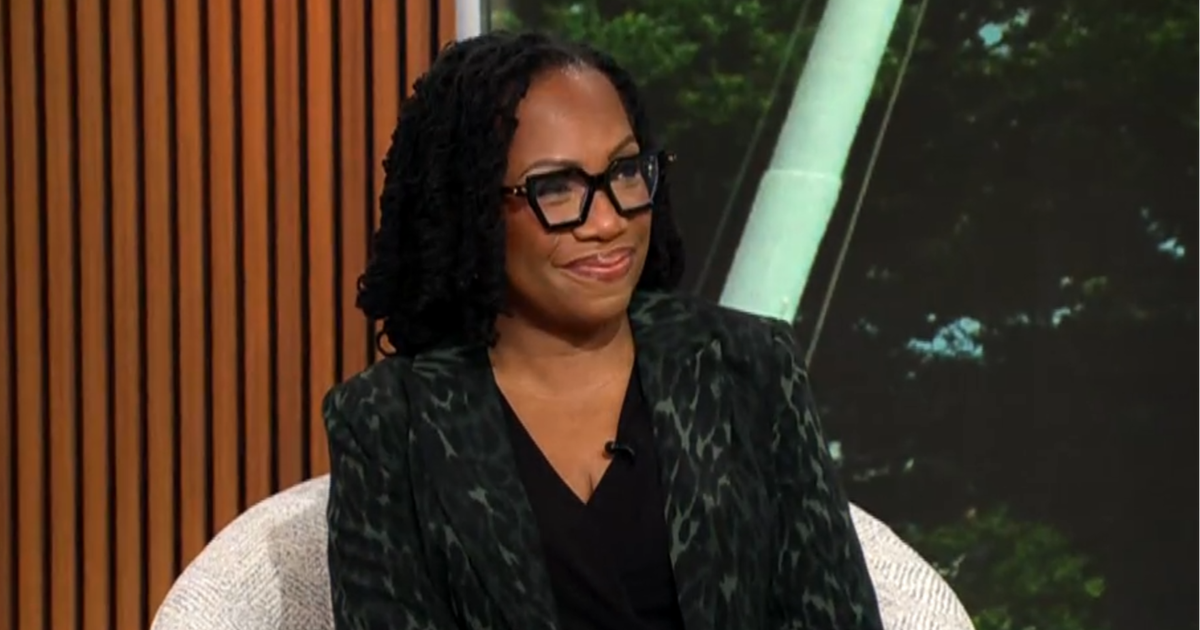

Supreme Court Justice Ketanji Brown Jackson: Finding Unity in Disagreement
A Model of Civility in a Divided Era
In an era where political and ideological divisions seem to dominate every corner of American public life, Supreme Court Justice Ketanji Brown Jackson offers a refreshingly hopeful perspective on how people with vastly different viewpoints can still work together respectfully. During a recent interview with “CBS Mornings,” Justice Jackson pulled back the curtain on life inside the nation’s highest court, revealing that despite the justices’ often starkly different legal philosophies and approaches to constitutional interpretation, they maintain a remarkably collegial working relationship. “The court is very good at compartmentalizing, meaning that we focus on our work,” she explained, emphasizing that this ability to separate professional responsibilities from personal feelings about disagreements has created what she believes could serve as “a model for learning how to disagree without being disagreeable.” This statement carries particular weight coming from someone who has experienced significant professional disagreements with her colleagues, yet maintains that the justices “get along well” and operate as a cohesive group despite their differences. Her observations offer a compelling counter-narrative to the increasingly polarized nature of American discourse, suggesting that respectful disagreement is not only possible but can be highly productive.
The Power of Focused Professionalism
Justice Jackson’s insights into the Supreme Court’s internal dynamics reveal a workplace culture built on mutual respect and dedicated professionalism. She described how each justice approaches their responsibilities with serious intent, working independently to develop their own understanding of complex legal issues before coming together to deliberate. “We work very hard. We come up with our own individual opinions as to how we think about the law,” she noted, highlighting the intellectual rigor that defines the Court’s work. This process of individual analysis followed by collective discussion creates an environment where diverse perspectives can coexist productively. The justices have developed what Jackson describes as an ability to “adapt to being in an environment with people who have very strongly held but different views.” This adaptation doesn’t mean abandoning one’s principles or watering down one’s beliefs; rather, it involves maintaining professional relationships and finding common ground where possible while still vigorously defending one’s legal interpretations. The fact that nine individuals with lifetime appointments, selected by presidents of different parties and holding varying judicial philosophies, can maintain what Jackson characterizes as a “very collegial” atmosphere speaks to the possibility of respectful coexistence even amid fundamental disagreements. In a society where family dinners and friendships sometimes fracture over political differences, the Supreme Court’s example of maintaining collegiality despite frequent 5-4 or 6-3 splits on contentious issues offers a valuable lesson in professional maturity.
Strong Dissents and Respectful Relationships
The relationship between Justice Jackson and her colleagues becomes even more remarkable when considering the sharpness of some recent legal disagreements. Since becoming the first Black woman to serve on the Supreme Court nearly four years ago, Jackson has established herself as one of the most vocal critics of certain Trump administration policies that have come before the Court. Her dissents have not been mild or equivocating; they have been forceful statements of principle. In one notable case involving nationwide injunctions and President Trump’s executive order attempting to end birthright citizenship, Jackson’s dissent drew an unusually pointed response from Justice Amy Coney Barrett, who was joined by five other justices. Barrett characterized Jackson’s dissent as choosing “a startling line of attack,” language that suggests significant disagreement about not just the legal conclusion but the approach to reaching it. When the Court ultimately ruled in favor of allowing the administration to proceed with its plan, Jackson stood completely alone among her colleagues, using stark language to describe the order as “not only truly unfortunate, but also hubristic and senseless.” These are strong words from a Supreme Court justice, reflecting deep disagreement on matters of constitutional significance. Yet despite these professional clashes—disagreements that involve fundamental questions about constitutional rights, executive power, and the role of the judiciary—Jackson maintains that the working relationships among the justices remain positive and respectful. This ability to separate the personal from the professional, to vigorously defend one’s position without making disputes personal, represents exactly the kind of civic engagement that seems increasingly rare in contemporary America.
The Deliberative Process Takes Time
Justice Jackson also offered valuable perspective on why Supreme Court decisions often take months to produce, particularly on contentious issues that capture public attention. With hot-button cases pending, including challenges related to President Trump’s tariff policies, many Americans grow impatient for resolution, wanting quick answers to pressing constitutional questions. But Jackson explained that “there are lots of nuanced legal issues that the court has to thoroughly consider,” emphasizing that the deliberative process simply cannot be rushed without compromising quality. “We actually deliberate over a period of time where each of the justices decides how they feel about the issues and writes, and it takes a while to write,” she noted. This description reveals a careful, methodical approach to jurisprudence that stands in sharp contrast to the rapid-fire news cycles and instant reactions that characterize much of modern life. Each justice must not only formulate their own position but articulate it in writing—a process that requires precision, research, and often multiple drafts. When multiple justices agree on a general outcome but for different reasons, or when dissenting justices want to explain their reasoning, the process becomes even more complex. The Court’s decisions become part of the permanent legal record, cited by lower courts and lawyers for generations, so accuracy and clarity matter immensely. Jackson’s explanation offers important context for understanding why the wheels of justice sometimes appear to turn slowly, particularly at the Supreme Court level where cases involve the most complex and consequential legal questions facing the nation.
Drawing on Personal History for Perspective
In discussing her recently released young adult edition of her book “Lovely One,” Justice Jackson revealed how her own experiences continue to inform her perspective on current challenges. She shared that the new edition includes a speech she delivered at a debate tournament while in high school in 1987—nearly four decades ago, yet still relevant to today’s challenges. The point of that speech, she explained, was “to really get people to focus on the moment and try to not be so overwhelmed by the circumstance.” This advice from her younger self has clearly stayed with Jackson throughout her remarkable journey from high school debater to Supreme Court justice, and she believes it holds wisdom for all Americans navigating today’s turbulent political and social landscape. By including this teenage speech in her book, Jackson bridges her past and present, showing young readers that the person now serving on the nation’s highest court was once a student facing her own challenges and uncertainties. This connection to her younger self also demonstrates how certain fundamental principles—focusing on what you can control, not being paralyzed by overwhelming circumstances, staying grounded in your values—remain constant even as someone’s circumstances change dramatically. For Jackson, who broke historic barriers by becoming the first Black woman to serve on the Supreme Court, this long view of personal development and the importance of remaining focused on core principles carries particular authority.
Hope for a Divided Nation
Perhaps most significantly, Justice Jackson offered a message of hope for a nation that often feels irreparably fractured along political, ideological, racial, and cultural lines. She acknowledged the reality of current divisions, saying “this moment in U.S. history is divided,” but refused to view this division as unprecedented or insurmountable. “We’ve certainly had other periods in our history in which we’ve been divided and we’ve come through them,” she observed, placing today’s challenges in the broader context of American history—a history that includes a Civil War, the struggle for civil rights, protests over Vietnam, and countless other moments when the national fabric seemed stretched to its breaking point. Her prescription for navigating division focuses on the local and personal rather than the grand and political. “If people really focus on their own values and the things that matter to them, if they invest in their communities and in their loved ones, we will make it through,” Jackson said. This advice shifts attention away from national political combat and toward the building blocks of civil society—families, neighborhoods, communities, and the relationships and institutions that give individual lives meaning. It’s a fundamentally optimistic vision that trusts in the resilience of ordinary people and local communities even when national-level politics seems dysfunctional. Coming from someone who works at the very pinnacle of the federal government’s judicial branch, someone who deals daily with the most contentious legal and political questions facing the nation, this message carries particular weight. Justice Jackson’s confidence that “we will make it through” reflects both historical perspective and daily experience working respectfully with colleagues who see the world very differently—proving that disagreement need not destroy relationship, and that diverse viewpoints can coexist within shared institutions dedicated to common purpose.