
Rory McIlroy’s Emotional Masters Victory: A Family Triumph at Augusta
A Champion’s Heartfelt Celebration
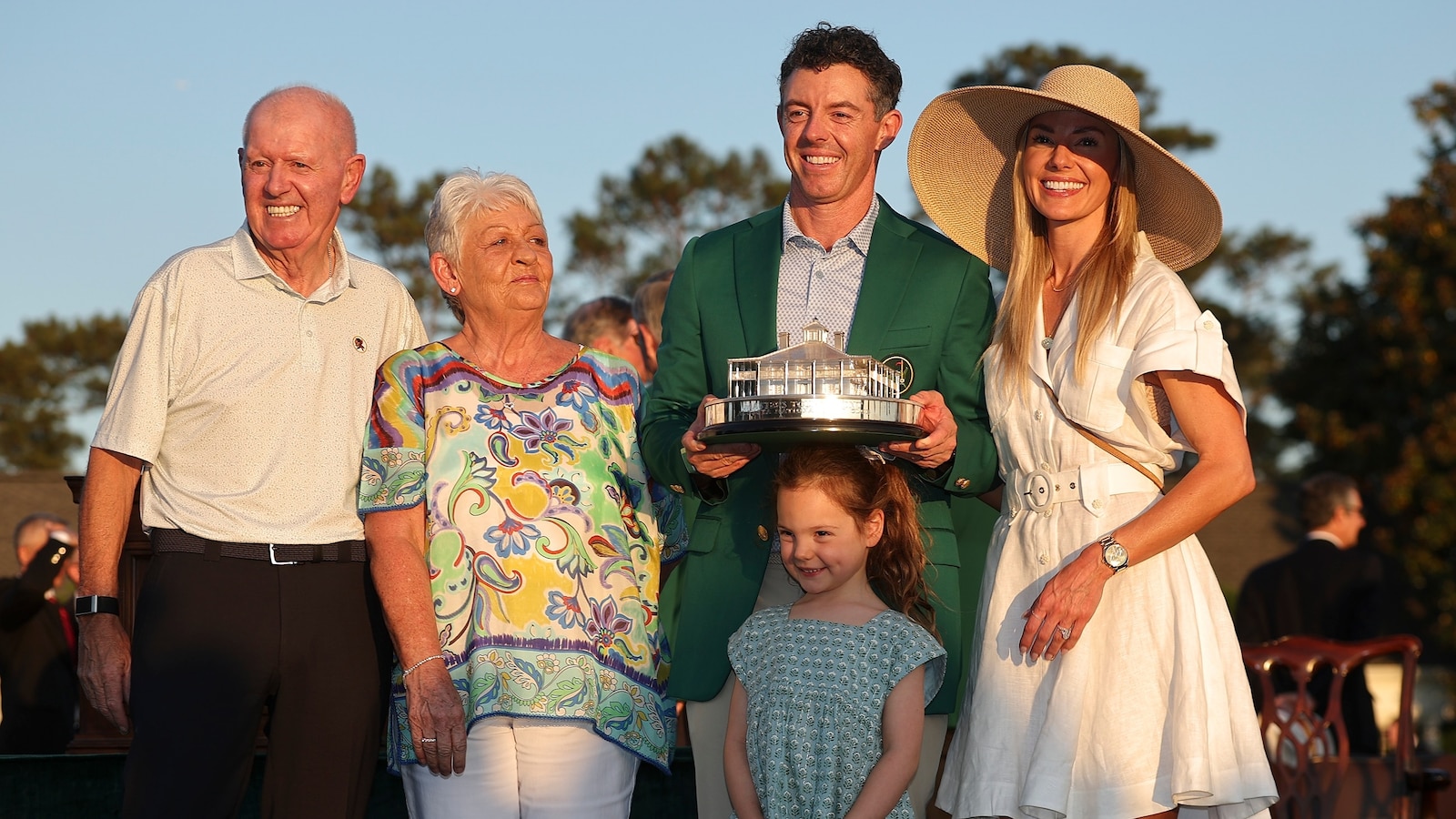
When Rory McIlroy walked off the 18th green at Augusta National Golf Club this past Sunday, he wasn’t just a golfer who had conquered one of the sport’s most prestigious tournaments—he was a father, a husband, and a son savoring a moment that transcended the game itself. The Northern Irish golf legend had just secured his second consecutive Masters title, a feat accomplished by only three other players in the tournament’s storied history. But what captured hearts around the world wasn’t just his remarkable performance on the course; it was the raw, unfiltered emotion he displayed as he gestured to his 5-year-old daughter Poppy to duck under the ropes and join him in celebration. The embrace between father and daughter, followed by a tender kiss with his wife Erica and warm hugs with his parents Rosie and Gerry, reminded everyone watching that behind every great achievement lies the support of family who weather the journey’s highs and lows together.
McIlroy’s victory at the 90th Masters Tournament was historic by any measure. Finishing at 12 under par—one stroke better than his 2025 Masters victory and one shot ahead of his closest competitor—he joined an elite club of back-to-back Masters champions that includes Jack Nicklaus, Nick Faldo, and Tiger Woods. The accomplishment placed him among golf’s immortals, but in those precious moments after sinking his final putt, the green jacket and the trophy seemed secondary to the people who had stood by him through countless tournaments, practice sessions, disappointments, and triumphs.
The Emotional Trophy Ceremony
As Augusta National Golf Club and Masters Tournament Chairman Fred Ridley slipped the iconic green jacket back onto McIlroy’s shoulders, his family looked on with pride and joy radiating from their faces. But it was during his acceptance speech that the true depth of emotion became apparent. Standing before the crowd with his loved ones seated in the front row, McIlroy cleared his throat and became visibly choked up as he began what he acknowledged would be “the hard part” of the ceremony. In a world where professional athletes are often portrayed as stoic and unshakeable, McIlroy’s vulnerability was both refreshing and deeply human.
“First and foremost, my wife and daughter, Erica and Poppy, they have to put up with me at home, and trust me sometimes that’s a tough thing to do,” McIlroy admitted with characteristic humility and humor. “But they have been my biggest supporters.” The acknowledgment spoke volumes about the reality of life with a professional athlete—the mood swings after disappointing rounds, the mental preparation that requires solitude and focus, the travel schedule that keeps families apart. Yet through it all, Erica and Poppy have remained his foundation, providing the stability and unconditional love that allows him to perform at the highest level when it matters most.
McIlroy’s mention of how the Masters has become “Poppy’s favorite week of the year” brought knowing smiles from parents in the audience who understand how children can find magic in the simplest things. “I don’t know [if] it’s because of the Par 3 tournament or it’s the all-you-can-eat ice cream in the player services building,” he joked, momentarily lightening the emotional weight of the occasion. The comment revealed a father who pays attention to what brings joy to his daughter’s eyes, who notices that sometimes the memories children cherish most aren’t the trophies and accolades but the ice cream and fun traditions that come along with them.
A Tribute to His Parents
When McIlroy turned his attention to his parents, the emotion deepened even further. Rosie and Gerry McIlroy hadn’t been present at Augusta for their son’s first Masters victory in 2025, and in a touching display of the superstitions that often accompany sports, they had initially been reluctant to attend this year’s tournament. “Surprisingly, I had to convince them to come this year, because they thought that the reason that I won was because they weren’t here,” McIlroy revealed. “So I’m glad that we proved that wrong.” The anecdote highlighted the sometimes irrational but deeply felt beliefs that families develop around athletic success, and the relief and joy of discovering that their presence could enhance rather than jinx the outcome.
With his voice thick with emotion, McIlroy delivered words that resonated far beyond the manicured grounds of Augusta National: “I owe everything to my mom and dad. You’re the most wonderful parents, and if I can be half the parent to Poppy that you were to me, then I know I’ve done a good job. Thank you.” In that moment, the Masters champion became simply a grateful son, acknowledging the sacrifices, encouragement, and love that had set him on this path decades earlier. For Rosie and Gerry McIlroy, who had nurtured their son’s talent from his earliest days picking up a golf club in Northern Ireland, hearing those words must have felt like a victory greater than any tournament could provide.
Rosie McIlroy’s presence in the crowd earlier that day had already made a statement, as she was spotted carrying a unique handbag adorned with newspaper headlines from Rory’s first Masters victory in 2025. The accessory was more than a fashion choice—it was a mother’s pride made tangible, a way of carrying her son’s achievements literally and figuratively, and a symbol of how families preserve and celebrate the milestones of their loved ones.
The Road to Victory
McIlroy’s path to this second Masters title was anything but smooth, which made the victory all the sweeter. He began the third round with a historic six-stroke lead, the largest cushion any player had ever taken into the weekend at Augusta. For most golfers, such an advantage would seem insurmountable, but as two-time Masters champion Bernhard Langer had told ABC News before the final rounds, “In golf, you really never know, and we’ve seen a lot, especially at Augusta on the back nine, so much can happen. An elite four-shot lead can dissipate in two holes.”
Langer’s words proved prophetic. By the end of Saturday’s third round, Cameron Young had clawed his way back into contention, erasing McIlroy’s commanding lead and forcing a tie going into the final day. The collapse could have been devastating, the kind of setback that haunts golfers for years. Instead, McIlroy demonstrated the mental fortitude that separates champions from contenders. On Sunday, with the pressure at its peak, he delivered two pivotal birdies on holes 12 and 13—historically treacherous stretches of Augusta’s back nine where many Masters dreams have died. Those crucial strokes gave him breathing room he would need, and he held on to win by a single shot.
McIlroy also became only the fourth player in 40 years to hold a lead or co-lead after each round of the Masters, according to ESPN Research. This statistic underscores not just his talent but his consistency under pressure, his ability to maintain focus across four grueling days when the eyes of the golfing world are trained upon every swing, every putt, every decision.
A Place in History
With this victory, Rory McIlroy has cemented his legacy among golf’s greatest champions. Winning consecutive Masters tournaments places him in extraordinarily rare company—only Jack Nicklaus, Nick Faldo, and Tiger Woods had previously accomplished this feat. These are names that define golf history, legends whose accomplishments have stood as benchmarks for generations. Now McIlroy’s name stands alongside theirs, a testament to his exceptional skill, determination, and ability to perform when the stakes are highest.
But perhaps what makes McIlroy’s achievement even more meaningful is the way he has chosen to share it. In an era when professional athletes are often criticized for being distant or entitled, McIlroy has consistently shown gratitude, humility, and genuine emotion. His post-victory celebration wasn’t about personal glory—it was about acknowledging the people who made the journey possible. From the way he immediately called his daughter onto the green to the tears in his eyes as he thanked his parents, McIlroy demonstrated that true success is measured not just in trophies and titles but in the relationships we nurture and the love we share.
The Human Side of Championship Golf
Rory McIlroy’s second consecutive Masters victory will be remembered for the historic achievement it represents, but it will be cherished for the humanity it revealed. In a sport often criticized as elitist or impersonal, McIlroy reminded us that golfers are fathers who worry about being good parents, sons who owe everything to their mothers and fathers, and husbands who depend on their partners’ patience and support. His emotional speech wasn’t scripted or calculated—it was the heartfelt expression of a man who understands that life’s greatest victories are meaningless without people to share them with.
As Poppy McIlroy posed with her father and the Masters trophy, as Erica stood proudly beside her husband, and as Rosie and Gerry beamed with parental pride, the world witnessed something more valuable than perfect golf. We saw a family united in celebration, bound by love that transcends wins and losses. We saw a champion who hasn’t forgotten where he came from or who helped him get there. And we saw a reminder that at the end of every great achievement stands a network of supporters whose contributions, though often invisible, are absolutely essential. Rory McIlroy may have won the Masters, but his greatest triumph was showing us all what truly matters.