
Remembering Isaiah Zagar: Philadelphia’s Visionary Mosaic Artist Who Transformed the City Into a Living Canvas
A Legacy Written in Broken Glass and Mirrors
Philadelphia has lost one of its most distinctive and beloved artistic voices. Isaiah Zagar, the visionary mosaic artist who spent decades transforming the city’s walls, buildings, and alleyways into shimmering dreamscapes of color and light, passed away on Thursday at his home at the age of 86. According to Philadelphia’s Magic Gardens, the nonprofit art center that stands as perhaps his most famous creation, Zagar died from complications related to heart failure and Parkinson’s disease. His passing marks the end of an era for Philadelphia’s art scene, but his work ensures that his creative spirit will remain embedded in the city’s landscape for generations to come. For those who have walked the streets of Philadelphia, particularly along the eclectic South Street corridor, Zagar’s influence is impossible to miss—his mosaics have become as much a part of the city’s identity as its famous cheesesteaks and historic Liberty Bell.
Born in Philadelphia, Zagar’s journey to becoming the city’s most prolific public artist took an unconventional path. After serving in the Peace Corps in Peru with his wife Julia, the couple returned to Philadelphia in 1968, settling in the South Street neighborhood that would become both their home and Zagar’s vast outdoor canvas. What followed was an extraordinary artistic career spanning more than five decades, during which Zagar created hundreds of public mosaics that fundamentally changed the visual character of Philadelphia’s streetscape. His work wasn’t confined to galleries or museums—instead, he brought art directly to the people, covering surfaces throughout the city with intricate designs made from broken glass, ceramic tiles, mirrors, bicycle wheels, bottles, and countless other found objects that most people would consider trash. In Zagar’s hands, these discarded materials became components of elaborate, fantastical artworks that invited passersby to see beauty in unexpected places and transformed ordinary urban spaces into extraordinary visual experiences.
The Magic of South Street and an Artist’s Deep Connection to Community
Emily Smith, executive director of Philadelphia’s Magic Gardens, captured the depth of Zagar’s commitment to his adopted neighborhood when she said, “He loved South Street, the city of Philadelphia, and the community fostered here with all of his heart.” This wasn’t mere sentiment—it was visible truth written across nearly every surface along the funky, bohemian South Street corridor where Zagar and Julia made their home. The couple became integral parts of the neighborhood’s identity, with Isaiah’s mosaics serving as both beautification and preservation, often covering deteriorating buildings and forgotten spaces with vibrant, intricate artwork that drew attention and foot traffic to areas that might otherwise have been overlooked. His work created what the foundation aptly described as “an everlasting mark on our city,” a permanent reminder that art belongs not just in rarefied spaces but in the everyday environments where people live, work, and gather. The immersive Philadelphia’s Magic Gardens on South Street, which now operates as a nonprofit museum, stands as the crown jewel of his artistic achievement—a labyrinthine indoor and outdoor space spanning multiple properties, entirely covered in Zagar’s signature mosaic work, drawing thousands of visitors from around the world each year who come to experience his unique artistic vision.
Art as Survival: Creating Through Adversity
Behind the dazzling surfaces and whimsical imagery of Zagar’s work lay a more complex story of an artist using creativity as a lifeline. As Emily Smith noted in her statement following his death, “While Isaiah lived with ups and downs of mental health struggles, and later with Parkinson’s Disease, he endlessly turned to his art-making to not only express himself, but as a tool to survive.” This revelation adds poignant depth to understanding Zagar’s prolific output and his seemingly compulsive need to cover surfaces with mosaic work. For Zagar, art wasn’t simply a profession or even a passion—it was a necessary practice, a way of processing the world and his place in it, a method of channeling difficult emotions and experiences into something tangible and beautiful. His willingness to work with broken and discarded materials takes on additional symbolic meaning when viewed through this lens—perhaps in reassembling fragments of glass and tile into coherent, beautiful wholes, he was also working to assemble and make sense of the fragments of his own experience. The fact that he continued creating even as Parkinson’s disease made physical work increasingly difficult speaks to the essential nature of art-making in his life. Many artists work from inspiration or opportunity, but for Zagar, creating art was as fundamental as breathing.
Battles to Preserve a Living Legacy
Despite—or perhaps because of—the unofficial, guerrilla nature of much of his work, Zagar’s mosaics occasionally became caught in the crossfire of urban development and preservation conflicts. One of the most significant of these battles involved a massive mosaic that Zagar worked on throughout the 1990s, covering a building in Philadelphia’s Old City neighborhood that housed The Painted Bride Art Center. When developers sought to demolish the building to make way for new construction, supporters of Zagar’s work launched a lengthy legal fight to save the artwork. Despite these efforts, demolition of the building began in December, though preservationists managed to salvage some portions of Zagar’s mosaic work. This conflict highlighted a broader question that cities around the world are grappling with: how do we balance progress and development with the preservation of public art, particularly when that art exists on privately owned buildings? Zagar’s work occupied a unique space—not quite authorized public art, not quite graffiti, but something in between, created with permission but often on structures that would later change hands or face demolition. The fact that efforts were made to salvage pieces of his work from the Painted Bride building, rather than simply allowing it to be destroyed, demonstrates the value that Philadelphia’s community placed on preserving Zagar’s artistic legacy, even when preservation of the original context proved impossible.
A Family of Artists and the Personal Made Public
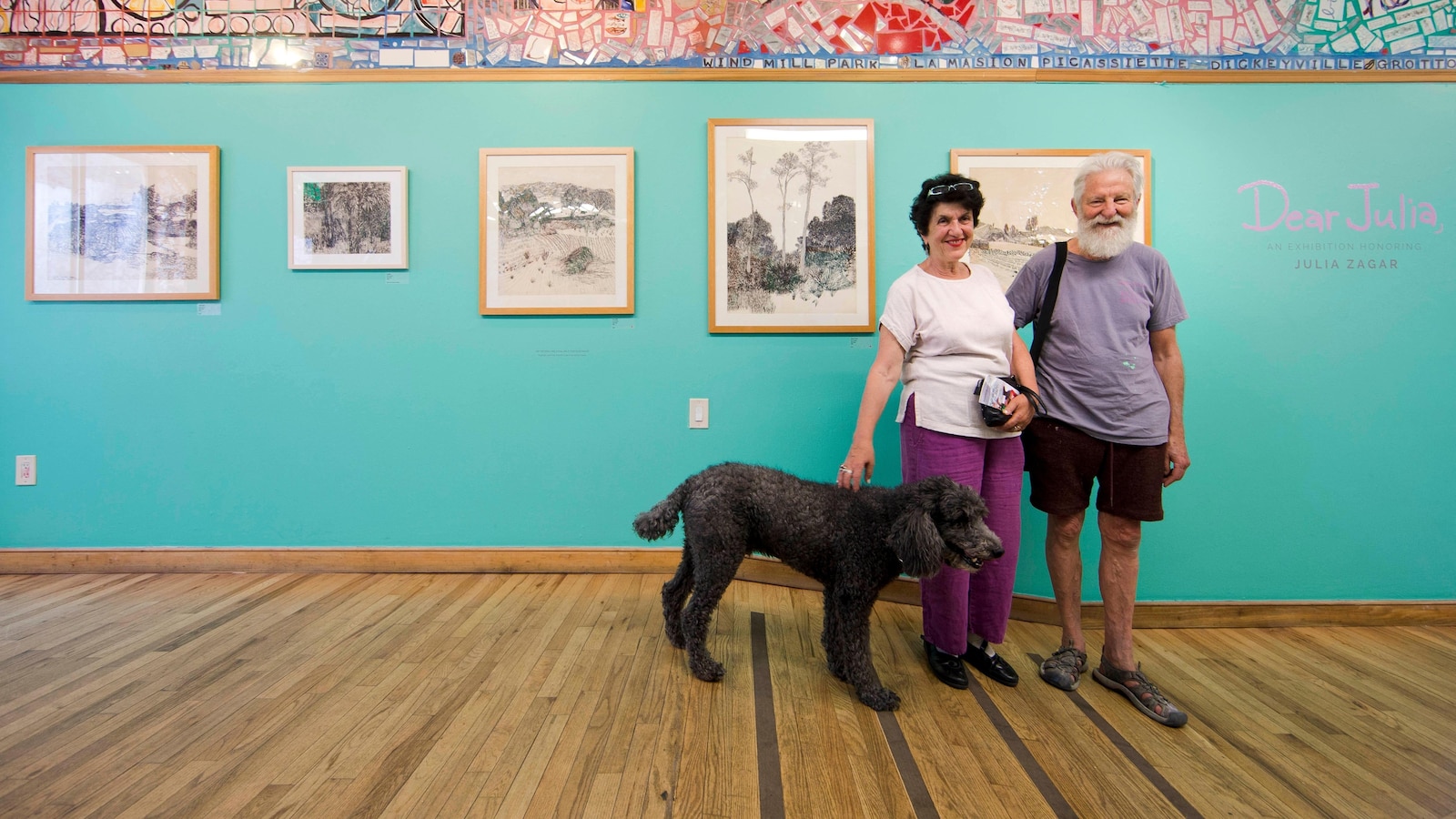
Isaiah Zagar’s artistic journey was deeply intertwined with his personal life, particularly his relationship with his wife Julia, whom he called his muse and artistic partner. Julia, who survives him along with their two sons, wasn’t merely a supportive spouse but an active collaborator in his vision, helping to run the Magic Gardens and supporting his work throughout their decades together. One of those sons, Jeremiah Zagar, became a filmmaker and directed a 2008 documentary titled “In A Dream,” which offered an intimate look at his father’s life, work, and creative process. The documentary didn’t shy away from the complexities of Isaiah’s personality or the challenges of growing up with a father whose artistic vision often blurred the boundaries between public and private life—Isaiah’s own home was as thoroughly covered in mosaic work as any public wall. This willingness to document the fuller picture of his father’s life, including the difficulties alongside the triumphs, has helped ensure that Isaiah Zagar’s legacy includes not just the physical artworks he left behind but also a deeper understanding of the artist himself, his motivations, his struggles, and the singular vision that drove him to transform an entire city into his canvas. The family’s involvement in preserving and interpreting his work helps ensure that future generations will be able to appreciate not just what Zagar created, but why and how he created it.
An Everlasting Mark on Philadelphia
As Philadelphia mourns the loss of Isaiah Zagar, the city can also celebrate the extraordinary gift he gave to its residents and visitors—a transformed urban landscape where art surprises and delights at every turn, where discarded materials become treasures, and where blank walls become windows into imaginative worlds. His hundreds of mosaics scattered throughout the city serve as a permanent reminder that art has the power to transform not just physical spaces but entire communities, creating shared experiences and landmarks that give neighborhoods unique identities. The fact that Philadelphia’s Magic Gardens continues to draw thousands of visitors each year demonstrates that Zagar’s work has transcended its local origins to become something of broader cultural significance, a destination that puts Philadelphia on the map as a city that values public art and creative expression. For those who walk the streets of Philadelphia, particularly along South Street, Zagar’s presence will continue to be felt in the glint of mirror fragments catching sunlight, in the intricate patterns of broken tile forming unexpected images, and in the sense of wonder that comes from encountering art in unexpected places. Isaiah Zagar may have passed away, but his vision lives on in the very fabric of the city he loved, an everlasting mark indeed—a testament to one artist’s belief that beauty can be created from broken things, that art belongs to everyone, and that a single determined individual can quite literally change the face of a city, one mosaic at a time.