
The Future of Urban Transportation: Uber’s Sky-High Partnership with Joby Aviation
A New Era of Commuting Takes Shape
The way we think about getting from point A to point B is about to undergo a revolutionary transformation. Uber, the company that fundamentally changed ground transportation over a decade ago, is now setting its sights on the skies. In an exciting development announced this week, Uber has detailed its partnership with Joby Aviation to bring all-electric air taxis to everyday travelers. This isn’t science fiction or a distant dream—it’s a real service launching later this year that will allow riders to book flights through the same app they currently use to hail a car. The partnership represents a significant milestone in urban air mobility, bringing what was once imagined only in futuristic movies into our present reality. Dubai will be the first city to experience this groundbreaking service, with major American cities like Los Angeles and New York on the horizon once regulatory approvals are secured from the Federal Aviation Administration.
Booking Your Flight: As Simple as Ordering a Ride
One of the most remarkable aspects of Uber Air is how seamlessly it integrates into the existing Uber ecosystem that millions of people already know and trust. There’s no need to download a separate app, create a new account, or learn a completely different booking system. When you open your regular Uber app and enter your destination, the technology will automatically determine if an air taxi route is available for your journey. If it is, you’ll see “Uber Air powered by Joby” appear right alongside your familiar ground transportation options like UberX or Uber Black. The booking process maintains Uber’s signature one-tap simplicity, but what you’re actually reserving is a complete multimodal journey that combines the best of ground and air travel. Your trip will include an Uber Black vehicle to take you to the vertiport (the launching pad for the air taxi), the actual flight in Joby’s electric aircraft, and another Uber pickup waiting for you at your destination to complete the final leg of your journey. This door-to-door service eliminates the complexity that has traditionally made private aviation inaccessible and impractical for most people.
The Aircraft: Engineering Excellence Meets Environmental Responsibility
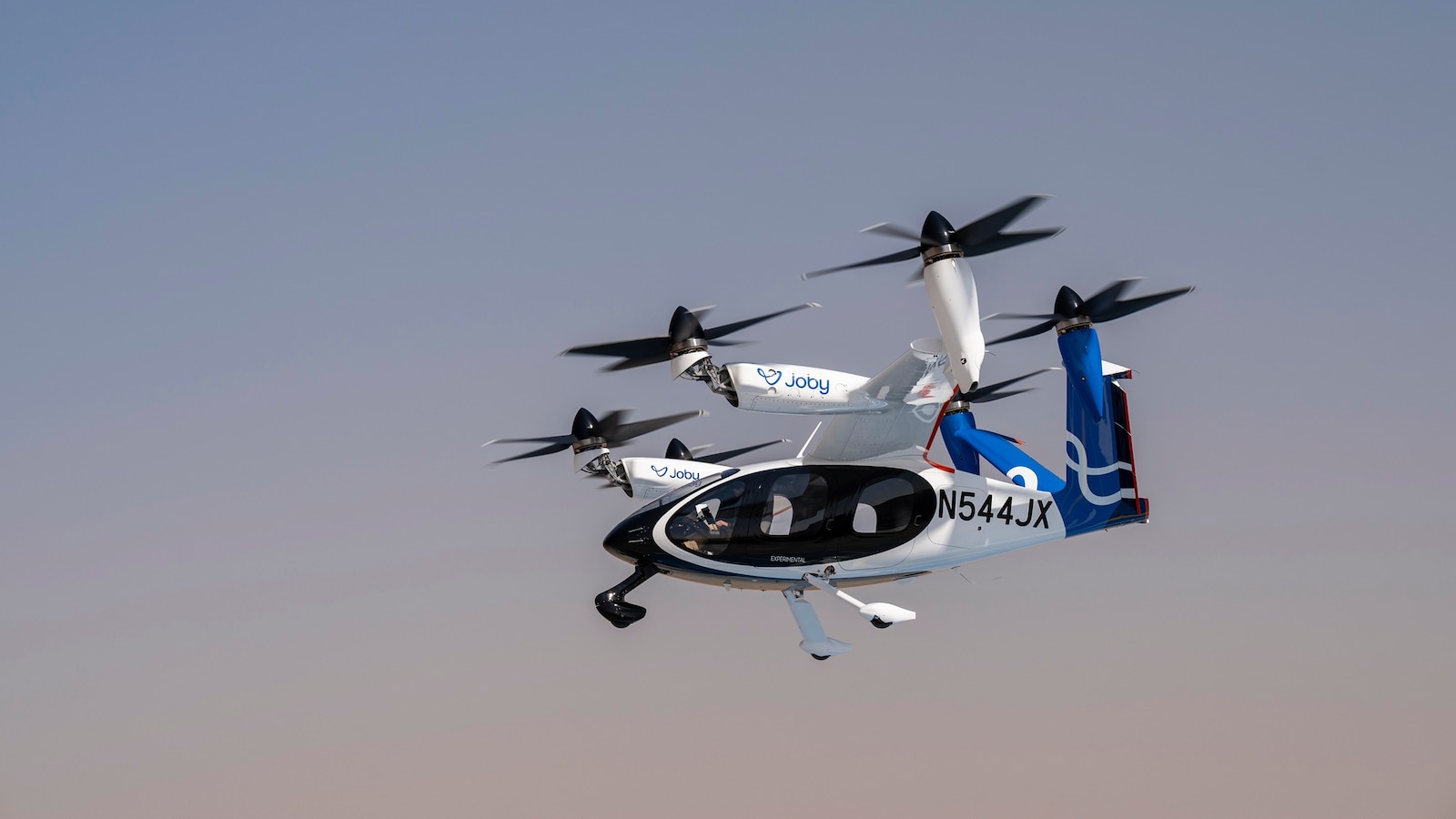
Joby Aviation’s aircraft represents a remarkable achievement in aviation engineering, designed specifically for urban environments rather than being adapted from traditional aircraft. These pilot-flown vehicles can accommodate four passengers and utilize vertical takeoff and landing (eVTOL) technology, which means they don’t require lengthy runways like conventional planes. Instead, they can operate from compact rooftop locations or specially designed landing pads, making them perfect for dense urban areas where space is at a premium. The aircraft features six tilting propellers that enable both vertical liftoff and efficient forward flight, enclosed in a sleek design with large panoramic windows that promise passengers spectacular views of the cityscape below. One of the most impressive engineering achievements is the aircraft’s remarkably low noise profile. Unlike the thunderous roar of helicopters that currently provide premium air transportation in cities, Joby’s aircraft has been specifically engineered to blend into the existing urban soundscape, addressing one of the major concerns about widespread adoption of air taxis in residential areas. Powered entirely by electricity, each aircraft can reach speeds of up to 200 miles per hour and travel approximately 100 miles on a single charge—more than sufficient for most urban and suburban commutes.
Safety First: Multiple Layers of Protection
When it comes to flying through the air, safety isn’t just important—it’s everything. Joby Aviation and Uber understand this fundamental truth, which is why the aircraft incorporates multiple redundant safety systems that go well beyond standard requirements. Each aircraft is equipped with four completely independent battery packs, ensuring that even if one or more fail, the vehicle maintains power. The flight computer system features triple redundancy, meaning there are three separate computer systems working simultaneously, each capable of controlling the aircraft independently if the others malfunction. These redundant systems are designed not just to meet Federal Aviation Administration standards, but to exceed them, providing passengers with confidence that their safety has been prioritized at every stage of design and operation. Perhaps most importantly, every flight will be piloted by a trained aviation professional—these aren’t autonomous drones, but aircraft with human expertise at the controls. The development process has been rigorous and extensive, with Joby’s fleet having already completed more than 50,000 miles of flight testing. Currently, the aircraft is in the final stage of FAA type certification, a comprehensive process that evaluates every aspect of the aircraft’s design, construction, and performance to ensure it meets the strict safety standards required for commercial passenger service in the United States.
The Price Tag: Premium But Not Prohibitive
One of the biggest questions potential passengers have about this new service is naturally, “How much will it cost?” While Uber hasn’t released exact pricing details yet—those will come closer to the actual launch—the company has provided helpful guidance by comparing the cost to existing services. The aerial portion of your Uber Air trip is expected to be priced similarly to an Uber Black fare for a comparable distance on the ground. This pricing strategy is significant because it positions air taxi service not as an ultra-luxury option reserved only for the extremely wealthy, but as a premium service accessible to the broader market of professionals and travelers who currently use Uber Black or similar premium transportation options. Before you confirm your booking, you’ll see complete, all-inclusive, per-passenger upfront pricing with no hidden fees or surprises, maintaining Uber’s commitment to pricing transparency. While it certainly won’t be as inexpensive as an UberX ride, the value proposition becomes clear when you consider the time savings—traveling at 200 mph while avoiding ground traffic could transform a two-hour commute into a fifteen-minute flight, making the premium price worthwhile for time-sensitive travel, airport connections, or special occasions.
Launch Timeline and Global Expansion Plans
Dubai has been selected as the proving ground for this revolutionary service, and the choice makes perfect sense. The city has established itself as a global hub for innovation and futuristic infrastructure, with a government actively supportive of next-generation transportation solutions. Joby has secured an exclusive six-year agreement to operate air taxi services in Dubai, giving the company a protected period to refine operations and demonstrate the viability of urban air mobility. The initial route network will connect some of Dubai’s most important destinations: Dubai International Airport, one of the world’s busiest aviation hubs; Dubai Mall, a major commercial and tourist center; Atlantis The Royal, a luxury resort; and American University in Dubai. These routes have been strategically selected to serve both residents and the millions of tourists who visit Dubai each year. However, Dubai is just the beginning. Both Uber and Joby have ambitious plans for expansion to major cities around the world. Los Angeles and New York City are high-priority targets in the United States, while international expansion is planned for the United Kingdom and Japan. Each of these markets presents unique opportunities and challenges, from Los Angeles’s notorious traffic congestion to New York’s density and complexity. The timeline for these expansions will depend on two critical factors: obtaining necessary regulatory approvals from aviation authorities in each country, and the construction of vertiport infrastructure—the network of takeoff and landing facilities that will serve as the nodes in the air taxi network. As this infrastructure develops and regulatory frameworks evolve to accommodate this new form of transportation, we can expect to see Uber Air gradually expanding to more cities, potentially transforming urban mobility on a global scale.