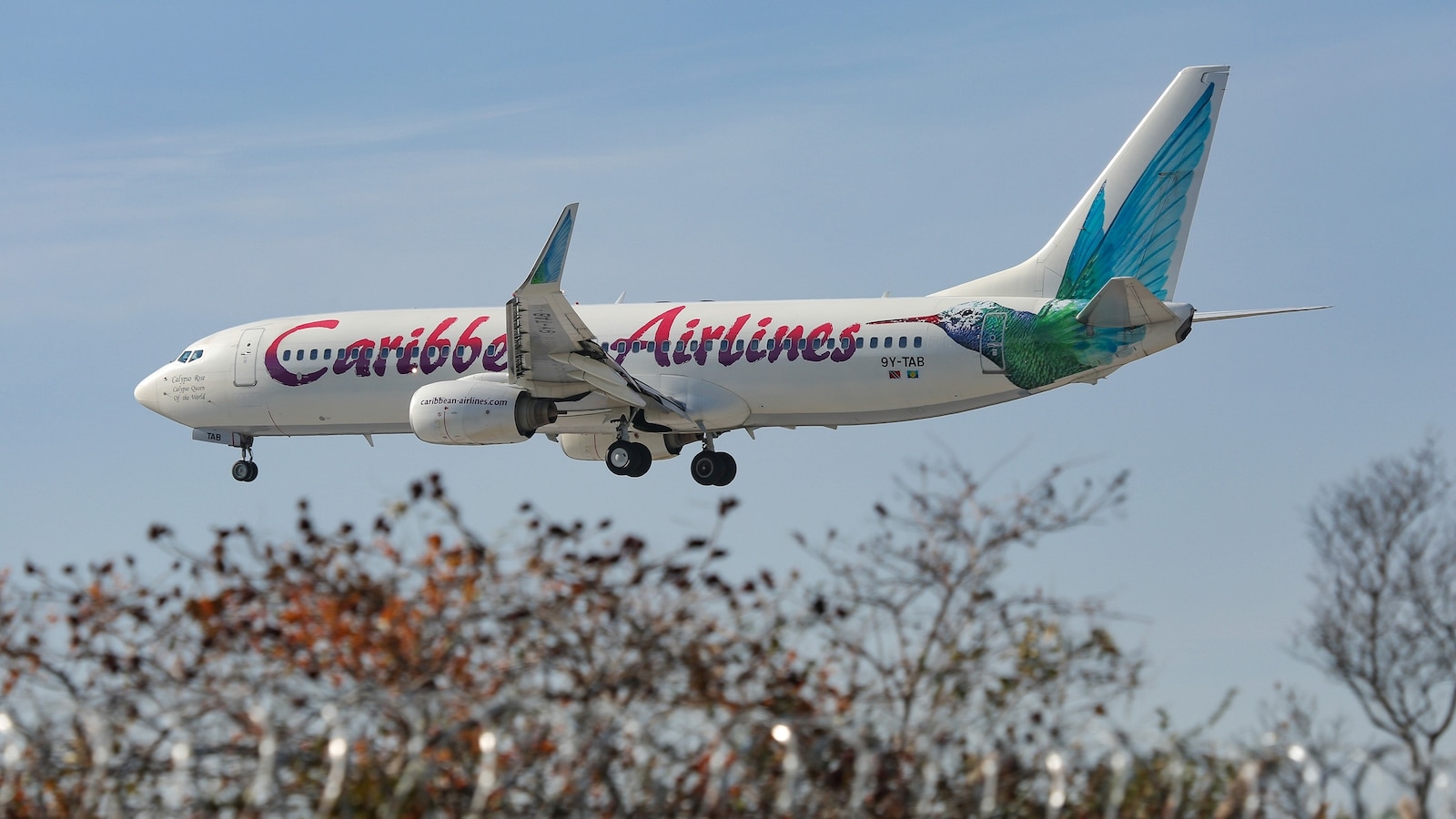

Baby Born at 30,000 Feet: A Miracle Mid-Flight Delivery Over New York
An Unexpected Arrival in the Sky
What was supposed to be a routine Caribbean Airlines flight from Kingston, Jamaica to New York’s John F. Kennedy International Airport on Saturday turned into an unforgettable experience when a passenger unexpectedly went into labor and gave birth as the aircraft was making its final approach. The dramatic event unfolded high above New York City, transforming an ordinary Boeing 737-800 into an impromptu delivery room. Air traffic control recordings captured the tense yet ultimately joyful moments as the pilot communicated with ground controllers about the medical situation developing on board. The pilot’s calm voice can be heard informing the tower that a pregnant passenger had gone into labor and requesting that medical personnel be standing by at the gate to provide immediate assistance upon landing. What makes this story even more remarkable is that despite the unexpected circumstances, both mother and baby came through the experience safely, thanks to the quick thinking and professionalism of the flight crew who found themselves managing a situation far beyond the typical in-flight service.
A Lighthearted Moment Amid the Drama
In what has become one of the most charming details of this airborne birth story, the ground controller at JFK Airport couldn’t resist adding a touch of humor to the intense situation. After confirming with the pilot that the baby had indeed been delivered—to which the pilot responded with an affirmative “Yes, sir!”—the controller jokingly suggested that the new mother should consider naming her newborn “Kennedy” in honor of the airport where the flight was landing. This lighthearted exchange, captured on air traffic control recordings that have since circulated widely, provides a humanizing glimpse into how even professionals dealing with emergency situations can find moments of levity and joy. The suggestion has resonated with people following the story, with many wondering whether the mother might actually consider the name as a permanent reminder of her child’s extraordinary entrance into the world. It’s these small moments of humanity that transform what could have been a purely medical incident into a story that captures hearts and imaginations, reminding us that even in our highly technical, modern world, the miracle of birth can still surprise and delight us.
Professional Response and Passenger Safety
Caribbean Airlines moved quickly to address the incident, releasing an official statement to ABC News confirming that a “medical event” had occurred during the flight, during which a passenger gave birth while en route from Jamaica to New York. The airline emphasized that upon the aircraft’s arrival at JFK, both the mother and her newborn were immediately attended to by medical personnel who were waiting at the gate as requested, and that both were receiving all necessary care. In their statement, Caribbean Airlines took the opportunity to commend their flight crew for their “professionalism and measured response,” noting that the crew managed the unexpected situation in accordance with established procedures while ensuring the safety and comfort of all passengers on board. Importantly, the airline noted that there was no declaration of emergency during the flight, suggesting that despite the unexpected nature of the birth, the situation remained under control throughout. This detail speaks volumes about the training and composure of the crew, who were able to handle what must have been a stressful and unprecedented situation for most of them without escalating to emergency protocols, which could have caused additional panic among passengers.
Understanding the Risks of Flying While Pregnant
This incident naturally raises questions about the safety and advisability of air travel during pregnancy, a topic that medical professionals take seriously when counseling expectant mothers. The American College of Obstetricians and Gynecologists (ACOG) provides comprehensive guidance on this subject, acknowledging that while risk factors can vary significantly depending on specific pregnancy timelines and individual health conditions, it’s generally considered safe for pregnant women to travel by air until relatively close to their due dates, provided they take appropriate safety precautions to ensure a comfortable and secure journey. However, ACOG is careful to note that travel may not be recommended for women experiencing pregnancy complications, and they strongly advise all pregnant women to consult with their doctors when planning any air travel. One crucial consideration that ACOG emphasizes is that pregnant travelers must think carefully about the possibility of pregnancy emergencies occurring when they’re far away from their usual healthcare providers and familiar medical facilities. Being thousands of miles from home, or in this case thousands of feet in the air, when complications arise can create significant challenges in providing optimal care, even when everyone involved responds professionally and competently.
Airline Policies on Pregnant Passengers
Caribbean Airlines, like most commercial carriers, maintains a specific policy regarding expectant mothers that attempts to balance the freedom of pregnant women to travel with safety considerations for both the passengers and the airline. According to their guidelines, pregnant mothers can travel without requiring special medical clearance up until the end of their 32nd week of pregnancy—roughly the beginning of the eighth month. The airline does recommend, however, that pregnant passengers obtain a statement from their doctor verifying the expected due date to prevent any issues with check-in staff or immigration officials at their destination who might have concerns about allowing a heavily pregnant woman to enter the country. Between the 32nd and 35th weeks of pregnancy, Caribbean Airlines’ policy becomes more stringent, requiring expectant mothers to present medical clearance from a physician confirming that they are experiencing a normal pregnancy, providing the estimated due date, and verifying that the mother is in good health. Finally, and most significantly, the airline’s policy explicitly states that “expectant mothers will not be accepted for travel after the 35th week of pregnancy,” which is approximately five weeks before a full-term delivery at 40 weeks. While it wasn’t immediately clear exactly how far along this particular passenger was in her pregnancy or whether she was in compliance with these policies, the incident serves as a dramatic reminder of why such policies exist and why the final weeks of pregnancy involve restricted travel.
A Story That Captures Our Imagination
There’s something universally compelling about a baby being born on an airplane that captures public attention in a way that many news stories simply don’t. Perhaps it’s the juxtaposition of one of life’s most ancient and fundamental experiences—childbirth—occurring in one of humanity’s most modern environments, thousands of feet above the earth in a pressurized metal tube hurtling through the sky at hundreds of miles per hour. Or maybe it’s the reminder that despite all our planning and controlling, life has a way of unfolding on its own schedule, respecting neither our calendars nor our carefully arranged travel itineraries. This particular story has all the elements that make such incidents memorable: a successful outcome with both mother and baby reported to be doing well, professional crew members who rose to an unexpected challenge, and that charming suggestion from the air traffic controller about naming the baby Kennedy. For the family involved, this will undoubtedly become a story told and retold throughout the child’s life—imagine the birthday parties where the tale of being born on a plane gets shared once again. For the flight crew, this was likely the most memorable shift of their careers, a day when their training was tested in ways they probably never anticipated during their certification courses. And for the other passengers on that Caribbean Airlines flight, they have a travel story that will be impossible to top, having witnessed the miracle of life at 30,000 feet while traveling to one of the world’s busiest cities. In our often divided and troubled world, stories like this remind us of what unites us all—the wonder of new life and the kindness of strangers who step up when needed most.