


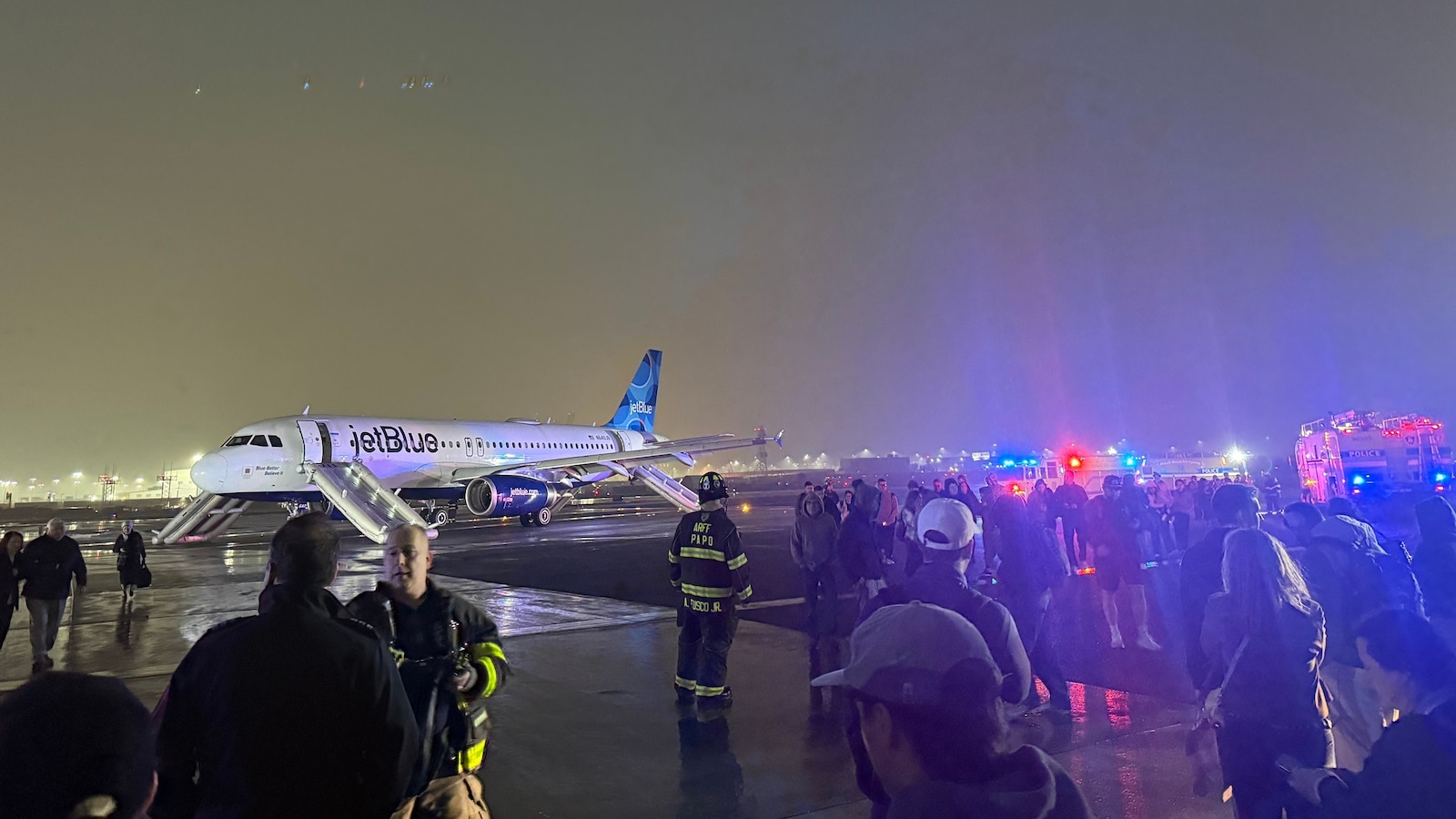

Emergency Evacuation at Newark Airport: JetBlue Flight Returns Safely After Engine Failure
Immediate Emergency Response and Passenger Evacuation
A frightening incident unfolded at Newark Liberty International Airport in New Jersey on Wednesday evening when JetBlue Flight 543 was forced to make an emergency return shortly after takeoff. The aircraft, which had departed at 5:43 p.m. Eastern Time bound for West Palm Beach, Florida, experienced what authorities described as an engine failure almost immediately after leaving the ground. According to the Port Authority of New York and New Jersey, the flight crew quickly recognized the severity of the situation and made the critical decision to turn the plane around and head back to Newark. What could have been a catastrophic situation was handled with professional precision by the crew, who managed to land the aircraft safely. However, the emergency was far from over once the wheels touched down. After the plane successfully landed and exited the active runway, the crew reported smoke in the cockpit—a development that prompted immediate action to protect the lives of everyone aboard. Following established safety protocols, the decision was made to evacuate all passengers using the aircraft’s emergency slides, those inflatable chutes that deploy from the plane’s doors during emergencies that many travelers hope they’ll never have to use.
Airport Operations Disrupted and Safety Measures Implemented
The emergency had ripple effects throughout Newark Liberty International Airport, one of the busiest aviation hubs serving the New York metropolitan area. Flight operations at the entire airport were temporarily suspended while emergency crews worked to clear the disabled JetBlue aircraft from the taxiway where it had come to rest after the evacuation. The Federal Aviation Administration took swift action by issuing a ground stop for the airport, citing an “aircraft emergency” as the reason for halting all flight movements. This meant that planes already in the air and approaching Newark had to either circle, divert to other airports, or delay their departures from their origin cities. For the thousands of travelers who pass through Newark daily, the incident caused significant disruptions to their evening travel plans. Airport authorities and the FAA worked efficiently to resolve the situation, and their efforts paid off relatively quickly. By approximately 7:00 p.m. Eastern Time, the ground stop was lifted and normal flight operations resumed at the airport. Nevertheless, the Port Authority and Newark Airport officials advised all travelers to contact their respective airlines directly for the most current information about their flights, as the temporary suspension had created a backlog that would take some time to clear.
Passenger Safety and Zero Injuries Reported
In what can only be described as the best possible outcome given the circumstances, the Port Authority reported that no injuries occurred during the entire incident. This remarkable achievement speaks volumes about the training and preparedness of JetBlue’s flight crew, who managed not only to safely return a malfunctioning aircraft to the airport but also to execute a full emergency evacuation without anyone getting hurt. Emergency slide evacuations, while designed to be safe, do carry inherent risks—passengers must slide down from significant heights, often while stressed and frightened, and injuries ranging from sprains to fractures are not uncommon in such scenarios. The fact that all passengers and crew members walked away from this incident unharmed is a testament to both the effectiveness of modern aviation safety procedures and the professionalism of those tasked with implementing them in high-pressure situations. For the passengers who were aboard Flight 543, the experience was undoubtedly terrifying. Imagine settling into your seat, preparing for a routine flight to sunny Florida, only to have the plane turn around minutes after takeoff, land in an emergency situation, and then be told you need to evacuate down an inflatable slide. Yet thanks to the crew’s handling of the situation, what could have been a tragedy became a story of aviation safety working exactly as it should.
JetBlue’s Response and Commitment to Investigation
JetBlue Airways responded to the incident with a statement that emphasized the airline’s unwavering commitment to passenger safety. “Safety is JetBlue’s top priority,” the company said, words that carry particular weight in the aftermath of an emergency like this one. The airline acknowledged the distressing experience their customers and crew members had endured and pledged to provide comprehensive support to everyone affected by the incident. Beyond the immediate care for those involved, JetBlue committed to working closely with federal authorities to conduct a thorough investigation into exactly what happened. When an aircraft experiences engine failure and smoke in the cockpit, aviation safety regulators take the matter extremely seriously. The investigation will likely involve experts from the FAA, the National Transportation Safety Board (NTSB), and possibly the aircraft and engine manufacturers. They will examine everything from maintenance records to the specific mechanical failure that occurred, the crew’s response to the emergency, and any lessons that can be learned to prevent similar incidents in the future. For JetBlue, an airline that has built its reputation on customer service and safety, this incident represents both a challenge and an opportunity—a challenge to their safety systems that, based on the outcome, appears to have been met successfully, and an opportunity to demonstrate transparency and accountability in how they handle the aftermath.
The Broader Context of Aviation Safety
This incident at Newark, while certainly alarming, actually demonstrates how remarkably safe modern air travel has become. Commercial aviation has evolved into one of the safest forms of transportation in human history, largely because of the multiple redundant safety systems, rigorous training requirements, and comprehensive regulatory oversight that govern every aspect of flight operations. Engine failures, while rare, are scenarios that pilots train for repeatedly throughout their careers. Aircraft are designed to fly safely even with one engine completely inoperable, and crews practice emergency procedures in sophisticated flight simulators until their responses become almost automatic. The fact that this JetBlue crew recognized the problem immediately, made the decision to return to the airport, landed safely, identified the additional hazard of cockpit smoke, and evacuated all passengers without injury shows the system working as designed. Every incident like this one contributes to the collective knowledge of the aviation industry. The investigations that follow don’t seek to assign blame but rather to understand exactly what happened and whether anything can be improved. This continuous process of learning and refinement is why flying has become progressively safer over the decades, even as the number of flights and passengers has grown exponentially.
Impact on Travelers and Looking Forward
For the passengers on Flight 543, this experience will likely remain memorable for years to come, even though they emerged physically unharmed. The psychological impact of an aviation emergency can be significant, and JetBlue’s commitment to supporting affected customers should include resources to help them process what happened. For other travelers passing through Newark that evening, the incident served as a reminder of the unpredictability of air travel and the importance of allowing extra time for connections and potential delays. As this story continues to develop, more details will likely emerge about the specific nature of the engine failure and what caused smoke to appear in the cockpit. Aviation authorities will release preliminary findings followed eventually by a comprehensive final report that will be studied by airlines, manufacturers, and safety experts around the world. For now, the key takeaway is that when faced with a serious in-flight emergency, the safety systems we’ve built around commercial aviation—the technology, the training, the procedures, and most importantly, the people—performed exactly as they should, turning a potentially catastrophic situation into one where everyone walked away safely.