


Trump Claims Latest Release Of Epstein Files ‘Absolves’ Him
The Document Dump and Trump’s Response
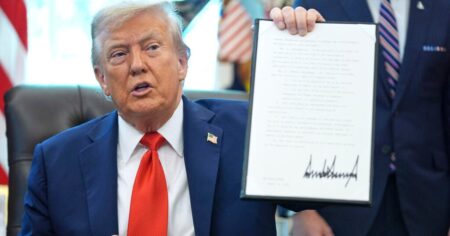
The recent release of documents related to Jeffrey Epstein has once again thrust the disgraced financier’s connections with powerful figures into the public spotlight. Among those mentioned in the files is former President Donald Trump, who has wasted no time in characterizing the documents as evidence of his innocence. Trump claims that these newly unsealed files actually “absolve” him of any wrongdoing in connection with Epstein’s criminal activities. The former president took to social media and public statements to assert that the documents prove he had distanced himself from Epstein years before the full extent of the financier’s sex trafficking operation became public knowledge. Trump’s interpretation of the files marks yet another chapter in the long-running scrutiny of his past association with Epstein, a relationship that has been a source of controversy and speculation for years. The documents, released as part of ongoing litigation and public records requests, contain depositions, emails, and other materials that shed light on Epstein’s social circle and the various wealthy and influential individuals who orbited around him during the height of his social prominence.
What the Documents Actually Reveal
The newly released Epstein files paint a complex picture that requires careful examination rather than simple interpretation. While Trump points to certain passages as exculpatory, legal experts and journalists who have reviewed the documents suggest the reality is more nuanced. Some documents do indicate that Trump and Epstein had a falling out, with testimony suggesting their friendship cooled sometime in the early 2000s, possibly over a real estate dispute in Palm Beach, Florida. However, other documents confirm what was already known: that Trump and Epstein moved in the same elite social circles for years, attended parties together, and were photographed together on multiple occasions throughout the 1990s and early 2000s. The files include testimony from various individuals who described seeing Trump at Epstein’s properties, though importantly, none of the released documents contain allegations of Trump participating in illegal activities. Some depositions mention Trump in passing, often in the context of social events or business dealings that were part of the normal interactions among wealthy New York and Palm Beach socialites. The absence of accusations against Trump in these particular documents is what the former president appears to be citing as proof of his innocence, though critics note that absence of evidence in these specific files doesn’t necessarily constitute evidence of absence of any connection.
The Historical Context of Trump’s Epstein Connection
To understand the significance of these new documents, it’s important to consider the well-documented history of Trump’s relationship with Jeffrey Epstein. The two men were part of the same elite social scene in New York and Florida for approximately fifteen years, from the late 1980s through the early 2000s. Photographs from this era show them together at numerous social events, and Trump himself made comments in a 2002 New York Magazine profile describing Epstein as a “terrific guy” who enjoyed the company of women “on the younger side.” This quote has haunted Trump for years, particularly after Epstein’s arrest and the full scope of his crimes became public. Trump has consistently maintained that while he knew Epstein socially, he was never close friends with him and had no knowledge of any illegal activities. The former president has claimed that he banned Epstein from his Mar-a-Lago club in Palm Beach, though the exact timing and circumstances of this alleged ban have been disputed and remain somewhat unclear. What is documented is that by the time Epstein was first prosecuted in 2008 for soliciting prostitution from a minor, Trump had already distanced himself from the financier, and there is no evidence of continued social contact between them after that period.
Political Implications and Partisan Interpretations
The release of these Epstein documents and Trump’s response to them cannot be separated from the current political climate. Trump, who is once again running for president, faces numerous legal challenges and continues to battle against various allegations and investigations. His political opponents have long used his past association with Epstein as a way to raise questions about his character and judgment, while his supporters have consistently dismissed these connections as guilt by association, pointing out that many prominent figures in business, politics, and entertainment knew Epstein during his years as a well-connected financier and philanthropist. The partisan divide in interpreting these documents is stark. Trump’s allies point to the lack of accusations against him in the files as definitive proof that the long-running insinuations about his involvement in anything inappropriate were always baseless political attacks. Meanwhile, his critics argue that his documented friendship with a convicted sex offender, regardless of when it ended, demonstrates poor judgment at minimum. This divide reflects the broader polarization in American politics, where the same set of facts can be interpreted in radically different ways depending on one’s political allegiance. The reality, as is often the case, is probably more complicated than either partisan narrative suggests—Trump clearly knew Epstein and moved in his social circles, but the available evidence, including these new documents, does not implicate him in Epstein’s crimes.
The Broader Epstein Network and Accountability Questions
The ongoing release of documents related to Jeffrey Epstein serves a purpose beyond any individual’s reputation—it provides continued insight into how a serial sex offender was able to operate with impunity for so long, protected by wealth, connections, and a network of powerful associates. The files mention numerous high-profile individuals from various fields, including politics, business, academia, and entertainment. Some of these mentions are significant, involving allegations of wrongdoing or participation in Epstein’s activities, while others are merely incidental, reflecting the broad social network Epstein cultivated as part of his strategy to gain influence and protection. The documents have reignited discussions about accountability for those who enabled Epstein, either actively or through willful ignorance. While Trump is the most politically prominent figure claiming vindication from these releases, many other individuals named in various capacities are also facing renewed scrutiny. Victims’ advocates have emphasized that the focus should remain on justice for Epstein’s survivors and ensuring that anyone who participated in or facilitated his crimes is held accountable, regardless of their wealth, power, or political affiliation. The challenge lies in distinguishing between those who were merely acquainted with Epstein during his years of social prominence and those who had knowledge of or involvement in his criminal enterprise.
Moving Forward: Truth, Transparency, and the Limits of Document Releases
As the public continues to digest these newly released Epstein files, several important considerations emerge. First, document releases like this are valuable for transparency and historical record, but they represent only a partial picture of complex events and relationships that unfolded over decades. The documents that have been released were created for specific legal purposes and may not contain the full story of everyone’s interactions with Epstein. Second, Trump’s claim that these files “absolve” him may be overstated—while they don’t appear to contain damaging new information about him, they also don’t fundamentally change what was already known about his past social relationship with Epstein. The absence of accusations in these particular documents doesn’t erase the poor judgment involved in befriending someone who would later be revealed as a monster, though it’s fair to note that many people who knew Epstein socially claim they had no knowledge of his crimes. Third, the politicization of these documents, while perhaps inevitable given the figures involved, risks overshadowing the experiences of Epstein’s victims and the systemic failures that allowed his abuse to continue for so long. The real value in these releases should be in understanding how such crimes were enabled and preventing similar situations in the future, rather than simply using them as ammunition in political battles. As more documents continue to be unsealed, the public should approach them with critical thinking, recognizing that the truth is often more nuanced than any single narrative, whether that narrative is designed to absolve or to condemn.