
A Childhood Hero’s Journey to Baseball Immortality: The Campaign to Get Dale Murphy into the Hall of Fame
Finding a Hero Through the Superstation
Growing up as a Yankees fan on Long Island in the 1980s, Rick Klein discovered an unlikely National League hero through the magic of cable television. Dale Murphy, the Atlanta Braves’ superstar outfielder, became more than just a player flickering across the “SuperStation TBS” screen—he became an idol who represented everything good about baseball. With his graceful play, genuine smile, powerful hitting, blazing speed, and those iconic red-white-and-blue pullover jerseys, Murphy embodied the all-American athlete. Media mogul Ted Turner had purchased the Braves partly to provide programming for his superstation, branding them “America’s Team,” and while that marketing slogan never quite stuck, it did something perhaps more valuable: it brought Murphy’s excellence into living rooms across the country. For Klein, a baseball-crazed kid with a contrarian streak who needed a team to root against the colorful, controversial 1980s Mets, Murphy and the Braves were perfect. What began as childhood fandom evolved into something far deeper—a lifetime of loyalty that eventually blossomed into genuine friendship, a development that Klein still finds surreal. This connection has now driven him to undertake something completely new in his professional life: despite spending his career covering political campaigns as a journalist, he’s never been part of one until now, working to get Dale Murphy enshrined in the National Baseball Hall of Fame.
The Man Behind the Legend
Dale Murphy wasn’t just exceptional on the field; he was genuinely exceptional off it. The Atlanta Braves of the 1980s were, frankly, pretty bad—they collected more losses than any other National League team that decade and made the playoffs just once. Yet Murphy shined brightly throughout, a superstar on consistently mediocre teams. Originally a gangly catcher with an erratic arm but power at the plate when he debuted in 1976, Murphy was moved to the outfield by legendary manager Bobby Cox, where he became a complete player combining power, speed, agility, slick fielding, and baseball intelligence. He won back-to-back MVP awards and maintained a dominant streak throughout the decade with few parallels. Beyond statistics, Murphy was famous for being a genuinely good person. Married to his college sweetheart Nancy, their growing family seemed to expand with every magazine profile (they eventually had eight children and now have 20 grandchildren with three more on the way). Profiles noted that Murphy endorsed milk and ice cream brands but neither drank nor smoked, adhering to his Mormon faith. For young Rick Klein, Murphy represented an ideal worth pursuing. At age 12, Klein convinced his family to travel to Atlanta-Fulton County Stadium, where he stood behind the dugout during batting practice yelling “Mr. Murphy” for 20 minutes until his hero signed his baseball—what Klein declared at the time was the best day of his life. That autograph, that moment, and that player would remain significant throughout Klein’s entire life.
When Heroes Become Friends
Murphy’s playing career ended in 1993 after injury-plagued seasons with Philadelphia and Colorado. By then, Klein was in high school, discovering interests beyond baseball, but the connection to his childhood hero never truly faded. As an adult, Klein reconnected with Murphy, first on Twitter and eventually in real life. Their first in-person meeting was for milkshakes, and when Klein extended his hand for a handshake, Murphy gave him a hug instead. Murphy even re-signed the baseball from Klein’s childhood, the original autograph having long faded from proud display in Klein’s boyhood bedroom. The rare privilege of getting to know his hero as a friend was something Klein treasured deeply. Over the years, they saw each other periodically, and this past summer at an event the Murphys host for fans in Atlanta, Klein fell into conversation about what it might take to get Murphy inducted into the Baseball Hall of Fame. The path to Cooperstown is extraordinarily difficult—it requires support from at least 75% of voters, a threshold Klein notes is familiar to political reporters as the same percentage of states needed to ratify a Constitutional amendment (which has happened only 27 times in American history). There are 351 members of the Baseball Hall of Fame out of more than 21,000 men who have played in Major League Baseball. For Murphy, whose time on the writer’s ballot expired over a decade ago, the route runs through the Era Committee—16 esteemed baseball minds who would gather this Sunday in a hotel conference room in Orlando to consider which of eight “modern era” retired players deserve plaques in Cooperstown, with likely only one, two, or at most three making it in.
A Grassroots Campaign for Cooperstown
What emerged from conversations among Murphy’s devoted fans was “Generation Murph,” a coordinated campaign to make the case for Murphy’s Hall of Fame worthiness. The effort brought together an unlikely coalition united by admiration for Murphy: country music megastars and TikTok influencers, actors, rock stars, politicians, comedians, rappers, graphic artists, and some of the biggest names in baseball. Wright Thompson, a prominent Southern author and senior writer for ESPN, wrote the script for a launch video announcing the MurphyToTheHall website, narrated by country music star and Murphy superfan Jason Aldean. Additional videos featured sports broadcaster Ernie Johnson, whose father had been the longtime voice of the Braves on TBS. A prominent Georgia public relations firm urged fans to send letters to the Hall, while the Georgia Sports Hall of Fame assembled a statistical analysis arguing that a back-to-back MVP, seven-time All-Star, five-time Gold Glove winner who led the league in home runs twice and RBIs twice belongs in baseball’s shrine. The support crossed political and cultural boundaries in remarkable ways. The launch video was retweeted by three governors—Brian Kemp of Georgia, Spencer Cox of Utah, and Ron DeSantis of Florida—along with Congressman Ro Khanna of California and comedian Larry the Cable Guy. Actor Michael Kelly posted a video recalling how Murphy, at the height of his fame, played backyard ball with neighborhood kids like Kelly himself. REM bassist Mike Mills re-released his plea “To the Veterans Committee,” recorded over a decade ago with his side band. When TMZ caught up with rapper Killer Mike to ask about OutKast joining the Rock and Roll Hall of Fame, he pivoted to declaring it was time for Murphy to enter baseball’s Hall.
The Case for Dale Murphy
The statistical and character-based case for Murphy’s induction is compelling. When he retired in 1993 with 398 home runs, he ranked 27th on the all-time list, with 24 of the 26 ahead of him already enshrined in Cooperstown. However, baseball’s steroid era—when juiced bodies shredded the record books—pushed Murphy down to 62nd on the all-time home run list, even as his achievements remained unchanged. What once looked like league-leading totals of 36 or 37 home runs seemed modest compared to the 60s and 70s sluggers were posting with chemical assistance. As his statistics faded from collective baseball memory in this distorted context, the complete picture of Murphy’s contributions risked being forgotten. ESPN baseball analyst Tim Kurkjian stated plainly: “His reputation as a baseball player and as a person is as spotless as any baseball player that I have covered over the last 45 years. Dale Murphy should go into the Hall of Fame.” MLB Network anchor Brian Kenny praised Murphy as a “complete player” in a segment titled “Cooperstown Justice,” declaring, “The Hall of Fame is about greatness—the peak. And it’s supposed to be about something we call sporting character. In both cases, Dale Murphy exceeds the Hall of Fame level. The Hall will be better with Dale Murphy in it.” Prominent sports voices rallied to Murphy’s cause, including Hall-of-Famer Chipper Jones, Bob Costas, and Keith Law of The Athletic. This year’s ballot also includes Barry Bonds and Roger Clemens, who would likely have been enshrined years ago if not for their connections to performance-enhancing drugs, along with Don Mattingly and the late Fernando Valenzuela, who like Murphy claim contributions far greater than statistics alone suggest.
What Baseball Means—And What Lasts
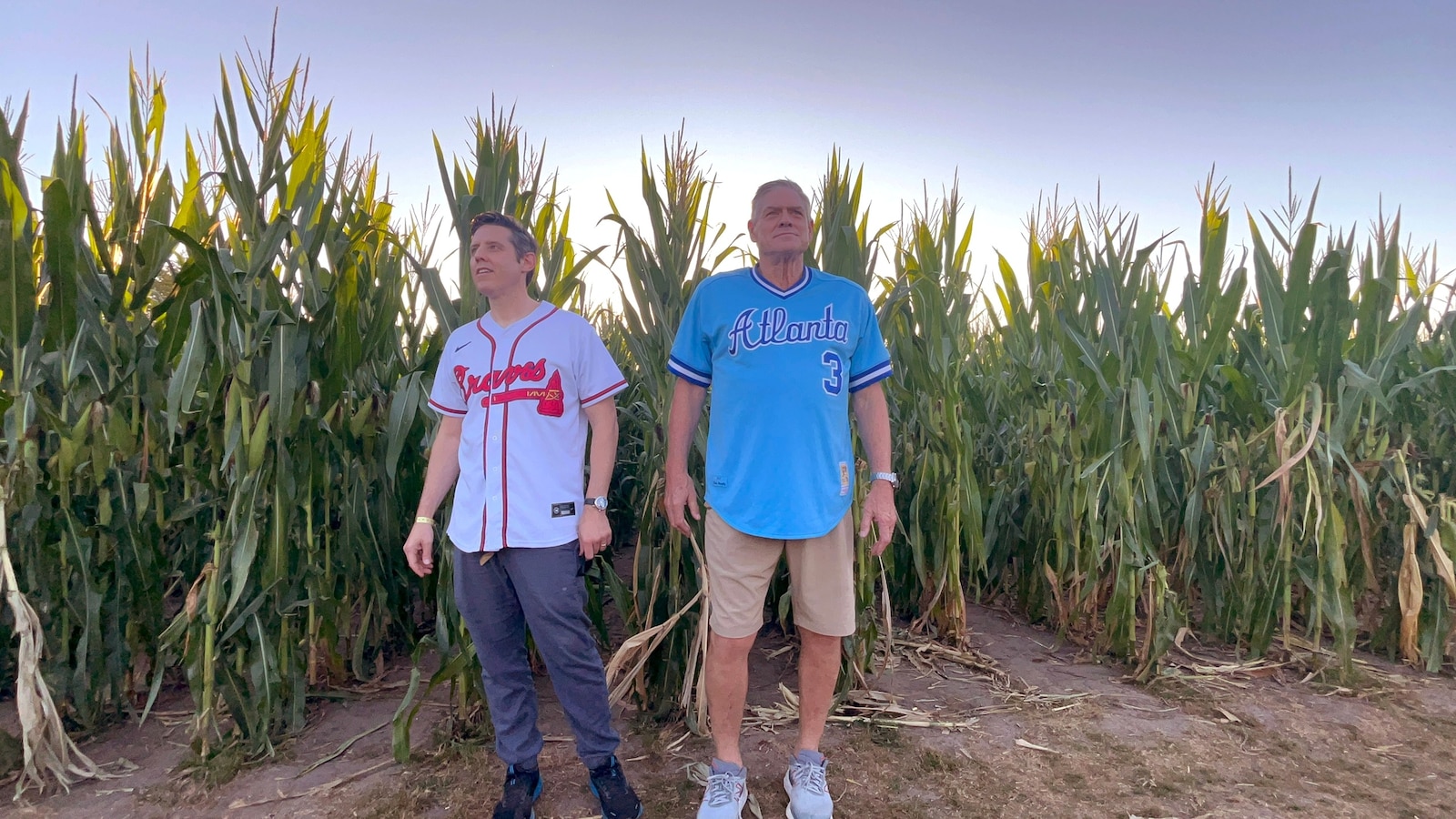
Last summer, Klein’s professional coverage of politics took him to Iowa dozens of times, but he had never visited the Field of Dreams site until he signed up for a Murphy event in Dyersville. The timing was poignant—Klein had lost his father, Stu, the basketball-coaching, baseball-loving dad who had taken Klein and his brother out of school for Yankees opening days and taught them to catch, throw, and keep score, the previous summer. Those memories rushed back when Klein saw the bright baseball field carved from crops, and he thought of his own family, including his wife and two sons who love baseball, and even their rescue dog—named Murphy. On a perfect summer evening, Klein had a catch with his childhood hero, the two walking out of the cornrows onto the field together like Ray Liotta’s Shoeless Joe Jackson in the movie. As the sun set over left field and the Iowa corn, Klein took in the scene, hearing James Earl Jones’ iconic line in his head: “This field, this game—it’s a part of our past, Ray. It reminds us of all that once was good, and it could be again.” Regardless of Sunday’s vote outcome, both Murphys have perspective on what truly matters. Nancy Murphy reflects that “people will remember him as an incredible ball player but mostly as an incredible human being, and he’s a wonderful father, grandfather, husband.” Dale, who turns 70 in March, considers himself beyond lucky: “There’s parts of your life that are going to last forever. And that’s your relationships and your family and your kids. When I was in my late 20s, I didn’t think I’d ever be done playing baseball. But it ended up going by pretty fast. I’m grateful for those chances and that opportunity, but also to be able to think and remember about those things that are most important in life.” For Klein and countless others, Murphy has already achieved a different kind of immortality—living on in the memories of fans who connected not just with a player’s statistics, but with the feelings and family moments that baseball made possible.