
A Teenager’s Fight Against Measles: One Family’s Story in America’s Resurgence
When a Sore Neck Became a Life-Threatening Battle
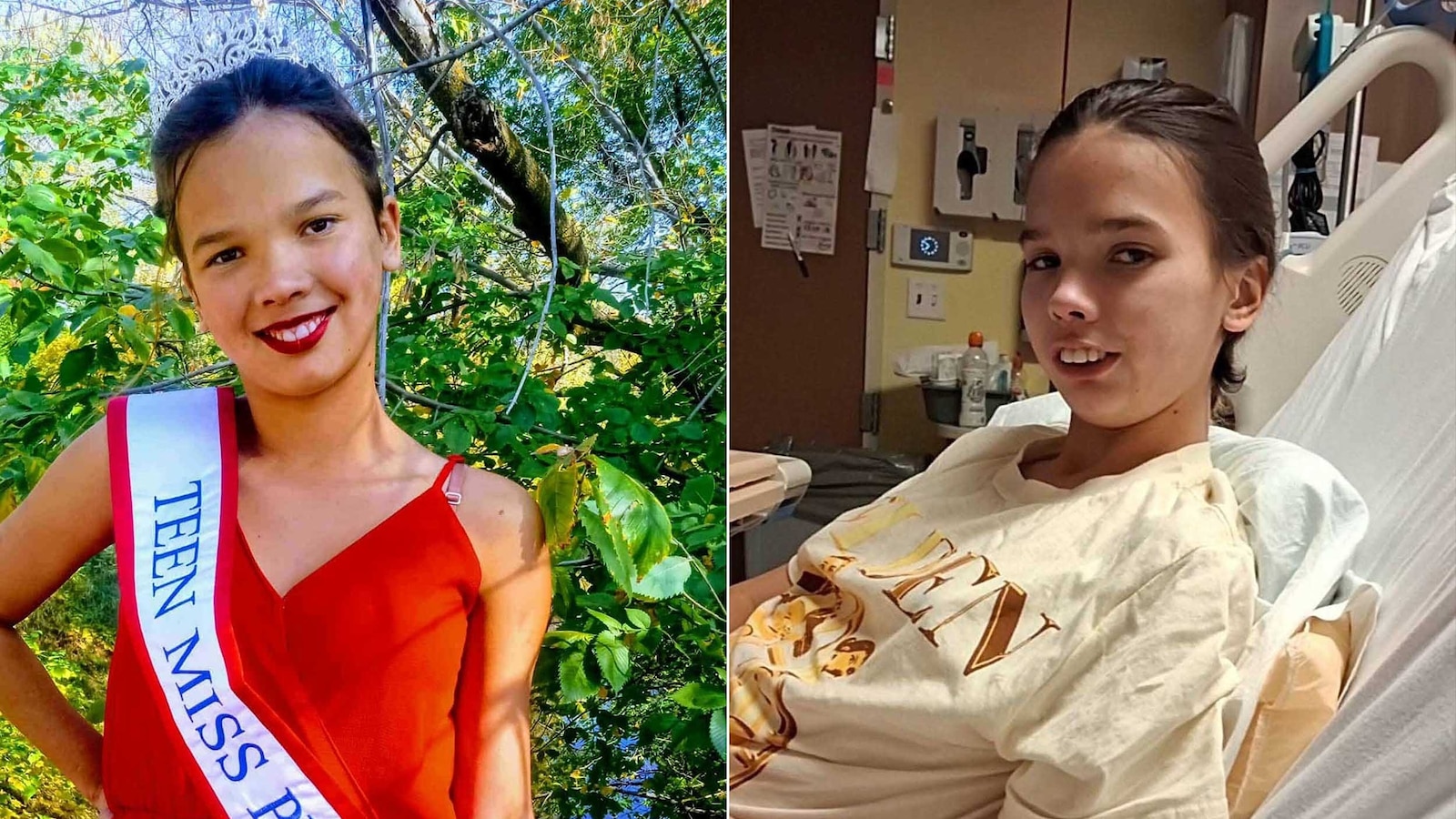
What started as a simple complaint about neck pain quickly spiraled into a nightmare for the Skjerva family of Cavalier, North Dakota. When 14-year-old Makayla Skjerva came home from school in February complaining of discomfort, her parents initially thought little of it—perhaps just another passing illness that teenagers sometimes experience. However, within days, that minor symptom transformed into something far more sinister. Body aches set in, followed by a fever and an alarming rash spreading across her skin. Then came the notifications that every parent dreads: alerts from both the health department and Makayla’s school warning that someone with measles had been present in the school gym. Soon after, test results confirmed their worst fears—Makayla had contracted measles, and her condition was deteriorating rapidly. What followed was a harrowing medical journey that would take this young girl across state lines, fighting for her life against a disease that many Americans had long considered a relic of the past. Makayla’s story is not just about one family’s struggle; it’s a stark reminder of the very real consequences as measles makes an alarming comeback across the United States, with 2023 seeing the highest number of cases in 33 years at 2,283 confirmed infections, and 2024 already surpassing 1,000 cases in just the first two months.
The Complication of Being Immunocompromised
Makayla’s situation was particularly precarious because of a condition she’s lived with since she was just five years old. Diagnosed with autoimmune encephalitis—a condition where the immune system mistakenly attacks the brain’s cells, causing dangerous inflammation—Makayla has required long-term immunosuppressive treatments throughout her childhood. While the autoimmune encephalitis itself doesn’t directly make someone more susceptible to infections, the necessary medications used to manage it significantly weaken the immune system’s ability to fight off diseases. Her stepmother, Ashley Skjerva, explained that Makayla has always been more vulnerable to illnesses and has historically struggled when battling infections. This is where the heartbreaking irony of Makayla’s case comes into focus: she was fully vaccinated against measles, having received both recommended doses of the MMR (measles, mumps, rubella) vaccine. The Centers for Disease Control and Prevention recommends that children receive their first dose between 12 and 15 months of age, and a second dose between ages 4 and 6. This two-dose regimen is remarkably effective—93% effective after one dose and 97% effective after two doses for people with healthy immune systems. But for someone like Makayla, whose immune system is deliberately suppressed by medication to manage her autoimmune condition, even full vaccination couldn’t provide the same level of protection. As Ashley poignantly put it, “Makayla has had [the vaccine], but with a [weak] immune system, it doesn’t do anything.”
The Critical Importance of Herd Immunity
Makayla’s case powerfully illustrates why public health experts place such emphasis on the concept of herd immunity—sometimes called community immunity. When more than 95% of a community is vaccinated against a disease like measles, the virus has difficulty finding vulnerable hosts and spreading, effectively creating a protective shield around those who cannot be fully protected by vaccines alone. This includes immunocompromised individuals like Makayla, babies too young to receive their vaccines, and people who cannot be vaccinated for legitimate medical reasons. Dr. Alok Patel, a pediatrician at Stanford Children’s Health and an ABC News contributor, emphasized this point clearly: “If we look at kids who are immunocompromised, they are relying on the community to protect them, not only against measles but against other infections. They rely on community immunity. They rely on having a 95% vaccination coverage shield so they do not catch the measles.” Unfortunately, vaccination rates have been declining in recent years across the United States, creating dangerous gaps in this protective shield. In Makayla’s hometown of Cavalier, recent data shows a medium measles risk, with only 70% to 79% of young children receiving at least one MMR dose—well below the 95% threshold needed for effective herd immunity. North Dakota has seen a troubling resurgence of the disease, with 24 measles cases reported so far this year and 36 cases in the previous year—the first the state had seen since 2011. Dr. Patel also addressed a common misconception that arises when vaccinated individuals like Makayla contract a disease: “This is why we talk about risk reduction. Nothing is 100% effective in life. Not car seats, not helmets, not vaccines, but we’re trying to reduce the risk of a complication.” He emphasized that the overwhelming majority of measles cases and serious complications occur in unvaccinated children, but immunocompromised children face elevated risks even when vaccinated.
A Rapid Descent Into Critical Illness
The speed at which Makayla’s condition deteriorated was frightening. She first felt ill on Tuesday, February 10th. By Friday, her parents attempted to take her to the emergency room, but medical staff turned them away because measles exposure had been confirmed at her school—they recommended managing her symptoms at home with Tylenol, ibuprofen, and nebulizer treatments. Both Makayla and her 1-year-old sister Armani, who hadn’t yet received her first MMR dose, contracted the virus. While little Armani experienced only mild symptoms and recovered quickly thanks to her otherwise healthy immune system, Makayla’s compromised immunity meant she faced an entirely different battle. By Thursday, February 19th—just nine days after her first symptoms—Makayla was struggling to breathe, with her oxygen saturation levels plummeting to a critically dangerous 62% (normal levels are typically 95-100%). At a clinic, medical staff immediately recognized the severity of her condition and sent her by ambulance to Sanford Children’s Hospital in Fargo, about 160 miles from home. At the hospital, doctors discovered that Makayla wasn’t just fighting measles—she had developed pneumonia (which affects up to one in twenty children with measles and is the most common cause of measles-related deaths in young children), COVID-19, and a bacterial infection called Haemophilus influenzae. This dangerous combination of co-infections, while not uncommon in patients with measles-associated pneumonia according to research, created a perfect storm threatening Makayla’s life. Her breathing became so labored that doctors escalated her oxygen support from a standard nasal cannula to a CPAP machine, then to a BIPAP machine, and finally determined she needed to be sedated and intubated.
A Desperate Race Against Time
What happened next tested the Skjerva family’s strength in ways they never imagined. As Makayla’s condition continued to decline despite intensive treatment, doctors delivered devastating news: she needed specialized care that wasn’t available in North Dakota. If she remained in Fargo, her only remaining option would be high-frequency oscillatory ventilation—essentially the last resort before her options ran out. Medical staff told the family bluntly: “If she stays here, we have to put her on the oscillator, and that’s her last stage here. We cannot do any more. If we put her on it, she will die. She will not come off of it.” Doctors stabilized Makayla enough for transport and gave the family just three hours to gather loved ones to say what they feared might be their final goodbyes. They placed Makayla in a paralytic state for the transfer—a medically induced paralysis to prevent her from fighting the ventilator during transport. The image of family members rushing to the hospital to see Makayla before she was airlifted away, not knowing if she would survive, is something no parent should have to endure. The air ambulance flew Makayla to M Health Fairview University of Minnesota Medical Center in Minneapolis. There wasn’t room for Ashley in the aircraft due to the number of paramedics needed, so she and Makayla’s mother drove three anguished hours to meet their daughter at the new facility. The medical team in Minneapolis had been prepared to place Makayla on an ECMO machine—a device that takes over the work of the heart and lungs by pumping blood out of the body, oxygenating it artificially, and returning it to the bloodstream. It’s a last-ditch intervention used when all other options have failed. Remarkably, and perhaps miraculously, the Minneapolis team managed to avoid the ECMO machine. Through careful management, they were able to keep Makayla on the ventilator while gradually reducing her dependence on it. They also prophylactically treated her for meningitis, another serious but less common complication of measles. About two days after arrival, doctors paused Makayla’s paralytic medications to check if she could move her extremities and respond to questions through finger movements or nodding—small signs that were monumental victories to her terrified family.
The Long Road to Recovery and a Message for Others
Slowly, almost miraculously, Makayla began to improve. Her oxygen levels stabilized enough that doctors could begin weaning her off the ventilator. On Saturday, February 28th, she was stable enough to be transferred back to Sanford Medical Center in Fargo, much closer to home. By early March, medical staff began removing lines and reducing her medications. On March 3rd, Makayla’s feeding tube was removed, and she was able to eat real food again, though she had to chew very slowly and carefully because the intubation had left her throat severely damaged. She began taking tentative steps with a walker, her body weak from the ordeal and significant weight loss. Finally, on Friday, March 6th—nearly a month after that initial complaint of neck pain—Makayla was discharged from the hospital. She returned home facing what Ashley describes as “a long road ahead.” Makayla continues to struggle with walking due to extreme weakness, and her family is working to set up virtual schooling since she cannot yet return to the classroom. Regular doctors’ appointments in Fargo and quarterly visits to Minneapolis will be part of her life for the foreseeable future. “Makayla is a fighter but the fight’s not over,” Ashley said during the ordeal. “We’re all trying to hold ourselves together and it’s been very difficult. I’m just glad she’s here still. That’s all I keep saying to myself.” Now that the acute crisis has passed, Ashley has channeled her family’s anger and sadness into a message for other families. While acknowledging that Makayla’s exposure to measles was “nobody’s fault” and that people have the right to make their own medical decisions, she hopes their story will help others understand what’s truly at stake. “I understand that people have the right to vaccinate or choose not to but please think about the fact that there are millions with autoimmune compromises,” Ashley explained. “That one poke can save their lives and can protect not only yourself and your children but others and their children as well.” Makayla’s story serves as a sobering reminder that measles is not just a harmless childhood illness that causes a rash and a few uncomfortable days at home. For vulnerable members of our communities—those with weakened immune systems, babies too young for vaccination, people undergoing cancer treatment, and others who depend on the rest of us for protection—measles can be a life-threatening disease. The decision to vaccinate extends beyond individual choice; it’s about whether we create communities where everyone, including the most vulnerable, can safely attend school, go to the grocery store, and live their lives without fear of contracting a preventable disease that could kill them. As measles cases continue to climb across America after decades of being virtually eliminated, Makayla’s month-long battle for survival should give us all pause to consider what’s at stake when community immunity breaks down.