


Honoring Heroes: Trump Awards Military Members and Olympic Champion During State of the Union
Purple Hearts for National Guard Members in Washington, D.C. Attack
In one of the most moving moments of Tuesday night’s State of the Union address, President Trump honored two West Virginia National Guard members who became victims of a tragic shooting near the White House last November. Air Force Staff Sgt. Andrew Wolfe, 24, and Army Spc. Sarah Beckstrom, 20, were ambushed while on patrol in the nation’s capital, an attack that shook the military community and the nation. Beckstrom tragically lost her life in the assault, while Wolfe sustained critical injuries that brought him to death’s door.
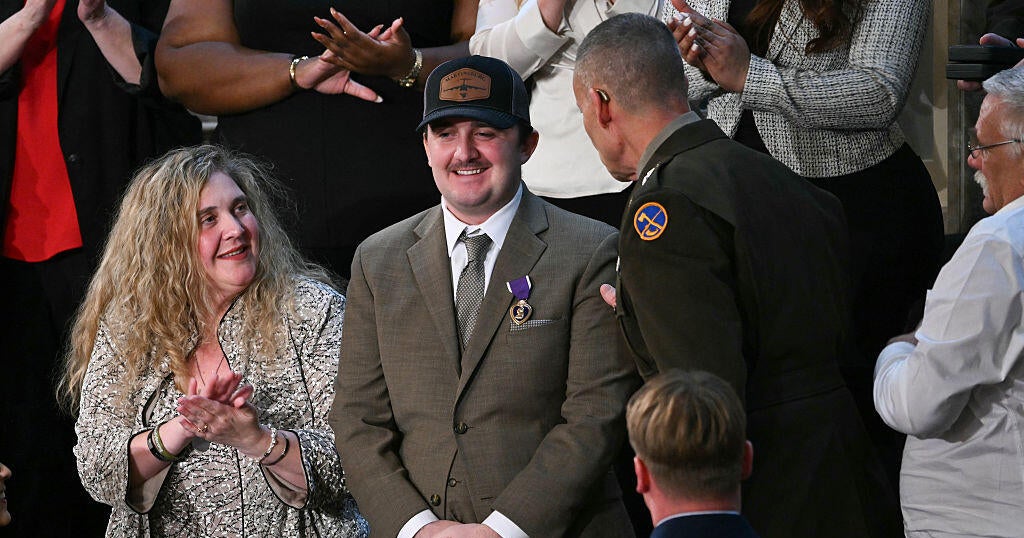
The president’s words reflected the gravity of their sacrifice as he described Wolfe’s remarkable recovery. “With God’s help, Andrew has battled back from the edge of death,” Trump told the assembled lawmakers and guests. Wolfe stood in the House Chamber to receive his Purple Heart, which was pinned to his lapel as the room erupted in applause. The image of the young staff sergeant, still recovering from his wounds but standing tall in his uniform, embodied the resilience and dedication of America’s service members.
Beckstrom’s story was equally powerful, though tragically cut short. The president shared details about her promising military career, noting that after completing a four-month deployment, she had voluntarily extended her service and was about to receive a promotion. Her family had been immensely proud of her accomplishments and dedication. “She was doing so well, they were so proud of her,” the president said, his voice carrying the weight of a loss felt across the military community. The very next day after learning about her upcoming promotion, Beckstrom was on patrol near the White House when she was shot in the head by what the president called “a terrorist monster from Afghanistan” who “shouldn’t have been in our country.” Her family accepted a posthumous Purple Heart on her behalf, a bittersweet recognition of their daughter’s ultimate sacrifice while wearing the uniform of the United States.
Presidential Medal of Freedom for Hockey’s Newest Hero
The atmosphere shifted from solemn remembrance to jubilant celebration as President Trump recognized Connor Hellebuyck, the goaltender whose extraordinary performance led the U.S. men’s hockey team to Olympic gold just days earlier. Hellebuyck will receive the Presidential Medal of Freedom, the nation’s highest civilian honor, for his role in what many are calling a modern miracle on ice. His stellar goalkeeping was instrumental in the team’s 2-1 victory over Canada in Sunday’s gold-medal game, marking the first U.S. men’s hockey gold medal since the legendary 1980 “Miracle on Ice” team captured the hearts of Americans during the Cold War era.
The entire Olympic hockey team had visited the White House earlier Tuesday before attending the State of the Union, where they received thunderous applause from lawmakers on both sides of the political aisle—a rare moment of bipartisan unity. The president didn’t hold back his admiration for Hellebuyck’s performance, declaring, “I’ve never seen a goalie play as well as Connor Hellebuyck.” The recognition highlighted not just athletic excellence but also the way sports can unite a nation and lift spirits. The team’s presence in the chamber, with their gold medals, created an electric atmosphere that momentarily transcended political divisions, reminding everyone of the pride Americans feel when their athletes compete and win on the world stage.
Century-Old Secrets: Medal of Honor for Korean War Hero
Perhaps the most historically significant award of the evening went to 100-year-old Navy Captain E. Royce Williams, who received the Medal of Honor—the military’s highest recognition for valor in combat—for heroism that remained classified for nearly half a century. Williams’s story reads like something from a Hollywood thriller, yet it’s entirely real and remained hidden in the shadows of Cold War secrecy for decades.
In 1952, during the Korean War, then-pilot Williams engaged in what would become one of the longest aerial battles in U.S. Navy history. Flying off the coast of the Korean Peninsula, he encountered seven Soviet MiG-15 jets and engaged in a 35-minute dogfight that tested every ounce of his skill, courage, and determination. When the battle ended, Williams had shot down four of the Soviet jets—an extraordinary feat of aerial combat that couldn’t be publicly acknowledged at the time due to the sensitive geopolitical implications of Americans and Soviets directly engaging in combat during the Korean conflict.
“Tonight, at 100 years old, this brave Navy captain is finally getting the recognition he deserves. He was a legend long before this evening,” President Trump announced. First Lady Melania Trump presented Williams with the medal as the entire chamber rose in a standing ovation that lasted several minutes. The centenarian’s presence served as a living bridge to a different era of American military history, and his recognition reminded everyone that heroism sometimes must wait generations to be properly honored. The emotion in the room was palpable as lawmakers and guests contemplated a young pilot engaging enemy aircraft in deadly combat, keeping that secret for fifty years, and finally, at the remarkable age of 100, receiving the nation’s gratitude.
Medal of Honor for Venezuelan Operation
The ceremony also recognized more recent military action as Chief Warrant Officer Eric Slover received the Medal of Honor for his role in the operation that captured former Venezuelan President Nicolás Maduro. According to President Trump, Slover served as the pilot of the first Chinook helicopter that descended on Maduro’s military compound during a nighttime raid—a high-stakes operation requiring precision, courage, and split-second decision-making.
The mission didn’t go according to plan, as Slover was “hit very badly in the leg and hip” while preparing to land, the president explained. For a helicopter pilot, leg injuries are particularly devastating since the use of legs is essential for operating the aircraft’s controls. Despite his wounds and the excruciating pain he must have endured, Slover maintained focus on the mission objective: delivering the special operations forces who would capture Maduro. “The only thing Eric was thinking about” was completing the mission, Trump said, highlighting the kind of dedication to duty that defines Medal of Honor recipients. Slover’s ability to continue piloting despite serious wounds, ensuring his fellow service members could accomplish their objective, exemplified the selflessness and determination that the Medal of Honor is meant to recognize.
Coast Guard Heroism During Texas Flooding Disaster
The final recognition of the evening went to Petty Officer 2nd Class Scott Ruskan, who received the Legion of Merit for “extraordinary heroism” during his response to the catastrophic Texas floods of July 2025. That disaster claimed more than 130 lives, including several dozen at Camp Mystic, a summer camp for girls where rising waters turned a place of childhood joy into a scene of terror and tragedy.
President Trump shared the story of 11-year-old Milly Cate McClymond, one of the campers at Camp Mystic, who found herself in a life-threatening situation as floodwaters threatened to sweep her away. “Millie Cate McClymond closed her eyes and prayed to God,” the president recounted. “She thought she was going to die.” In her moment of deepest fear, when all seemed lost, help arrived from above as Ruskan descended from a Coast Guard helicopter. “Nobody knew where he came from,” Trump said, capturing the almost miraculous nature of the rescue.
For Ruskan, it was his first-ever rescue mission—an extraordinary beginning to what will surely be a distinguished career. The president noted that the young Coast Guard member had “always [been] top in his class,” but classroom excellence is vastly different from the chaos and danger of a real-world disaster. Yet Ruskan rose to the challenge spectacularly, not just saving Milly Cate but ultimately lifting 164 people to safety from the floodwaters. His recognition highlighted the often-overlooked heroes of the Coast Guard, who routinely risk their lives in rescue operations during natural disasters, often with far less public attention than their counterparts in other military branches. Milly Cate was present at the State of the Union alongside her rescuer, a living testament to the impact one brave individual can have when duty calls and seconds matter. Their presence together—the rescuer and the rescued—provided a powerful reminder that behind every military decoration is a real story of human courage, compassion, and the determination to save lives regardless of personal risk.