
UCLA’s Historic Championship: Coach Cori Close Reflects on a Dream Come True
A Sleepless Night of Victory and Reflection
When Cori Close opened her eyes on Monday morning, her reality had fundamentally changed. She was no longer just the head coach of UCLA women’s basketball—she was now an NCAA championship-winning coach, a title that had eluded the storied program throughout its entire history. The Bruins’ dominant 79-51 victory over South Carolina in the national championship game on Sunday evening had rewritten the record books and fulfilled a dream that Close and her team had pursued with unwavering dedication. In the early morning hours following the historic win, Close admitted to “Good Morning America” that sleep had been nearly impossible to come by. “I’m not sure I ever would have been able to go to sleep—I still may be a little numb,” she confessed, her voice reflecting the surreal nature of the achievement. The magnitude of what her team had accomplished in Phoenix was still sinking in, even as celebrations continued around her.
The victory wasn’t just about the final score or the trophy that Close hoisted high above her head. It represented the culmination of years of hard work, strategic planning, and the building of a team culture that prioritized connection and sacrifice over individual glory. As Close processed the win, she found herself flooded with memories—faces of players past and present, moments of struggle and triumph, and the countless people who had contributed to this journey. “I just keep thinking, and all these faces keep flooding my mind. It’s really about the journey and who I’ve been able to share things with,” she reflected. For Close, this championship was never about personal achievement; it was about “paying it forward” and honoring the relationships that had shaped her path to this moment. Her humility in victory spoke volumes about her character and coaching philosophy.
The Power of Selfless Connection
What made this UCLA team special wasn’t just raw talent, though they certainly had plenty of that. Close was quick to point out that talent alone wouldn’t have been sufficient to claim a national championship. The true differentiating factor was something much harder to quantify: the team’s extraordinary selflessness and their deep connectivity to one another. In a remarkable display of senior leadership, six of the team’s seniors accounted for all of UCLA’s points during the Final Four round—a testament to experience, composure, and the trust that had been built throughout the season. Close explained that from the beginning, the team understood that success would require “incredible selflessness and sacrificial selflessness, elite work ethic, and just a relentless competitive spirit.” These weren’t just buzzwords posted on a locker room wall; they were principles that every player embodied in their daily approach to the game.
The morning before the championship game, Close shared a powerful metaphor with her team during their walkthrough session. She spoke about how three strands woven together cannot easily be broken, drawing a parallel to how their team’s strength came from their interconnectedness. No matter what role each player filled—whether they were a starter logging heavy minutes or a reserve providing energy from the bench—every individual’s sacrifice mattered equally to the collective mission. This philosophy created an environment where egos were checked at the door and the team’s success always superseded personal statistics or recognition. As Close watched her players prepare for the biggest game of their lives, she could see something special in their demeanor. “They were just so locked in,” she recalled. “I turned to Pam Walker, my director of basketball operations, and said, ‘We got this, we’re going to win this thing.’ And I just knew I could see it in their eyes.” That confidence wasn’t born of arrogance but of a deep understanding that her team was prepared, united, and ready to seize their moment.
A Growth Mindset as the Foundation
Throughout the season, Close had emphasized one core value above all others: the growth mindset. This concept—the belief that abilities and intelligence can be developed through dedication and hard work—became the philosophical foundation upon which the Bruins built their championship campaign. Close didn’t position herself as a coach who had all the answers or who stood above her players dispensing wisdom from on high. Instead, she committed to being “in the trenches” with them, growing alongside them, learning from setbacks, and celebrating progress together. This approach created a powerful bond of trust between coach and players. When players saw that Close was willing to be vulnerable, to admit when adjustments were needed, and to continuously evolve her own coaching methods, it gave them permission to do the same in their own development. “For them to recognize that I want to be in the trenches with them and grow with them, that really is meaningful,” Close explained.
This growth mindset wasn’t just applied to basketball skills—it extended to character development, emotional resilience, and the ability to handle pressure in high-stakes situations. Throughout the season, Close challenged her players to view obstacles not as roadblocks but as opportunities to learn and improve. When the Bruins faced adversity during games or dealt with the inevitable ups and downs of a long season, they had a framework for responding constructively rather than becoming discouraged. This mental approach proved invaluable during the NCAA tournament, where the margin for error is razor-thin and the pressure intensifies with each successive game. By the time UCLA reached the championship game against South Carolina, they weren’t just physically prepared—they were mentally and emotionally ready to handle whatever the moment demanded. The growth mindset that Close had cultivated became the invisible advantage that helped her team perform at their absolute best when it mattered most.
Lessons from a Legendary Mentor
Cori Close’s coaching philosophy didn’t develop in a vacuum. She had the extraordinary privilege of being mentored by John Wooden, arguably the greatest college basketball coach of all time, for fifteen years before his passing. Wooden, who led UCLA’s men’s basketball program to an unprecedented ten national championships, saw something special in Close and invested time in helping her develop her own coaching identity. One of the most important lessons Wooden imparted was the importance of authenticity. He told Close, “It’s not a matter of how I would do it, you’re wired uniquely. You need to teach and coach in a way that you’re uniquely called to do it.” This advice gave Close permission to honor Wooden’s principles while expressing them through her own personality and approach. She didn’t need to be John Wooden; she needed to be the best version of Cori Close.
Wooden’s emphasis on coaching from the inside out became a cornerstone of Close’s methodology. The legendary coach reminded her constantly: “You’re not coaching people’s jump shots, you’re coaching people’s hearts.” This perspective transformed how Close viewed her role. She wasn’t just a technical instructor teaching X’s and O’s; she was a developer of human beings who happened to play basketball. When coaches invest in players’ character, values, and emotional well-being, the athletic performance naturally follows. As Wooden would say with his characteristic twinkle in his “big blue eyes”: “But if you coach their hearts really well, usually their jump shots end up pretty good too.” This wisdom proved prophetic in UCLA’s championship run. The Bruins shot the ball exceptionally well against South Carolina, but that accuracy was built on a foundation of confidence, trust, and mental clarity that came from knowing their coach cared about them as people first and players second. Wooden’s legacy lived on through Close’s leadership, demonstrating how great coaching transcends generations when the fundamental principles remain rooted in character and human connection.
The Championship Performance
The national championship game itself was a masterclass in execution and dominance. UCLA’s 79-51 victory over South Carolina wasn’t a nail-biting, down-to-the-wire thriller—it was a statement. The Bruins played with confidence, precision, and poise, never allowing their opponents to establish any momentum. The 28-point margin of victory was the largest in a women’s NCAA championship game in recent memory, showcasing just how thoroughly UCLA had prepared for this moment. The performance reflected everything Close had built over the course of the season: selfless ball movement, tenacious defense, smart decision-making under pressure, and contributions from players at every position. The six seniors who scored all the Final Four points demonstrated the leadership and experience that championship teams require, but they did so within a system that valued team success over individual recognition.
Throughout the game, Close remained composed on the sideline, trusting in the preparation and the players to execute the game plan. Her calm demeanor sent a message to her team that they were ready for this moment, that there was no need to panic or force anything. When UCLA made their runs, Close encouraged them to stay focused and not become complacent. When South Carolina attempted to mount any sort of comeback, she made timely adjustments and reminded her players of the principles that had gotten them to this point. The victory was comprehensive in every sense—the Bruins dominated the boards, took care of the basketball, shared the ball unselfishly, and played with an intensity that South Carolina simply couldn’t match. As the final seconds ticked off the clock and the confetti began to fall in Phoenix, Close experienced the culmination of countless hours of work, years of relationship-building, and the fulfillment of a dream that had seemed impossibly distant when she first took the UCLA job.
A Legacy Defined by More Than Wins
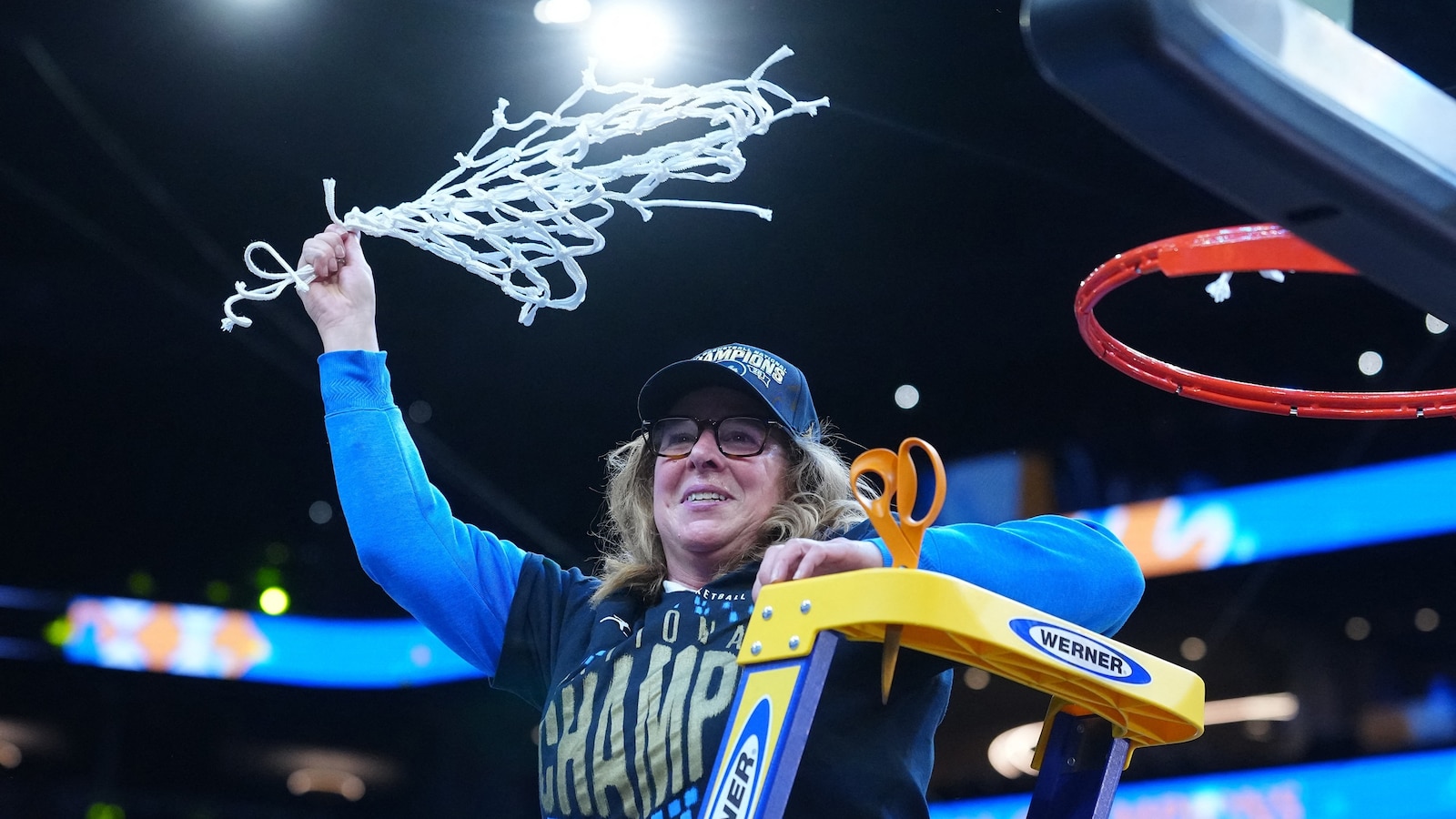
As Cori Close cut down the nets in Phoenix, wearing the championship cap and carrying the trophy that represented the pinnacle of college basketball achievement, she embodied a coaching philosophy that prioritizes people over plays, character over championships, and relationships over records. Yes, the trophy was tangible proof of success, and yes, this victory would forever change how Close’s tenure at UCLA is remembered. But in her heart, Close understood that the true legacy of this championship extended far beyond the hardware. It was about the young women she had mentored, the lives she had impacted, and the culture she had built—one that emphasized growth, selflessness, and connection. The faces that flooded her mind in the sleepless hours after the victory represented her true measure of success: players who had become better people, not just better basketball players, through their time at UCLA.
The championship also represented validation of Close’s decision to coach authentically, to honor the lessons she learned from John Wooden while expressing them through her own unique voice. In a sports world that often demands conformity and rewards coaches who fit certain stereotypes, Close proved that there are multiple paths to excellence. Her willingness to be vulnerable with her players, to grow alongside them rather than positioning herself as having all the answers, created a team culture that was resilient, adaptive, and ultimately unstoppable. As she looks toward the future, Close knows that this championship has raised expectations and that maintaining this level of success will bring new challenges. But she also knows that if she stays true to the principles that brought her team to this moment—coaching hearts first, fostering genuine connection, maintaining a growth mindset, and honoring the legacy of mentors like John Wooden—UCLA women’s basketball will continue to compete at the highest level. For now, though, she allows herself to feel the full weight and joy of this historic achievement, grateful for the journey and the people who made it possible.