


Vietnam’s Historic Power Consolidation: To Lam Takes Dual Leadership Role
A New Era of Centralized Leadership
Vietnam has entered a significant new chapter in its political history as To Lam, the country’s Communist Party General Secretary, has been unanimously elected as president by the National Assembly. This five-year appointment marks a dramatic departure from Vietnam’s long-standing tradition of distributing power among different leaders, where the roles of party chief and state president have typically been held by separate individuals. The 69-year-old leader now controls both the Communist Party apparatus and the governmental structure, creating a concentration of authority not seen in Vietnam for decades. This consolidation mirrors the leadership models currently in place in neighboring China under Xi Jinping and Laos, signaling a potential shift in how Vietnam approaches governance in the 21st century.
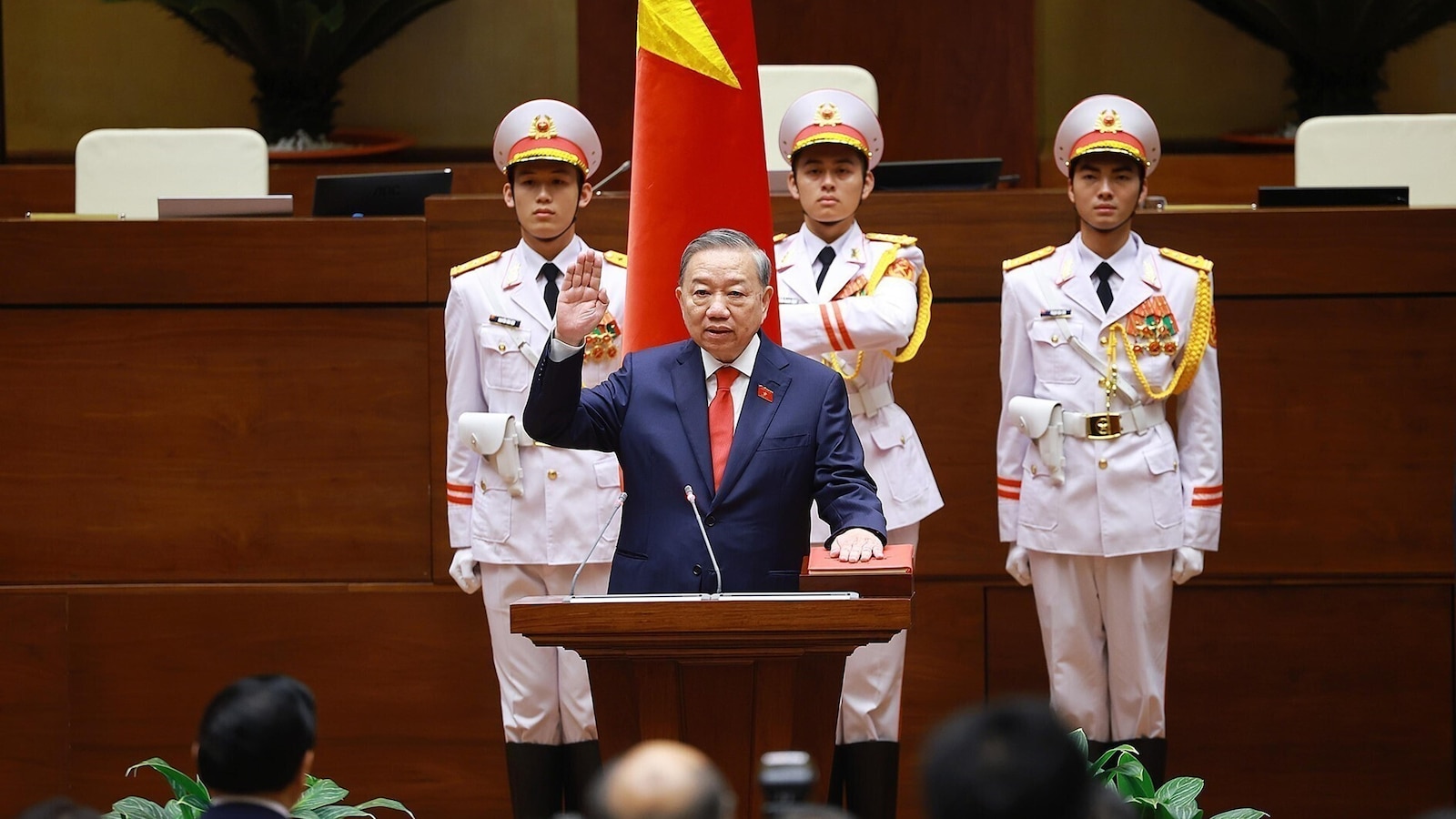
The development was not entirely unexpected by political observers who have been tracking Vietnam’s internal dynamics. When Lam was reelected as Communist Party head in January, analysts noted that his strengthening grip on party authority made it highly likely he would also assume the presidency. This isn’t actually the first time Lam has held both positions simultaneously – he briefly occupied both roles in 2024 following the death of his predecessor, Nguyen Phu Trong. However, this time the arrangement is formalized and intended to last for a full five-year term, giving Lam unprecedented authority to shape Vietnam’s future direction. During his swearing-in ceremony before the National Assembly, Lam outlined his vision for the country, emphasizing that maintaining peace and stability would be his paramount concern, as these elements form the foundation for achieving rapid and sustainable economic growth. He pledged to work toward improving the living standards of Vietnamese citizens, ensuring that the benefits of the nation’s development would be shared broadly across society.
The Implications of Concentrated Power
The significance of this power consolidation cannot be overstated for Vietnam’s political landscape. According to Nguyen Khac Giang, a researcher at Singapore’s ISEAS–Yusof Ishak Institute, Lam now possesses “a stronger mandate and far more political room to push through his agenda than any leaders” since the 1980s. That decade marked a pivotal moment in Vietnamese history when the government launched comprehensive reforms known as “Doi Moi,” which transformed the country from a centrally-planned, state-run economy into a more market-oriented system open to foreign investment and participation. The reforms of that era laid the groundwork for Vietnam’s remarkable economic transformation over the subsequent decades.
This concentration of authority in Lam’s hands presents both opportunities and risks for Vietnam’s future. On the positive side, having one leader control both the party and the state could enable faster decision-making processes, greater coherence in policy implementation, and an improved capacity to push through difficult but necessary reforms at what many view as a critical juncture in Vietnam’s development. The streamlined command structure could help Vietnam respond more quickly to economic challenges and global changes. However, experts also caution that there are inherent dangers in concentrating so much power in one person’s hands. As Nguyen Khac Giang pointed out, “the risk is that concentration of power can move faster than institutional reform.” In other words, while one leader might be able to make decisions quickly, the institutional frameworks and checks and balances that ensure good governance might not keep pace, potentially leading to hasty decisions or unchecked authority.
From Police Chief to Supreme Leader
To Lam’s journey to Vietnam’s highest offices represents a remarkable political trajectory that differs from many of his predecessors. His rise caps the ascent of a career policeman who climbed the ranks from Vietnam’s security services all the way to the pinnacle of political power. This unusual path was significantly aided by his role in overseeing a massive anti-corruption campaign that was launched by his predecessor, Nguyen Phu Trong. As head of the Ministry of Public Security, Lam was the chief enforcer of this sweeping initiative, which targeted corrupt officials across various levels of government and removed numerous political figures from power. This campaign not only demonstrated Lam’s effectiveness and loyalty to the party’s stated goals but also helped eliminate potential rivals and obstacles to his own advancement.
Since assuming the role of party chief, Lam has wasted no time in implementing Vietnam’s most ambitious bureaucratic restructuring since those landmark reforms of the 1980s. His reform agenda has been comprehensive and aggressive, including significant job cuts across the government apparatus, the merger of various ministries to create more efficient organizational structures, the redrawing of provincial boundaries to better reflect economic and demographic realities, and the advancement of major infrastructure projects aimed at modernizing Vietnam’s physical and economic foundations. These reforms signal Lam’s determination to modernize not just Vietnam’s economy but its entire governmental structure, streamlining operations and reducing inefficiencies that have accumulated over decades.
Economic Ambitions and Challenges
Lam’s primary focus has been on economic performance and stimulating private-sector growth, aiming to evolve Vietnam beyond the labor-intensive and export-driven economic model that has served the country well over the past several decades. While this model successfully lifted millions of Vietnamese citizens out of poverty and created a substantial manufacturing-based middle class, Lam recognizes that Vietnam must advance to the next stage of development to remain competitive in the global economy. The country has set extraordinarily ambitious targets, aiming for annual economic growth of 10% or higher over each of the next five years – a goal that would be impressive for any developing nation and would require sustained momentum across multiple sectors of the economy.
However, significant challenges stand in the way of achieving these lofty ambitions. The most immediate challenge is transforming this bold vision into tangible results while navigating an increasingly turbulent global economic environment. The recent conflict in Iran has triggered energy market disruptions that are rippling through the world economy, creating uncertainty and volatility that affect all nations, particularly those heavily dependent on international trade like Vietnam. Economic data from the first quarter of the year shows the complexity of the situation: Vietnam’s economy expanded at an annualized rate of 7.8%, which represents an improvement over the 7.1% growth rate recorded for the previous year. However, this figure still falls short of the ambitious 9.1% target and also represents a slowdown compared to the growth rates achieved in late 2025, suggesting that maintaining momentum will require concerted effort and perhaps adjustments to current strategies.
Navigating Geopolitical Pressures
Beyond economic challenges, Lam faces considerable political and diplomatic hurdles in implementing his reform agenda and maintaining Vietnam’s position on the international stage. Domestically, he will need to secure buy-in from various political factions and interest groups for his ambitious reforms, which inevitably create winners and losers. More significantly, he must navigate Vietnam’s increasingly complex foreign policy environment, which requires careful balancing between competing major powers. The United States has been applying pressure on Vietnam regarding its substantial trade surplus with America, a situation that could lead to trade restrictions or other economic measures if not addressed diplomatically. This pressure comes at a time when Vietnam has been positioning itself as an attractive alternative to China for companies seeking to diversify their manufacturing operations.
Simultaneously, Vietnam must manage its relationship with China, which is both the country’s largest trading partner and a rival claimant to territory in the South China Sea, where tensions have periodically flared over disputed islands and maritime rights. This dual relationship with China – as essential economic partner and potential security threat – requires particularly delicate handling. As Nguyen Khac Giang observed, Vietnam “has benefited from a careful balancing strategy in foreign policy, but maintaining that position will become harder in a more turbulent world.” The country has historically succeeded by maintaining pragmatic relationships with all major powers, avoiding exclusive alignment with any single bloc while maximizing economic and security benefits from multiple sources. Whether this balanced approach can continue under a more centralized leadership structure, and in an increasingly polarized global environment where countries face mounting pressure to choose sides, remains one of the crucial questions that will define Lam’s tenure and Vietnam’s trajectory in the coming years.