


Living with Profound Autism: The Murphy Family’s Journey
A Day in the Life of Round-the-Clock Care
In their Ayer, Massachusetts home, the Murphy family experiences moments that might seem unusual to outsiders but are simply their normal. Nine-year-old Connor Murphy walks in circles around his father before dropping to the kitchen floor, only to get up and repeat the pattern again. Rather than viewing this as a disruption, Matthew Murphy sees it as an opportunity for connection, lifting his son, tickling him, and spinning together in spontaneous play. This scene captures the essence of life in the Murphy household, where everything revolves around the needs of Connor and his twin brother Ronan, both of whom have profound autism requiring constant supervision and care. “They’re going to need 24-7 care for the rest of their lives,” Matthew Murphy acknowledges with a mixture of realism and determination. “Life will be a challenge for them, and we have to prepare them as best we can.” This preparation isn’t just about the present; it’s about an uncertain future that keeps both parents awake at night, wondering what will happen to their beloved sons when they’re no longer around to care for them.
The Changing Landscape of Autism Diagnosis and Research
The understanding and diagnosis of autism have undergone significant transformations in recent decades, creating both progress and new challenges. Autism rates have been climbing for years, driven primarily by two factors: the adoption of a much broader diagnostic criterion for autism spectrum disorder in 2013 and increased awareness that has led to more children being identified and diagnosed. While this increased awareness has been beneficial in many ways, it has created an unintended consequence—most newly diagnosed cases are relatively mild, which has shifted attention away from those with the most intensive needs. Currently, about 1 in 31 children in the United States are diagnosed with autism spectrum disorder, and researchers estimate that approximately a quarter of these cases fall into what experts now call “profound autism.” This term, introduced in 2021 by the Lancet Commission, describes individuals who are nonspeaking or minimally verbal, have significant intellectual disabilities, and require constant care throughout their lives. Meanwhile, the current political climate has complicated matters further, with the Trump Administration promoting unproven and debunked claims about autism’s causes, which experts say creates confusion and spreads misinformation that could harm public health efforts, even as more funding flows into research.
The Push for a Separate Diagnosis and Its Controversy
A growing movement within the medical and advocacy communities is calling for profound autism to be recognized as its own distinct diagnosis, separate from the broader autism spectrum disorder. Proponents argue that this separation would ensure people like Connor and Ronan Murphy receive the specialized support, services, and research attention their condition demands. Andy Shih, chief science officer for Autism Speaks, emphasizes that regardless of where individuals stand on this debate, “there’s absolutely no doubt that we need to elevate awareness about the needs of this group.” Judith Ursitti, president of the Profound Autism Alliance and mother to an adult son with profound autism, advocates strongly for the separation, pointing out that this population lacks appropriate treatments, adequate supports, and enough trained providers capable of handling their level of care. Most critically, she notes, the vast majority of clinical research doesn’t include them. “If you don’t have research, you won’t have treatments. You won’t have achievable services and supports,” Ursitti explains, highlighting the fundamental difference that while some people across the spectrum have high but intermittent support needs, those with profound autism require constant, unrelenting care.
However, not everyone in the autism community agrees with creating a separate diagnosis. Dena Gassner, a senior research scientist at Drexel University’s autism institute who is herself autistic and the mother of an autistic adult with moderate support needs, worries about the potential for stigmatization that a “profound autism” label might create. She argues that being autistic isn’t the problem—the real issue is “the massive lack of supports and services” available throughout society. Gassner believes the autism community needs to present “a unified voice to talk about services for the entirety of the spectrum” rather than fragmenting into separate diagnostic categories. Matthew Murphy, however, sees no harm in a new label if it helps identify and address a distinct level of need, remaining pragmatic about whatever might help his sons receive better care.
The Murphy Twins: From Early Concerns to Current Challenges
The Murphys’ journey with autism began even before their sons were born. They knew the twins faced higher-than-average risks for neurodevelopmental disabilities due to several factors: twin births inherently carry increased risk, and some research suggests the type of in vitro fertilization they used might also contribute. When the boys arrived nearly a month early, the couple initially wasn’t overly concerned when their sons missed typical developmental milestones, knowing that premature twins often develop a bit more slowly. However, when the boys weren’t walking by around 18 months old, the Murphys sought professional evaluation and began speech and occupational therapy. At age four, Connor and Ronan received their official diagnosis of level 3 autism, representing the highest level of need, essentially equivalent to what is now being called profound autism.
Today, at nine years old, the twins function at levels far below their chronological age. They typically speak in one- to three-word sentences and require constant reminders and intensive guidance for basic daily activities like showering and brushing their teeth. Academically, they perform at the level of three-and-a-half-year-olds, enjoying Sesame Street and preschool toys while requiring the same constant vigilance as much younger children. They’re vulnerable to everyday dangers that other nine-year-olds can easily navigate, such as running into busy streets without awareness of the risk. This reality became terrifyingly clear last summer when Connor briefly left the house in his pajamas, without shoes, and walked half a mile before being found. “Our number one concern is their safety,” says 47-year-old Andrea Murphy, a statement that shapes every decision the family makes.
Creative Safety Measures and Community Integration
The Murphys have become inventive in their approach to keeping their sons safe while still allowing them to experience life as fully as possible. Their home features GPS locators hidden in the boys’ shoes, sensors with alarms on all windows and exterior doors, and special locks requiring thumbprints on doors leading to the basement and a food cabinet. Their advocacy extends beyond their home—they worked with their sons’ school to get the playground fenced in and raised money for their local police department to participate in Project Lifesaver, a specialized search-and-rescue program for individuals with cognitive conditions who might wander. Despite these precautions, both parents remain hypervigilant whenever the children are awake, regardless of the hour. “If that’s at three in the morning, it’s at three in the morning,” Matthew explains, describing a reality of parenting that never truly allows them to relax their guard.
Yet the Murphys refuse to let these challenges isolate their family. A typical Saturday trip to Target illustrates both the difficulties they face and their commitment to community participation. On the ride over, Ronan rocks back and forth in his seat. Inside the store, Andrea places her hand on Connor’s back to provide security as he walks behind the shopping cart. Meanwhile, Matthew navigates a toy aisle with Ronan, who spots Bluey figurines and wants them desperately. When Matthew explains they already have those toys at home and returns them to the shelf, Ronan becomes upset and collapses on the floor. As other shoppers pass by, his father quietly and patiently calms him, holding his hands to help him up—a scene that might draw stares but that the Murphys have learned to handle with grace and determination. “We can’t live our lives in a bubble,” explains 48-year-old Matthew. “We want them to experience life.” These outings serve multiple purposes: they’re beneficial for the boys’ development, they help the parents maintain some semblance of normal family life, and they allow the broader community to see and understand families living with profound autism.
Finding Joy and Facing an Uncertain Future
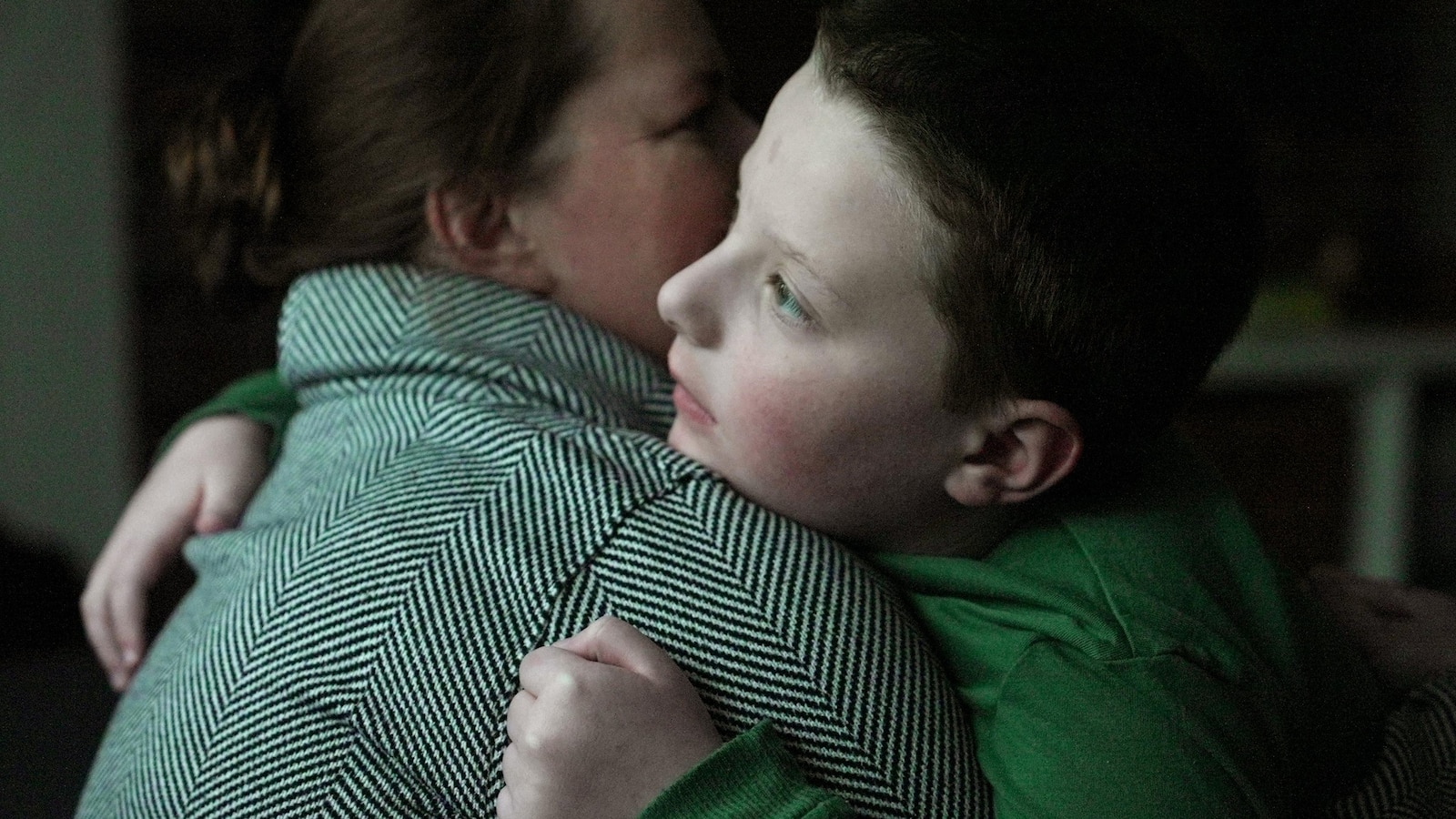
Despite the constant demands and challenges, the Murphys have learned to focus on joy amid the struggles. They celebrate and nurture each boy’s unique personality—Ronan’s artistic, outdoorsy, and boisterous nature, and Connor’s quiet and reserved temperament. Both sons shower their parents with affection, like when Connor nuzzles into his mother as they sing “You Are My Sunshine” together, creating moments of pure connection that transcend the difficulties. “They bring a light to you no matter how bad of a day you’re having,” Matthew says with obvious love. “It’s all unconditional love.” This perspective helps sustain them through the intensive daily routines, including three hours of applied behavior analysis therapy every weekday after school, provided by professionals from The Autism Community Therapists in Acton who come to their home.
During these sessions, the boys work on crucial skills that most children develop naturally. One evening, Ronan practices language skills with therapist Julia Orareo at the kitchen table, giving her instructions on drawing an elephant. “Draw a body,” he says successfully, and when she prompts “How about an eye?” he thinks before responding, “Draw an eye.” “Good sentence!” she encourages, celebrating this small but significant victory. Later, when he asks, “Do a hug?” they embrace, showing the warmth that makes this difficult work rewarding. Meanwhile, Connor practices language and matching skills in the living room before joining his brother at the table for the painstaking process of trying new foods—cherry tomatoes for Connor, broccoli for Ronan. Andrea explains the multi-step process: “Seeing that on the plate is kind of step one. Step two is actually touching it. Step three would be kind of either smelling it or putting it to their lips,” with even more steps following. What seems simple is actually a carefully designed pathway toward the long-term goal of helping the boys become more independent.
This question of independence weighs heavily on the Murphys’ minds, particularly as they approach a critical deadline: age 22, when public educational support for children ends in Massachusetts. Both parents work full-time—Matthew at a nonprofit helping injured veterans and Andrea in healthcare—but they’re painfully aware that their combined income may never be enough to provide for their children throughout adulthood. The question that haunts them most is what happens after they’re gone. “You never know when God is gonna take you off this green earth,” Matthew says, his voice reflecting the weight of this concern. “The thing that keeps me awake at night is what their future looks like… That’s the great unknown.” This uncertainty affects countless families facing similar circumstances, highlighting the urgent need for better systems, supports, and societal understanding of profound autism—whether it becomes a separate diagnosis or remains part of the broader spectrum, the needs of these individuals and their families remain real, constant, and deserving of our attention and resources.