
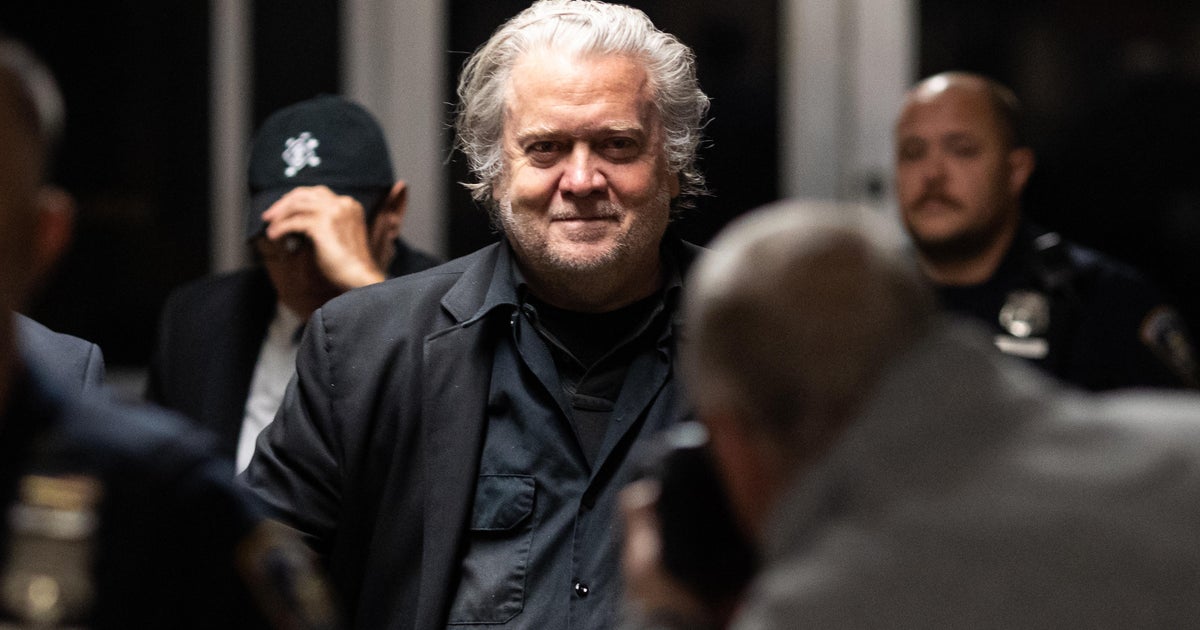

Justice Department Drops Criminal Case Against Steve Bannon: A Turning Point in Political Prosecutions
The Unexpected Reversal
In a stunning legal development that has sent shockwaves through Washington’s political landscape, the Justice Department has made the decision to abandon its criminal case against Steve Bannon, the controversial former adviser to President Trump. Bannon had been convicted and imprisoned for refusing to cooperate with the House committee investigating the January 6th Capitol riot. U.S. Attorney for D.C. Jeanine Pirro filed a motion on Monday requesting that a judge dismiss the indictment against Bannon “with prejudice,” a legal term meaning the charges cannot be brought again in the future. The government’s official reasoning cited “prosecutorial discretion” and claimed that dropping the case serves “the interests of justice.” Bannon himself did not object to this dismissal, marking a complete about-face in a case that had seen him serve approximately four months behind bars in 2024. This dramatic reversal represents more than just one man’s legal victory—it signals a fundamental shift in how the Justice Department approaches cases born from politically charged congressional investigations.
The Original Controversy and Conviction
Steve Bannon, a polarizing media personality and former White House chief strategist, found himself in legal jeopardy after he flatly refused to comply with a subpoena from the House January 6th committee. The committee, led by Democrats and a small number of Republicans, was conducting an extensive investigation into the circumstances surrounding the Capitol riot and the broader efforts by President Trump and his supporters to challenge the 2020 election results. Though Bannon wasn’t officially part of Trump’s administration during the lead-up to January 6th, he remained a vocal cheerleader for the president’s cause. The committee specifically highlighted Bannon’s ominous prediction made on January 5, 2021, when he declared that “all hell is going to break loose tomorrow”—a statement that seemed eerily prescient given what unfolded the next day. When the committee demanded his testimony and documents, Bannon dug in his heels, arguing that the requested information fell under executive privilege, a legal principle that protects certain communications involving the president from disclosure. The Democratic-controlled House wasn’t having it and voted in 2021 to recommend contempt of Congress charges. The Justice Department quickly followed through with an indictment, setting the stage for a legal battle that would land Bannon in prison and spark ongoing debates about congressional power and political weaponization of the justice system.
The Trial and Its Aftermath
The legal drama took an interesting twist just days before Bannon’s trial was set to begin in mid-2022. His legal team suddenly shifted strategy, announcing that Bannon was now willing to testify before the committee. They claimed that “circumstances have now changed” because President Trump had decided to waive executive privilege, the very shield Bannon had previously relied upon to justify his non-compliance. Despite this last-minute willingness to cooperate, it was too little, too late in the eyes of the jury. A Washington D.C.-based jury found Bannon guilty of contempt of Congress, and he was subsequently sentenced to spend time behind bars. Bannon served his sentence, walking out of prison in October 2024, but he never accepted defeat. Even after completing his incarceration, he continued fighting his conviction through the legal system, taking his case all the way to the Supreme Court. His arguments centered on two main points: first, that he hadn’t willfully defied the subpoena but was simply following his lawyers’ advice to wait until executive privilege questions could be properly resolved; and second, that the entire prosecution was politically motivated from the start. These claims resonated with Bannon’s supporters, who viewed him as a victim of partisan persecution rather than someone who had genuinely obstructed a legitimate congressional investigation.
The Justice Department’s About-Face and Political Implications
The Justice Department’s decision to drop the case didn’t stop with simply dismissing the charges at the trial court level. On Monday, the department also asked the Supreme Court to vacate an appellate court ruling that had previously upheld Bannon’s conviction and to send the entire matter back down to the district court. This comprehensive effort to undo Bannon’s conviction was framed by Deputy Attorney General Todd Blanche as part of a broader mission to reverse what he characterized as “the prior administration’s weaponization of the justice system.” Blanche took to social media platform X to announce that “the Department of Justice told the Supreme Court that Steve Bannon’s conviction arising from the J6 ‘Unselect’ Committee’s improper subpoena should be vacated.” The language used—particularly the term “Unselect Committee,” which echoes President Trump’s own dismissive rhetoric about the January 6th investigation—signals a dramatic philosophical shift within the Justice Department. This move raises profound questions about the independence of federal prosecutors and whether criminal cases should be pursued or dropped based on the political priorities of whoever occupies the White House. Critics worry that this sets a dangerous precedent where politically connected individuals can escape consequences for defying congressional oversight, while supporters argue it corrects an injustice and prevents Congress from weaponizing contempt charges against political opponents.
The Broader Context: Congressional Contempt in the Political Arena
The timing of the Bannon case dismissal is particularly noteworthy given another high-profile contempt controversy that recently played out in Congress. Last month, the House Oversight Committee voted to recommend holding Bill and Hillary Clinton in contempt after the former president and secretary of state initially refused to testify in an investigation related to Jeffrey Epstein. However, just before the full House was scheduled to vote on the contempt recommendation, the Clintons reversed course and agreed to appear for depositions. Republican Representative James Comer of Kentucky, who chairs the oversight panel, declared that the Clintons had “caved” to the pressure. This parallel situation highlights how contempt of Congress has become a political football, wielded by whichever party controls the House to pressure their opponents. The stark contrast in outcomes—Bannon was prosecuted and imprisoned, while the Clintons agreed to cooperate before facing similar consequences—underscores the subjective nature of these proceedings. It raises uncomfortable questions about equal application of the law and whether political considerations play too large a role in determining who faces prosecution for defying congressional subpoenas and who manages to negotiate their way out of trouble.
What This Means for Justice and Democracy
The dismissal of charges against Steve Bannon represents far more than the resolution of one man’s legal troubles—it’s a flashpoint in ongoing battles over accountability, political power, and the rule of law. For Bannon’s supporters, this decision vindicates their long-held belief that he was unfairly targeted for his political associations and views rather than for any genuine legal wrongdoing. They see this as a necessary correction that prevents Congress from abusing its investigative powers to persecute political opponents. For critics, however, the dismissal is deeply troubling, suggesting that well-connected political figures can defy legitimate congressional oversight without consequence, undermining the system of checks and balances that is supposed to prevent abuse of power. The case also illustrates the challenges of conducting politically sensitive investigations in an increasingly polarized environment. When congressional committees divide along partisan lines, and when the Justice Department’s willingness to prosecute depends on which administration is in power, it becomes difficult to separate legitimate legal proceedings from political theater. As the dust settles on the Bannon case, Americans are left to grapple with difficult questions about what accountability looks like in modern politics, whether anyone is truly above the law, and how we can maintain faith in institutions that seem to bend with the political winds rather than stand firm on consistent principles of justice.