
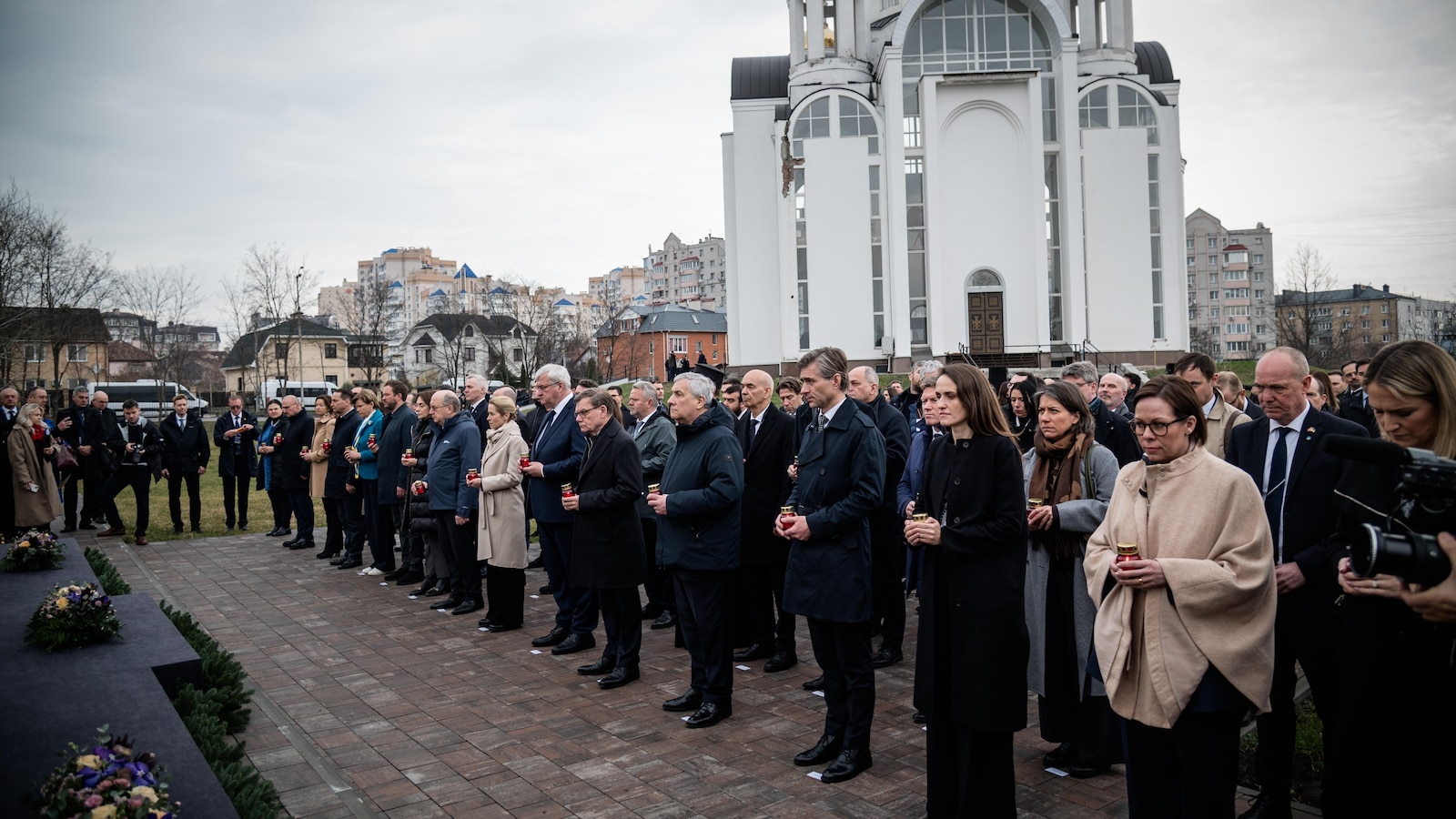

European Leaders Unite in Ukraine to Remember Bucha’s Dark Anniversary
Four years after Russian forces committed horrific atrocities in the Ukrainian town of Bucha, European foreign ministers traveled to Kyiv this week in a powerful show of solidarity and remembrance. The visit comes at a critical time when international attention has shifted toward the Middle East crisis, and efforts to resolve the Ukraine conflict have stalled. A delegation of twelve European foreign ministers, accompanied by numerous other officials, arrived by train in Ukraine’s capital, where they were greeted by Ukrainian Foreign Minister Andrii Sybiha. The timing of their visit was deliberate—marking the grim anniversary of the discovery of massacres that shocked the world and became a defining symbol of the war’s brutality. Their presence serves as a reminder that Europe remains committed to supporting Ukraine and ensuring justice for war crimes, even as the conflict enters its fifth year with no clear path to resolution.
The Horrors of Bucha: A Wound That Won’t Heal
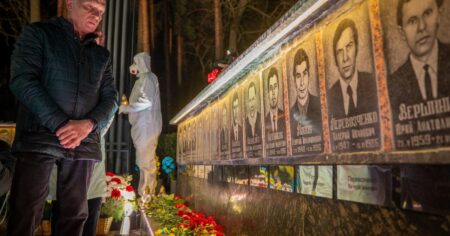
The atrocities in Bucha remain one of the most disturbing chapters of Russia’s invasion of Ukraine. When Russian troops invaded on February 24, 2022, they quickly occupied this small town near Kyiv, maintaining control for approximately one month. When Ukrainian forces finally retook the area, they discovered a scene of unimaginable horror—more than 400 bodies left behind by what many have characterized as a cleansing operation. The victims told a story of systematic brutality: many had been shot down in the streets, some with their hands bound behind their backs, while others bore evidence of torture and sexual violence. The United Nations documented over seventy summary executions, painting a picture of calculated cruelty rather than the chaos of combat. At the Church of Saint Andrew in Bucha, European ministers viewed graphic photographs and video evidence of these massacres. Polish Foreign Minister Radek Sikorski’s response captured the gravity of what they witnessed: “Anybody who claims that Vladimir Putin is not a war criminal should come and see for themselves.” His words reflected the raw emotion and moral clarity that the evidence demands—this wasn’t collateral damage or the fog of war, but deliberate acts of violence against civilians.
Europe’s Promise: Justice and Accountability
The European delegation’s visit was about more than remembrance—it was a commitment to action and accountability. EU foreign policy chief Kaja Kallas emphasized the critical importance of ensuring that both those who ordered the killings and those who carried them out face justice. Her message was clear: without accountability, the cycle of violence continues, and victims’ families are left with no recourse but revenge. “If you don’t see people doing this to your family held accountable, you will want revenge,” Kallas explained, highlighting how justice serves as a foundation for eventual reconciliation and peace. Ukrainian Foreign Minister Sybiha welcomed this European commitment, stating that “such a strong European presence on this day demonstrates that justice for this and other Russian atrocities is inevitable.” Part of the meetings focused specifically on reassuring Kyiv that European nations remain dedicated to holding Russia accountable for its invasion and the crimes committed during it. This promise of comprehensive accountability, Sybiha noted, is vital to restore justice in Europe. The challenge ahead is enormous—documenting evidence, identifying perpetrators, building legal cases, and ultimately bringing war criminals to trial. But the European ministers’ presence in Bucha sent a message that this work will continue, regardless of how long it takes or how the geopolitical winds shift.
Competing Priorities and Fading Attention
One of the most concerning aspects of the current situation is how international attention has shifted away from Ukraine. The conflict in the Middle East, particularly the Iran war, has become a top priority for the United States, creating fears that resources desperately needed by Ukraine—especially air defense systems—might be diverted elsewhere. Additionally, the Middle East crisis has driven up energy prices, providing Russia with windfall profits that fund its war machine. EU foreign policy chief Kallas was frank about this challenge: “We can’t let it slip off the table. We are the ones who have to keep this up because nobody else does.” Her words acknowledge a difficult reality—that Europe may find itself as Ukraine’s primary champion as American focus wavers. Meanwhile, U.S.-mediated negotiations to end the war have ground to a halt, with no clear timeline for when they might resume. “The talks are stalled,” Kallas confirmed, adding another layer of uncertainty to Ukraine’s future. The situation is further complicated by economic factors: Russia stands to benefit from surging oil prices and a temporary U.S. waiver on Russian oil sanctions designed to ease supply shortages. As Asian nations increasingly compete for Russian crude oil amid an energy crisis, Moscow’s ability to fund its military operations grows stronger, making Ukraine’s fight more difficult and Europe’s support even more crucial.
Ukraine Strikes Back: Targeting Russia’s Oil Infrastructure
In response to Russia’s continued aggression and ability to profit from oil exports, Ukraine has dramatically intensified its long-range drone attacks on Russian oil facilities. Over just the past week, Ukrainian forces have struck targets in the Baltic Sea region five times, specifically targeting infrastructure that allows Russia to export the oil that finances its war effort. The Ukrainian Defense Ministry reported successful strikes on oil export facilities in Russia’s northwest Leningrad region, including the Transneft terminal in Primorsk, where attacks on March 22-23 hit oil loading infrastructure and storage tanks, starting fires. Repeated strikes on the Novatek Ust-Luga port complex have damaged storage facilities and loading docks, causing large fires that disrupted operations. According to Finland’s Prime Minister Petteri Orpo, Ukraine has deployed more than 2,500 drones against Russia’s oil ports in the Gulf of Finland and Baltic Sea in recent weeks, and these operations are expected to continue. The strategic logic is clear: by targeting the oil infrastructure that generates revenue for Moscow’s war machine, Ukraine can weaken Russia’s ability to sustain its military operations. The Kremlin has acknowledged the effectiveness of these strikes, with spokesman Dmitry Peskov confirming that “intensive work is being carried out” to strengthen air defenses at Ust-Luga and other critical infrastructure facilities. These drone attacks represent Ukraine’s attempt to level the playing field and strike at Russia’s economic lifelines when conventional military victories remain elusive.
Europe’s Unity Tested: Challenges Ahead
Despite the strong show of solidarity in Kyiv, the European Union faces significant internal challenges in maintaining support for Ukraine. The bloc’s unity has been tested by members with different priorities and relationships with Russia. Most notably, Hungary has emerged as a consistent obstacle to unified European action, objecting to new sanctions on Russia that the EU attempted to approve last month. Budapest has quarreled with other EU partners over both support for Ukraine and Russian oil deliveries, creating friction within the bloc. Even more concerning for Ukraine’s immediate future, Hungary has blocked a massive 90 billion euro ($103 billion) loan package at a time when Kyiv desperately needs cash to keep its government and military functioning. Additionally, while Ukraine has formally applied for EU membership—a move that would represent a historic shift in European politics—the process is expected to take years, offering little immediate relief or security. These internal European divisions highlight a troubling reality: while individual European nations and the EU leadership remain committed to Ukraine, translating that commitment into concrete action requires unanimous agreement that isn’t always forthcoming. The challenges are compounded by the enormous costs of supporting Ukraine militarily, economically, and through humanitarian aid, all while European nations face their own economic pressures. Yet the foreign ministers’ visit to Bucha demonstrates that for many European leaders, the moral imperative remains clear—the atrocities committed in towns like Bucha cannot be forgotten or forgiven, and Russia must ultimately be held accountable, regardless of how long that process takes or what sacrifices it requires.