
Lindsey Vonn’s Courageous Olympic Journey Ends in Heartbreak
A Champion’s Determination Meets Devastating Reality
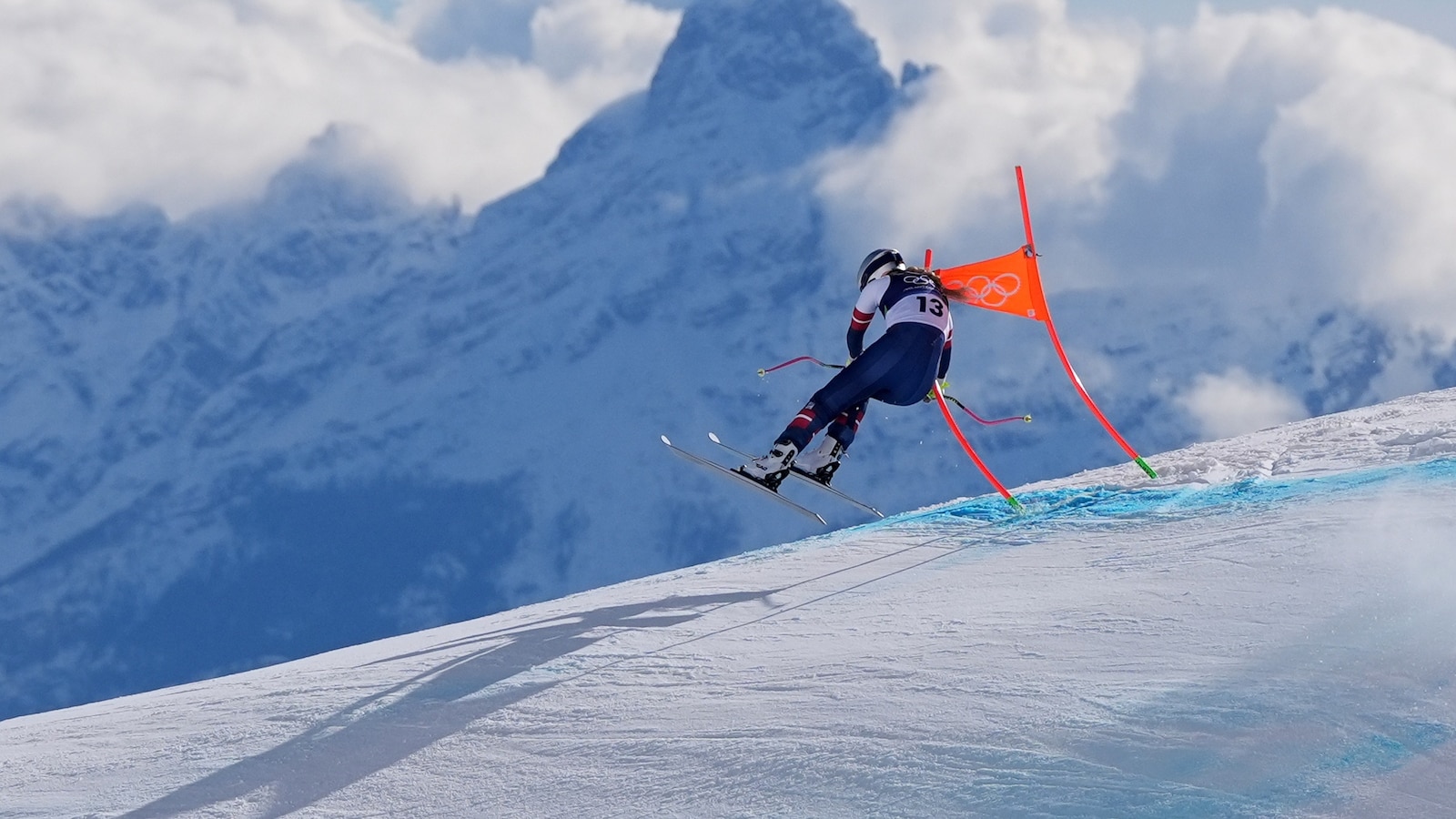
The world of alpine skiing witnessed both the incredible courage and heartbreaking vulnerability of one of its greatest athletes on Sunday when American skiing legend Lindsey Vonn crashed during the downhill competition at the Milan Cortina Winter Olympics. At 41 years old, Vonn was already defying conventional wisdom by attempting to become the oldest alpine skier—male or female—to win an Olympic medal. What makes her story even more remarkable is that she was competing with a torn anterior cruciate ligament (ACL) in her left knee, an injury that would sideline most athletes indefinitely. The crash occurred just 13 seconds after she left the start gate on the Olympia delle Tofane slope, a course that would ultimately prove unforgiving. According to the U.S. Ski & Snowboard team, Vonn’s right ski pole caught on a gate, throwing her off balance and sending her into an uncontrollable tumble down the mountain. The accident was a devastating end to what was meant to be a triumphant comeback story, transforming a moment of Olympic glory into one of medical emergency as helicopters arrived to airlift the injured champion to a nearby hospital.
The Brutal Reality of Downhill Skiing
The crash itself was terrifying to witness. Video footage captured Vonn tumbling violently down the slope before sliding to a stop, where she lay in the snow, clearly in severe pain. Spectators, including Vonn’s own family members waiting at the finish line, watched in stunned silence as rescue crews rushed to her aid. The broadcast caught her screams of pain, a raw and haunting reminder that beneath the glory and national pride of Olympic competition are real human beings risking everything. Fellow Olympic skier Sam Morse, competing in the men’s downhill event, provided insight into what went wrong: “She caught her right arm, right shoulder on the gate. If you’re planted on the ground, that’s one thing, you can usually use your core and rotate it. But she’s in the air, so she’s just a victim to rotating and it’s really hard to correct that. Once you’re spinning in the air you have no reference point to stabilize off of.” Morse went on to characterize downhill skiing as “one of the last gladiator sports,” emphasizing the lack of safety equipment beyond a helmet: “There’s no seat belts, there’s no roll cages. We’re out there in these little skintight suits just hurtling down the mountain.” This perspective puts Vonn’s decision to compete with existing injuries into sharp relief—she wasn’t just pushing through discomfort, but willingly entering one of the most dangerous arenas in sport while already compromised.
A Body Already Bearing the Scars of Glory
Lindsey Vonn’s body tells the story of a career spent pushing the absolute limits of human performance. She already had a titanium implant in her right knee from previous injuries, and for Sunday’s race, she was wearing a heavy brace on her recently injured left knee. The ACL tear she was skiing with had occurred just over a week before, on January 30th, during a practice run at a World Cup race in Crans-Montana, Switzerland. That injury alone would typically require months of recovery and rehabilitation. But the damage wasn’t limited to the ligament—Vonn was also dealing with a bone bruise and tears to her meniscus, the crucial cartilage cushioning between the upper and lower leg bones. For most athletes, this combination of injuries would represent an absolute red line, a clear signal from the body that it needs time to heal. But Vonn is not most athletes. After extensive consultations with doctors, intense therapy sessions, physical testing, and practice runs back on the slopes, she made the decision that would define this chapter of her career: she would compete. “I am confident in my body’s ability to perform,” she declared, a statement that now reads as both admirably determined and heartbreakingly prophetic.
The Refusal to Give Up on a Dream
Just a week before the Olympic opening ceremony, Vonn stood before the media at a press conference in Cortina d’Ampezzo and delivered words that captured both her competitive spirit and the stakes she understood she was facing. “I’m not letting this slip through my fingers. I’m gonna do it. End of story,” she stated with characteristic directness. “I’m not crying, my head is high, I’m standing tall. And I’m gonna do my best, and whatever the result is, that’s what it is. But never say I didn’t try.” These words reveal an athlete who understood the risks but couldn’t live with the regret of not attempting what might be her final Olympic moment. For someone who had dedicated her entire life to the sport, who had sacrificed so much and achieved so much, the idea of watching from the sidelines was simply unbearable. This wasn’t recklessness or ego—it was the mindset of a champion who had always found a way to overcome obstacles, who had built a legendary career on refusing to accept limitations. The decision was made with full awareness, after medical consultations and realistic assessments. Vonn believed in herself, in her preparation, and in the possibility that she could create one more moment of Olympic magic despite the odds stacked against her.
A Legacy Beyond This Moment
To understand the magnitude of what Vonn attempted, one must appreciate what she has already accomplished in her sport. She is one of the most successful female alpine skiers in history, a four-time overall World Cup champion with three Olympic medals already to her name, including the gold in downhill at the 2010 Vancouver Games. Her career has been marked by both extraordinary triumphs and devastating setbacks, yet she has consistently returned stronger. Most recently, in December, Vonn had won at the Audi FIS World Cup at St. Moritz, Switzerland, capturing her 83rd World Cup race victory. “It’s like a dream. It’s more than a dream,” she said after that win. “I worked so hard this summer and we have such a great team and everything has really come together, but it almost doesn’t feel real.” That victory demonstrated that even at 41, Vonn remained competitive at the highest levels of her sport. It’s what made her Olympic attempt credible rather than quixotic—she had proven just months earlier that age hadn’t diminished her skills. While Sunday’s crash ended her Olympic competition, with American Breezy Johnson of Jackson Hole, Wyoming, becoming only the second American after Vonn to win gold in the event, Vonn’s legacy extends far beyond any single race or medal.
The Aftermath and What Comes Next
Following the crash, the U.S. Ski & Snowboard Team confirmed that Vonn had been airlifted from the mountain, noting this is common practice for injuries during alpine competition. They later updated that “Lindsey Vonn sustained an injury, but is in stable condition and in good hands with a team of American and Italian physicians.” The specific nature and extent of her new injuries have not been fully disclosed, but given the violence of the crash and her pre-existing damage, the road ahead will undoubtedly be challenging. What remains to be seen is whether this crash marks the end of Vonn’s competitive career or merely another chapter in her ongoing story of resilience and comeback. She has overcome so much before, has returned from injuries that ended other careers, that it would be foolish to count her out entirely. Yet at 41, with the accumulated damage of a long career in one of sport’s most punishing disciplines, the calculation of risk versus reward inevitably shifts. What cannot be questioned is the courage it took to even attempt this Olympic run. In choosing to compete despite her injuries, Vonn demonstrated something that transcends medals and podium finishes—she showed the fierce determination that defines great athletes, the refusal to let fear or pain write the final chapter of her story. Whether this crash proves to be that final chapter or not, Lindsey Vonn has already secured her place among the legends of her sport, not just for her victories, but for the spirit with which she pursued them until the very end.