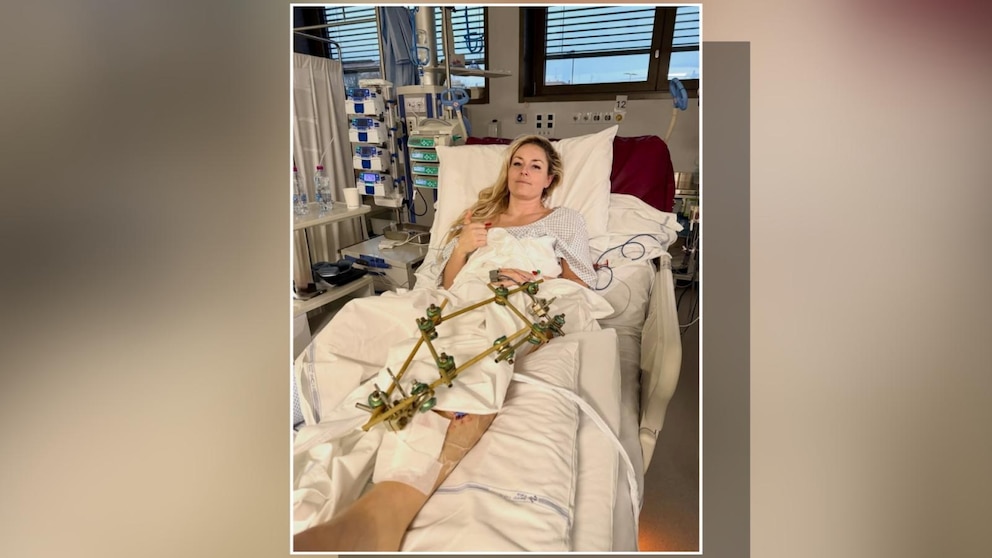

Lindsey Vonn Discharged from Hospital Following Serious Winter Olympics Crash
A Champion’s Latest Battle
Olympic skiing legend Lindsey Vonn has been discharged from the hospital following a terrifying crash during the 2026 Winter Olympics that left fans, fellow athletes, and the entire sports world holding their breath. The American ski racing icon, whose career has been defined as much by her incredible triumphs as by her remarkable resilience in the face of injury, faced perhaps her most serious medical challenge yet when she suffered a complex tibial fracture during competition. What made this particular injury so concerning wasn’t just the fracture itself, but the rare and potentially devastating complication that followed—one that, in the worst-case scenarios, could have resulted in amputation. Thanks to the swift action of her medical team and the world-class care she received, Vonn is now on the road to recovery, though the incident serves as a sobering reminder of the tremendous physical risks these athletes take every time they push themselves to the limit in pursuit of Olympic glory.
The crash itself was the kind of heart-stopping moment that makes spectators gasp and turn away. Vonn, competing in an event that has been both her proving ground and her battlefield throughout her storied career, lost control at high speed on the challenging Olympic course. The fall was violent, and it was immediately clear to those watching that something was seriously wrong. Medical personnel rushed to her aid on the mountainside, and she was quickly transported to a nearby medical facility for emergency evaluation and treatment. Initial assessments revealed the tibial fracture, but as doctors examined her more closely, they discovered the complication that would make this injury far more serious than a typical broken bone. The quick response from the medical team on-site and the specialists who took over her care likely made the difference between a difficult recovery and a potentially career-ending or even life-altering outcome.
Understanding the Medical Emergency
The complex tibial fracture that Vonn sustained is serious enough on its own—the tibia, or shinbone, is the larger of the two bones in the lower leg and plays a crucial role in bearing the body’s weight and enabling movement. When this bone breaks, particularly in the kind of high-impact crash that occurs in downhill skiing, the fracture can be complicated, involving multiple fragments or damage to surrounding tissues. However, what elevated Vonn’s injury from serious to potentially catastrophic was the rare complication that developed. While the specific nature of this complication hasn’t been fully detailed publicly to respect Vonn’s privacy, complications from tibial fractures that can lead to amputation typically involve issues with blood supply to the lower leg and foot, severe tissue damage, or compartment syndrome—a painful and dangerous condition where pressure builds up within the muscles to dangerous levels, cutting off blood flow and potentially causing permanent muscle and nerve damage.
Compartment syndrome, in particular, is a medical emergency that requires immediate intervention. When it occurs, the swelling and pressure within the leg’s muscle compartments can become so severe that blood cannot flow properly to tissues, and without oxygen-rich blood, muscles and nerves begin to die within hours. If not treated promptly with surgical intervention—typically a procedure called a fasciotomy, where doctors cut open the connective tissue surrounding the muscles to relieve the pressure—the damage can become irreversible, potentially necessitating amputation to save the patient’s life. The fact that Vonn’s medical team acted so quickly suggests they recognized the signs of this or a similar complication immediately and took the necessary steps to prevent the worst outcomes. Their expertise and rapid response undoubtedly saved not just Vonn’s leg, but potentially her life, and certainly preserved her quality of life going forward.
A Career Marked by Courage and Comebacks
For those who have followed Lindsey Vonn’s career, this latest injury is unfortunately part of a familiar pattern, though no less concerning for its repetition. Throughout her time as one of the world’s premier ski racers, Vonn has suffered numerous serious injuries, undergone multiple surgeries, and staged comeback after comeback that seemed almost superhuman in their defiance of what the human body should reasonably be able to endure. She has torn ACLs and MCLs, fractured bones, endured grueling rehabilitation periods, and returned to competition at the highest level time and again. Her ability to overcome these setbacks has become as much a part of her legend as her record-breaking performances on the slopes. She has won Olympic gold, claimed World Cup titles, and set records that may stand for generations, all while battling through injuries that would have ended the careers of lesser athletes.
What makes Vonn’s resilience so remarkable isn’t just the physical recovery—though that in itself is extraordinary—but the mental fortitude required to return to a sport that has broken her body repeatedly. The psychological challenge of getting back on skis after a serious crash, of pushing through fear and pain to once again hurtle down a mountain at speeds that most people can’t even imagine, requires a level of courage that goes beyond athletic ability. Vonn has spoken openly in the past about the mental battles she’s faced, the doubts that creep in during long, painful recoveries, and the determination it takes to silence those doubts and trust her body again. This latest injury, given its severity and the potential consequences she faced, may test that mental strength more than any challenge she’s encountered before. The question on everyone’s mind now is whether this will be one comeback too many, or whether Vonn will once again defy the odds and find her way back to the sport she loves.
The Outpouring of Support and the Road Ahead
Since news of the crash and the severity of Vonn’s injury became public, there has been an overwhelming outpouring of support from around the world. Fellow athletes, both from the skiing community and from other sports, have sent messages of encouragement and solidarity. Fans have flooded social media with well-wishes and expressions of admiration for Vonn’s courage and strength. The skiing world, in particular, has rallied around one of its brightest stars, with competitors who line up against Vonn on race days expressing their genuine concern and hoping for her full recovery. This response speaks to the respect Vonn has earned not just through her achievements, but through the grace and professionalism she has displayed throughout her career, even in the face of repeated setbacks.
The road to recovery from this kind of injury is long and uncertain. While Vonn has been discharged from the hospital, which is certainly a positive sign, she faces months of rehabilitation and healing. The initial focus will be on ensuring the fracture heals properly and that there are no lingering effects from the complication that made her injury so dangerous. Physical therapy will be intense and gradual, working to restore strength, flexibility, and function to the injured leg. Beyond the physical healing, there will be the psychological process of coming to terms with what happened and making decisions about the future. At this stage, it’s too early to say whether Vonn will attempt another comeback or whether this injury will mark the end of her competitive career. Those closest to her have indicated that the focus right now is simply on healing and that any decisions about returning to competition will come much later, after she’s had time to recover and assess what she wants for her future.
Reflections on Risk, Sacrifice, and the Olympic Spirit
Vonn’s crash and the serious injury that resulted serve as a stark reminder of the incredible risks that Olympic athletes take in pursuit of excellence. While viewers at home watch these competitions with excitement and national pride, it’s easy to forget that these athletes are pushing their bodies to the absolute limits of human capability, often in dangerous conditions and at speeds where the margin for error is virtually nonexistent. Downhill skiing, in particular, is one of the most dangerous Olympic sports, with racers reaching speeds of 80 miles per hour or more on icy, treacherous courses. At those speeds, even the smallest mistake can result in devastating crashes. The athletes who compete in these events know the risks—they live with them every day—but they choose to compete anyway because of their love for the sport and their drive to be the best.
The sacrifices these athletes make go far beyond the physical risks. They spend years training, often from childhood, dedicating their lives to their sport in ways that require giving up normal experiences and opportunities that most people take for granted. They endure punishing training regimens, time away from family and friends, and the constant pressure of competition and expectation. When injuries occur, as they inevitably do in such demanding sports, these athletes face not just the physical pain and the long recovery process, but also the emotional toll of interrupted careers, missed opportunities, and uncertain futures. Lindsey Vonn’s story embodies all of these sacrifices and challenges, but it also embodies the indomitable spirit that drives Olympic athletes—the refusal to give up, the determination to overcome obstacles that seem insurmountable, and the courage to keep pushing forward even when the personal cost is high. As Vonn begins her recovery, she carries with her the support of millions who recognize not just her athletic achievements, but her embodiment of the Olympic spirit at its finest. Whether this injury marks the end of her competitive career or becomes another chapter in her story of resilience, Lindsey Vonn has already secured her legacy as one of the greatest and most courageous athletes of her generation.