


Tensions Rise in the Strait of Hormuz as Iran and U.S. Face Off
Saudi Arabia Issues Urgent Call for Regional De-escalation
In response to escalating military tensions in the Persian Gulf, Saudi Arabia has stepped forward with an urgent diplomatic appeal aimed at preventing the region from spiraling into further conflict. The Saudi government’s concerns were triggered after Iran launched its first attack on a Persian Gulf neighbor in nearly a month, coinciding with the United States beginning operations to escort commercial vessels through the strategically vital Strait of Hormuz. The Saudi Foreign Ministry released a carefully worded statement expressing deep concern about the current military situation unfolding in their neighborhood. Their message was clear and direct: the region needs immediate de-escalation, restraint from all parties, and a renewed commitment to diplomatic solutions rather than military confrontation.
The Saudi statement specifically highlighted the importance of supporting Pakistani mediation efforts, acknowledging Pakistan’s role as a potential bridge between the conflicting parties. The kingdom emphasized that reaching a political solution through dialogue is essential to prevent the region from descending into greater instability and chaos. Saudi officials made it abundantly clear that continued escalation serves neither regional interests nor global stability. Furthermore, the Saudi government stressed the critical importance of restoring normal international maritime navigation through the Strait of Hormuz, a waterway through which nearly a third of the world’s seaborne oil passes. They demanded that all vessels be guaranteed safe and secure passage without any restrictions, recognizing that disruptions to this vital shipping lane could have catastrophic effects on global energy markets and international trade.
Iran’s Defiant Stance: “We Haven’t Even Started Yet”
While diplomatic voices call for calm, Iran’s rhetoric suggests a nation prepared for prolonged confrontation. Mohammad Bagher Ghalibaf, Iran’s chief negotiator in talks with the United States and also the speaker of Iran’s parliament, issued a stark warning that demonstrates Tehran’s confidence in its position despite mounting international pressure. In a social media post that sent ripples through diplomatic channels, Ghalibaf declared that Iran has “not even started yet” in its standoff over control of the Strait of Hormuz. This ominous statement suggests that Iranian leaders believe they have significantly more leverage and capability to escalate the situation than they have so far demonstrated.
Ghalibaf’s comments revealed Iran’s strategic calculation that time is on their side in this confrontation. He stated plainly that “the continuation of the status quo is intolerable for America” while simultaneously asserting that Iran has barely begun to exert its influence in the region. This assessment reflects Iran’s belief that the United States faces greater pressure to resolve the crisis quickly than Iran does, potentially giving Tehran negotiating leverage. The Iranian negotiator also accused the United States and its allies of putting shipping security at risk through their military presence in the Gulf, turning the usual Western narrative on its head by portraying American naval operations as the destabilizing factor rather than Iranian actions. Despite this combative rhetoric, Ghalibaf predicted that the “malign presence” of U.S. forces would eventually diminish, suggesting that Iran views the current American military posture as unsustainable in the long term.
U.S. Navy Faces Coordinated Iranian Assault During Strait Transit
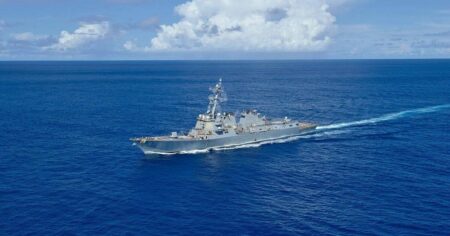
The dangers facing naval vessels in the Strait of Hormuz became dramatically apparent when two U.S. Navy destroyers successfully navigated through the waterway while under sustained attack from Iranian forces. According to defense officials who spoke to CBS News on condition of anonymity due to the sensitive nature of national security matters, the USS Truxtun and USS Mason entered the Persian Gulf after facing what was described as a coordinated and intensive Iranian barrage. The two destroyers, supported by Apache helicopters and additional aircraft providing air cover, encountered multiple types of threats during their passage through the narrow strait.
Iranian forces launched a sophisticated, multi-layered attack involving small boats, missiles, and drones in what military officials characterized as a sustained assault designed to overwhelm the ships’ defensive capabilities. The intensity and coordination of the attacks demonstrated Iran’s ability to bring various military assets to bear simultaneously, creating complex defensive challenges for the American vessels. However, despite the ferocity of the Iranian offensive, neither U.S. destroyer sustained any damage. Military officials reported that the ships’ defensive measures, significantly enhanced by robust air support, successfully intercepted or deterred each incoming threat. Remarkably, officials emphasized that not a single projectile launched by Iranian forces actually reached either ship, showcasing the effectiveness of American naval defense systems and the coordination between surface vessels and supporting aircraft. This successful transit represents a significant operational achievement for the U.S. Navy while simultaneously demonstrating the very real dangers that commercial vessels face when attempting to navigate these contested waters without military protection.
Commercial Shipping Navigates Crisis with Mixed Results
The impact of the Strait of Hormuz crisis extends far beyond military vessels, affecting the global shipping industry that relies on this waterway for the transport of energy resources and commercial goods worth billions of dollars. Denmark’s shipping giant Maersk announced that one of its vessels successfully completed a transit through the strait under American military escort, offering a glimmer of hope for the resumption of commercial shipping operations. The ship in question, the Alliance Fairfax flying the U.S. flag, had been stranded in the Gulf since the current crisis erupted in February. When the vessel was offered the opportunity to transit the strait accompanied by U.S. military assets, the company accepted, and on May 4th, the ship successfully exited the Persian Gulf with military protection. Maersk reported that the transit was completed without any incidents and that all crew members remained safe and unharmed throughout the passage.
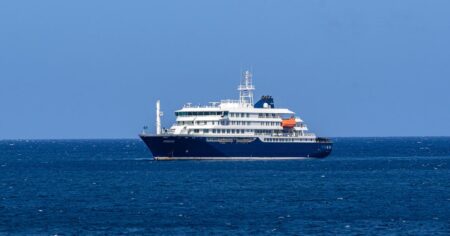
However, not all vessels have been so fortunate. South Korea found itself directly affected by the crisis when one of its cargo ships came under apparent attack. An explosion and fire were reported aboard the South Korean vessel HMM Namu on Monday as it navigated the contested waterway. The incident, which has been effectively blocked since the broader Middle East conflict erupted on February 28th, highlighted the indiscriminate danger facing commercial vessels regardless of their country of origin or flag. Fortunately, South Korea’s foreign ministry reported on Tuesday that all 24 crew members aboard the stricken vessel—including six South Korean nationals—escaped injury, and the fire was completely extinguished. The HMM Namu, a substantial vessel measuring almost 590 feet in length and sailing under the Panamanian flag according to MarineTraffic tracking data, represents just one of many commercial ships caught in the crossfire of this geopolitical standoff.
South Korea Weighs Participation in U.S.-Led Maritime Protection
The attack on the HMM Namu has placed South Korea in a difficult diplomatic position, forcing Seoul to carefully consider its response to American requests for allied participation in Gulf operations. President Trump seized upon the incident to urge South Korea to join what he has dubbed “Project Freedom,” the U.S. military operation designed to escort stranded vessels through the Strait of Hormuz. Trump argued that the attack on a South Korean vessel should serve as a wake-up call, prompting Seoul to contribute to American-led efforts to secure the waterway that is vital for the fuel exports upon which South Korea’s economy heavily depends.
In response to this pressure, South Korea’s defense ministry announced on Tuesday that it would “carefully review our position” regarding participation in the U.S. operation, though notably, officials stopped short of making any firm commitment to join. The ministry outlined several factors that would inform Seoul’s decision-making process, including considerations of international law, the safety of international maritime routes, South Korea’s long-standing alliance with the United States, and the current security situation on the Korean peninsula, where tensions with North Korea remain a constant concern. The ministry also pointed out that South Korea has already been “actively participating in international discussions on cooperation to ensure safe passage through the Strait of Hormuz,” suggesting that Seoul may prefer multilateral approaches over bilateral military operations. This measured response reflects the delicate balancing act South Korea must perform, weighing its security alliance with the United States against potential economic relationships with Iran and concerns about being drawn into a Middle Eastern conflict while facing security challenges closer to home.
Diplomatic Progress Amid Military Confrontation
Despite the military escalation, diplomatic channels remain open, with both sides acknowledging ongoing negotiations even as they engage in confrontational rhetoric and actions. Iran’s Foreign Minister Abbas Araghchi provided a somewhat mixed message on Monday, stating that talks with the United States are “making progress” thanks to Pakistan’s mediation efforts, while simultaneously criticizing American military operations in the Gulf. Araghchi’s comments suggest that diplomatic and military tracks are proceeding on parallel courses, with neither side willing to abandon either approach.
The Iranian foreign minister specifically criticized Project Freedom, dismissing it as “Project Deadlock” and arguing that military operations cannot solve what is fundamentally a political crisis. His statement that “events in Hormuz make clear that there’s no military solution to a political crisis” represents an appeal to diplomatic engagement even as Iranian forces continue to challenge American naval vessels and commercial shipping. Araghchi also issued a warning to the United States to “be wary of being dragged back into quagmire by ill-wishers,” suggesting that Iran views some regional actors as deliberately trying to escalate the conflict. Interestingly, he included a similar warning to the United Arab Emirates, indicating Iranian concerns about the positions being taken by various Gulf Arab states. This dual-track approach—maintaining diplomatic communication while engaging in military confrontation—characterizes the current state of U.S.-Iranian relations in the Gulf. Both sides appear to be using military actions to strengthen their negotiating positions while keeping diplomatic channels open as a potential off-ramp from the crisis. Whether diplomacy can ultimately prevail over military escalation remains one of the most consequential questions facing the region and the broader international community.