


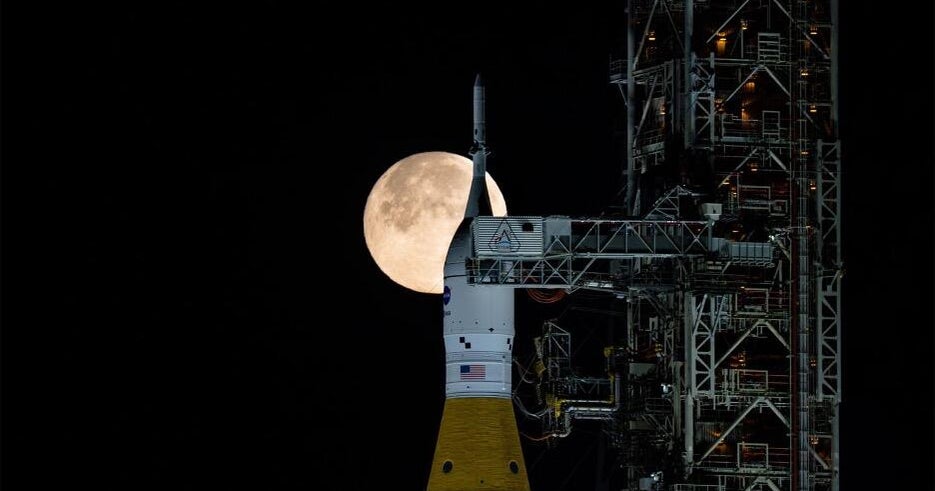

NASA’s Historic Return to the Moon: The Artemis II Mission
Humanity’s First Lunar Journey in Over Half a Century
After navigating through weeks of technical delays and overcoming significant engineering challenges, NASA stands ready to make history once again. The Artemis II mission represents humanity’s first crewed journey to the moon in more than 50 years, marking a pivotal moment in space exploration. Scheduled to lift off on Wednesday, April 1, at 6:24 p.m. EDT, the mission will carry four astronauts on an ambitious nine-day voyage around the moon and back to Earth. The crew includes NASA commander Reid Wiseman, pilot Victor Glover, astronaut Christina Koch, and Canadian astronaut Jeremy Hansen. They’ll be launched aboard the Space Launch System rocket, currently the most powerful operational booster in the world, with weather forecasters predicting an encouraging 80% chance of favorable launch conditions. When Wiseman arrived at Kennedy Space Center with his crew on Friday, his enthusiasm was palpable: “Hey, let’s go to the moon! I think the nation and the world has been waiting a long time to do this again.” The journey hasn’t been without its obstacles—the original February launch date was pushed back first by hydrogen fuel leaks and later by complications with the upper stage propellant pressurization system. However, NASA engineers have successfully resolved both issues, finally clearing the path for this historic liftoff.
A Test Flight Like No Other: Breaking New Ground
The Artemis II mission represents a series of significant firsts that underscore just how groundbreaking this flight truly is. This will mark the rocket’s inaugural flight with a human crew aboard and only its second flight overall. It’s also the first piloted flight of the Orion deep space crew capsule, aptly named “Integrity.” As Commander Wiseman emphasized, this isn’t just another space mission—it’s fundamentally a test mission with numerous variables and potential outcomes. “When we get off the planet, we might come right back home. We might spend three or four days around Earth. We might go to the moon. That’s where we want to go, but it is a test mission, and we are ready for every scenario,” Wiseman explained to reporters. The crew brings impressive credentials to this venture: Wiseman, Glover, and Koch are all NASA veterans with previous space experience, while Hansen will make history as the first Canadian to venture beyond Earth orbit. Together, they’ll become the first crew to head moonward since Apollo 17 touched down on the lunar surface more than five decades ago. This mission serves as a crucial stepping stone in what’s become a new space race—this time between NASA and China, which has announced plans to land their “taikonauts” on the moon by 2030. NASA aims to win this competition by launching one, possibly two, moon landing missions by 2028.
The Road Ahead: Building a Permanent Lunar Presence
The Artemis II mission fits into a broader, more ambitious vision for humanity’s relationship with the moon. This flight represents the essential first step in thoroughly testing the Orion capsule with a human crew before attempting more complex operations. Next year, NASA plans to have astronauts rendezvous and dock in low-Earth orbit with new moon landers currently being built by SpaceX and Blue Origin, testing critical systems and verifying operating procedures. Following these tests, NASA astronauts are scheduled to attempt an actual moon landing near the lunar south pole in just two years. But the ambitions extend far beyond planting flags and taking photographs. NASA’s long-term vision includes increasing flight rates and designing a permanent moon base where astronauts can spend weeks or even months conducting research and developing new technologies. NASA Administrator Jared Isaacman, who unveiled these updated plans in February with an estimated seven-year budget of $20 billion, described this “step-by-step approach” as “exactly how NASA achieved the near impossible” during the Apollo program in the 1960s. However, he stressed a fundamental difference in philosophy: “But this time, the goal is not flags and footprints. This time, the goal is to stay. America will never again give up the moon.” This commitment represents a paradigm shift in space exploration—moving from brief visits to establishing a sustained human presence beyond Earth.
Launch Day: A Powerful Beginning to an Incredible Journey
The launch itself promises to be a spectacular demonstration of human engineering prowess. The Artemis II crew will blast away from Florida atop the Space Launch System rocket’s nearly 9 million pounds of thrust—a force difficult to comprehend until you consider the numbers. At liftoff, the entire vehicle will weigh 5.7 million pounds, and within just eight minutes, it will accelerate the Orion crew ship to a velocity of nearly 5 miles per second. To put that speed in perspective, at that velocity, the spacecraft would cross about 70 football fields, placed end to end, in just one second. Following liftoff, two critical rocket firings—one occurring 50 minutes after launch and another about an hour later—will establish the spacecraft on an elliptical orbit reaching a high point of 43,760 miles above Earth. This altitude exceeds the distance traveled by any astronauts since the final Apollo mission in 1972. The Orion capsule will separate from its Interim Cryogenic Propulsion Stage three hours and 23 minutes after launch, beginning what Wiseman describes as a “crazy first day.” During this initial 24-hour orbit, the crew faces an intensive schedule of systems checks, verifying that communications, navigation, propulsion, and life support systems all function properly before committing to the lunar journey. These tests cover everything from the sophisticated to the mundane—including the “waste collection” system, NASA’s polite term for the spacecraft’s cramped toilet facilities. Pilot Glover, with assistance from Wiseman, will test Orion’s maneuvering capabilities by approaching and flying around the spent upper stage of the rocket, simulating the precise flying techniques that future crews will need when rendezvousing with lunar landers or NASA’s planned Gateway space station in lunar orbit.
The Lunar Encounter: Seeing What No Human Has Seen Before
Following a brief four-hour rest period and another crucial engine firing using the service module’s main engine, the crew will face the critical “go-no-go” decision point approximately 25 hours after launch. If all systems check out satisfactorily, the trans-lunar injection burn will commence—a six-minute, five-second engine firing that will boost the ship’s velocity by about 900 mph, just enough to break free from Earth’s gravitational grip and begin the four-day coast to the moon. This mission follows a “free return” trajectory, meaning the spacecraft will fly around the leading edge of the moon, using lunar gravity to naturally bend its path back toward Earth without requiring additional rocket burns. This approach provides an inherent safety feature—even if major navigation or propulsion problems develop after leaving Earth orbit, the capsule will still return home without needing its thrusters. The Artemis II crew will pass within approximately 4,100 miles of the lunar surface at their closest approach. What makes this flyby particularly exciting is that the crew will become the first humans to directly observe large regions of the moon’s far side. While Apollo astronauts flew behind the moon, their missions were timed to ensure daylight at landing sites facing Earth, leaving the far side in darkness. With an April 1 launch date, about 21% of the moon’s far side will be sunlit during the Artemis II flyby, giving the crew unprecedented opportunities to see portions never before observed by human eyes. Christina Koch described the careful planning required: “Four people, two windows pointing right at the lunar surface, and a highly choreographed dance, really, of who has the cameras, who has the other voice recording devices.” Victor Glover added an interesting observation about having the first woman view the moon up close: “There’s actually some differences, they think that she can potentially see colors that we may not see.”
Coming Home: The Most Dangerous Phase
The return to Earth represents perhaps the most perilous phase of the entire mission. Assuming an on-time launch, the Artemis II crew will fly farther from Earth than any humans since Apollo 13’s unplanned trajectory following their 1970 explosion, potentially reaching a record distance of 252,000 miles from home. When the time comes to return, the crew capsule will plunge back into Earth’s atmosphere at approximately 25,000 mph—roughly 7 miles per second—experiencing temperatures as high as 5,000 degrees Fahrenheit as friction with atmospheric molecules creates an electrically charged fireball around the spacecraft. This intense heat will block radio communications for about five minutes, creating an anxious period for mission controllers and families watching from the ground. The heat shield protecting the crew during this fiery descent carries some historical baggage. During the unpiloted Artemis I test flight in 2022, the identical heat shield design suffered unexpected damage, with large chunks of the outer protective layer breaking away during reentry. While the capsule landed safely, NASA launched an extensive investigation to understand what went wrong. Engineers discovered that during the Artemis I mission’s “skip” reentry trajectory—where the capsule dipped into the atmosphere, bounced back out, then made its final descent—heating patterns caused gas to build up beneath the heat shield’s outer layer, creating pressure that blew chunks away. For Artemis II, NASA has designed a different reentry profile with a shorter skip phase, allowing the outer protective layer to erode more evenly without creating dangerous pressure buildups. While future missions will use an entirely redesigned heat shield, NASA determined that the current design remains safe for this mission when combined with the modified trajectory. If all goes according to plan, nine minutes into the 13-minute reentry process, the crew will monitor the deployment of eleven parachutes—the most complex parachute system ever flown on a piloted spacecraft—that will slow their descent from 300 mph to a gentle splashdown velocity of just 15-17 mph. The capsule will splash down in the Pacific Ocean on April 10, where Navy recovery forces will extract the crew and transport them by helicopter to a waiting ship. After medical checks and calls to loved ones, the astronauts will return to Houston, while engineers begin the meticulous process of analyzing data from this historic flight, paving the way for humanity’s return to the lunar surface.