


The Extraordinary Crew of Artemis II: Four Trailblazers on Humanity’s Return to the Moon
A Historic Mission with Exceptional Astronauts
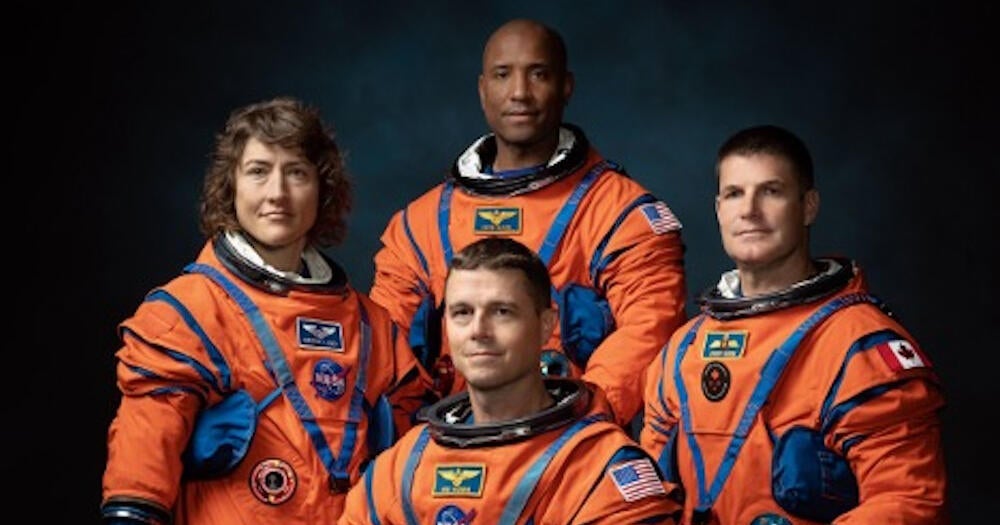
When the Artemis II mission launches this week, it will carry four remarkable individuals on a journey that will take humanity back toward the moon for the first time in over half a century. This isn’t just another space mission—it’s a pivotal moment that will pave the way for lunar landings planned for 2028 and the eventual construction of a permanent base near the moon’s south pole. The crew represents the best of what humanity can achieve: a single father raising two daughters while commanding one of the most challenging missions in NASA history, a Navy pilot who has overcome personal struggles to reach for the stars, a woman who will make history as the first female to fly to the moon, and a Canadian who will become his nation’s first astronaut to venture beyond low-Earth orbit. Selected with great fanfare in April 2023, these four have spent the past three years preparing for their nine-day mission to loop around the moon. Each brings a unique perspective and extraordinary background to this trailblazing flight, and together they embody the spirit of exploration that drives humanity to reach beyond our planet and discover what lies beyond.
Reid Wiseman: A Commander Who Balances Duty and Devotion
At 50 years old, mission commander Reid Wiseman carries the weight of not just leading this historic mission, but also raising two daughters as a single father. Born in Baltimore, Wiseman’s journey to this moment has been marked by both professional achievement and personal tragedy. With degrees in computer and science engineering from Rensselaer Polytechnic Institute and systems engineering from Johns Hopkins University, he became a naval aviator in 1999, flying F-35 and F-18 fighter jets from aircraft carriers before joining NASA’s astronaut corps in 2009. His space credentials include a 2014 mission to the International Space Station, where he spent 165 days in orbit and completed two spacewalks. But it’s his life on Earth that has truly tested his strength. His wife Carroll, a registered nurse, died in 2020 after battling cancer. Even as her illness progressed, she insisted the family remain where Reid worked, recognizing how important his career was to him and their children. Her words became his marching orders to continue pursuing his dreams, even as he navigated the challenge of single parenthood—something he calls the greatest challenge of his life. His daughters would prefer he stay home, he admits openly, but they understand this is a once-in-a-lifetime opportunity. As Wiseman puts it, parents have to live their dreams just like their children do, and through his example, he’s teaching them about courage, sacrifice, and the importance of pursuing what matters most.
Victor Glover: The Pilot Who Found Strength in Family Support
Victor Glover’s path to the Artemis II pilot seat reads like an adventure novel. Born in Pomona, California, the 49-year-old Navy Captain is married with four children and holds an impressive collection of academic credentials: an engineering degree from California Polytechnic State University and three master’s degrees in military aviation, systems engineering, and management. As an F/A-18 pilot, he has logged over 3,500 hours of flight time across more than 40 different aircraft, completed more than 400 carrier landings, and flew 24 combat missions. His diverse experience includes a deployment aboard the USS John F. Kennedy aircraft carrier, a year as a Navy exchange pilot at the Air Force Test Pilot School, and even a stint as a Legislative Fellow working in a U.S. senator’s office when he was selected as an astronaut in 2013. Glover served as pilot of the first operational SpaceX Crew Dragon flight to the International Space Station in 2020-21, spending 168 days in orbit and completing four spacewalks. But perhaps his most revealing moment came when discussing his assignment to Artemis II. He was going through significant personal and professional challenges when the assignment came, making it a difficult time to shift gears. When he finally told his family about the mission, their reaction—erupting with excitement and support—gave him something he didn’t even realize he needed. The emotion is still raw when he talks about it, revealing a man who draws strength from his family’s belief in him and the mission ahead.
Christina Koch: Explorer of Earth and Space
Christina Koch represents the pioneering spirit that has driven exploration throughout human history. At 47, the mission specialist from Grand Rapids, Michigan, who grew up in Jacksonville, North Carolina, brings a unique blend of scientific expertise and adventurous spirit to the crew. A surfer, rock climber, and avid traveler who enjoys backpacking and photography, Koch holds a bachelor’s degree in engineering from North Carolina State University and studied abroad in Ghana. Her career path has taken her to some of the most remote and challenging environments on Earth before she ever left the planet. She worked as an electrical engineer at NASA’s Goddard Space Flight Center, then spent time as a research associate in Antarctica, even wintering over at the remote Amundsen-Scott South Pole Station. She contributed to developing science instruments for NASA’s Juno probe currently orbiting Jupiter and worked on spacecraft studying the Van Allen radiation belts. Her fieldwork continued with the National Oceanic and Atmospheric Administration in Alaska and Samoa. When she started dating her future husband, she told him she was applying to become an astronaut but reassured him not to worry—it would never happen. But it did. Joining the astronaut corps in 2013, Koch spent 328 days aboard the International Space Station in 2019-20, conducting six spacewalks including the first three all-female spacewalks in history. Now she will become the first woman to fly to the moon, a milestone that carries profound significance. For Koch, space exploration isn’t just about the adventure—it’s about answering fundamental philosophical questions. Are we alone in the universe? How did our solar system form? What can we learn about ourselves when separated from the rest of humanity? These questions, she believes, are answered through our boldest journeys, and they inform how we live our everyday lives back on Earth.
Jeremy Hansen: Canada’s Lunar Pioneer
Jeremy Hansen’s journey from a farm in Ontario to the moon exemplifies how childhood dreams can become reality through dedication and perseverance. At 50, the Canadian mission specialist grew up in London, Ontario, spending his early years on a farm before his family moved to Ingersoll during his high school years. A rock climber and mountain biker who loves sailing, Hansen is married with three children. His aviation career began remarkably early—at just 12 years old, he joined the Royal Canadian Air Cadet Squadron, earning his glider pilot wings at 16 and obtaining a private pilot’s license a year later. After earning a bachelor’s degree with honors in space science from the Royal Military College, Hansen became a CF-18 fighter pilot in 2004, serving as a combat operations officer and working with NORAD on Arctic flying operations. The Canadian Space Agency selected him for astronaut training in 2009, and in 2017, he became the first Canadian to lead a NASA astronaut class. While fifteen Canadians have flown in space before him, Hansen will be the first to venture beyond low-Earth orbit and the first to fly around the moon. He approaches the historic nature of his mission with both excitement and realism. As he points out, Artemis II is a test flight, and test flights carry inherent risks. He’s had frank conversations with his family about the possibility of not returning—a lot to ask of loved ones, but something they’ve embraced with remarkable support. His young adult children have shown up for him in ways that fill him with gratitude. Hansen speaks candidly about the risks, noting that losing a crew shouldn’t shock us, and if it happens, the most important response is to prepare the next rocket for the next four volunteers willing to take that journey.
Looking Toward a New Era of Lunar Exploration
As these four remarkable individuals prepare for their nine-day mission around the moon, they carry with them not just their own dreams and the hopes of their families, but the aspirations of all humanity. Their diverse backgrounds—military aviators, electrical engineers, polar researchers, and combat pilots—demonstrate the breadth of experience required for such an ambitious undertaking. Christina Koch perhaps captured it best when she expressed her hope that this mission marks the start of an era where every person on Earth can look at the moon and think of it not just as something to gaze at in wonder, but as an actual destination we can reach. Canadian astronaut Jeremy Hansen spoke to the profound nature of the experience awaiting them—traveling to the far side of the moon and looking back at Earth from that unique perspective, seeing our home planet as the astronauts of the Apollo era did generations ago. The Artemis II mission represents more than a technological achievement or a geopolitical milestone. It embodies human courage, the strength of families who support their loved ones’ dangerous dreams, the breaking of barriers that once seemed insurmountable, and the international cooperation necessary to achieve great things. As Commander Wiseman, Pilot Glover, and Mission Specialists Koch and Hansen prepare for launch, they do so knowing they’re writing the next chapter in humanity’s greatest adventure—our journey to become a multi-planetary species, starting with our nearest celestial neighbor, the moon.