


Trump’s Proposed Triumphal Arch: A Monument of Unprecedented Scale Near Arlington Cemetery
A Monument That Would Reshape Washington’s Skyline
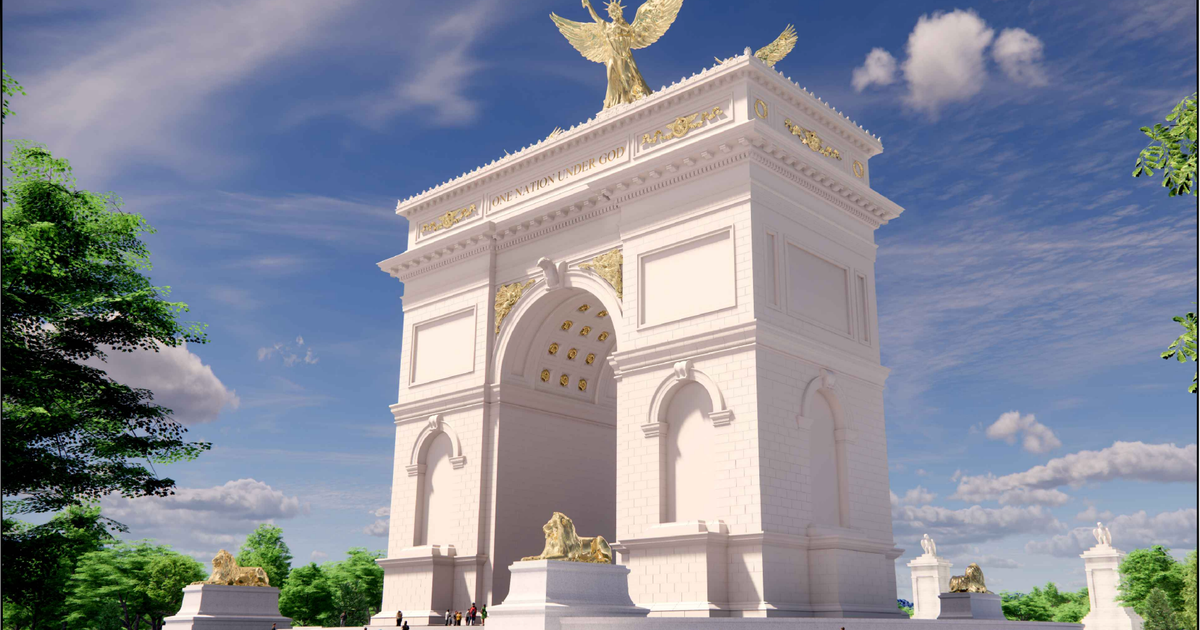
The Interior Department has unveiled ambitious plans for President Trump’s proposed triumphal arch, a structure that would dramatically alter the iconic Washington D.C. landscape. The renderings reveal a monument of staggering proportions—standing approximately 250 feet tall, more than double the height of the nearby 99-foot Lincoln Memorial. If constructed, this would become the world’s tallest triumphal arch, surpassing Mexico City’s Plaza de la República by roughly 30 feet. The sheer scale of this project represents not just an architectural undertaking, but a bold statement about national identity and presidential legacy. The proposed location sits strategically in a traffic circle on the Virginia side of the Potomac River, positioned between two of America’s most sacred sites—the Lincoln Memorial and Arlington National Cemetery—though the land technically falls within District of Columbia boundaries. This placement would create a new focal point in the nation’s capital, one that would be impossible to miss from virtually any vantage point along the National Mall.
Design Details and Patriotic Symbolism
The architectural vision for this monumental arch incorporates deeply symbolic American imagery and messaging. According to the designs prepared by Harrison Design, a Washington-based architecture firm, the structure would feature prominent inscriptions reading “One Nation Under God” on one side and “Liberty and Justice For All” on the other—phrases that echo the Pledge of Allegiance and foundational American values. The design calls for gold-colored statues of Lady Liberty to crown the top of the arch, flanked by two eagles, the national bird and a long-standing symbol of American strength and freedom. At ground level, four statues of lions would guard the base of the structure, adding to the monument’s imposing presence. The overall aesthetic bears resemblance to Paris’s famous Arc de Triomphe, though on a significantly larger scale. This blend of classical architectural elements with distinctly American symbolism appears designed to create a structure that honors both historical monument-building traditions while asserting a uniquely American character. The renderings show how the arch would create dramatic sight lines, framing views of both the Lincoln Memorial and the Washington Monument from certain angles, fundamentally changing how visitors experience these historic landmarks.
Presidential Vision and the 250th Anniversary Rationale
President Trump has been the driving force behind this project, personally championing the arch and sharing various design concepts over recent months. According to reports, the president has explicitly stated the arch is for “me,” a remarkably candid acknowledgment of the monument’s connection to his personal legacy. Publicly, Mr. Trump has framed the project as a commemoration of the country’s 250th anniversary, positioning it as a patriotic tribute rather than a personal monument. This anniversary milestone—America’s semiquincentennial—provides a historical justification for such an ambitious undertaking, suggesting the arch would serve as a lasting symbol of American achievement and endurance for future generations. The president’s stated ambition for the arch to be “the biggest one of all” in the world reflects his well-documented preference for superlatives and record-breaking achievements. This approach to monument-building represents a departure from recent decades of American memorial design, which has tended toward more contemplative, horizontal structures like the Vietnam Veterans Memorial or the National September 11 Memorial. Instead, Trump’s vision reaches skyward, demanding attention and projecting power in a manner more common to monuments of the 19th and early 20th centuries.
Funding Plans and Taxpayer Investment
The financial particulars of this ambitious project reveal that American taxpayers will bear a significant portion of the construction costs. According to spending documents released by the administration’s National Endowment for the Humanities, substantial federal funds have already been earmarked for the arch’s development. The endowment’s spending plan, which received approval from the Office of Management and Budget in September, reserves $2 million in special initiative funds and an additional $13 million in matching funds specifically for this project. This $15 million allocation represents just a portion of what would likely be a much larger total cost for a structure of this magnitude. For comparison, major monuments and memorials in Washington typically cost tens or even hundreds of millions of dollars when factoring in design, materials, construction, and site preparation. The use of National Endowment for the Humanities funds is particularly noteworthy, as this agency typically supports cultural programs, historical preservation, and educational initiatives rather than new monument construction. The funding mechanism raises questions about budget priorities and whether resources directed toward the arch might otherwise support other cultural or historical programs across the country. As with any major federal project, the full scope of costs will likely expand as planning progresses and construction challenges emerge.
Practical Concerns and Logistical Challenges
Beyond the aesthetic and financial considerations, the proposed arch faces significant practical challenges that could complicate or even prevent its construction. Perhaps most pressing is the structure’s location along a flight path for Ronald Reagan Washington National Airport, one of the busiest airports in the country. A 250-foot structure in this location would raise serious aviation safety questions, potentially interfering with pilots’ approach angles and creating new hazards for aircraft. The Federal Aviation Administration would need to conduct extensive reviews and likely require modifications to flight patterns or the structure itself. Additionally, the site’s position between Arlington National Cemetery and the Lincoln Memorial touches on sensitive historical and cultural considerations. Arlington Cemetery serves as the final resting place for hundreds of thousands of American service members and has maintained a character of solemn reverence since its establishment during the Civil War. Many may question whether an arch of such grandiose proportions appropriately respects the cemetery’s sacred nature. The proximity to the Lincoln Memorial also creates concerns about how the new structure would affect the experience of visiting that beloved monument. The renderings show the arch would dramatically dominate the Lincoln Memorial when viewed from certain angles, potentially diminishing the visual impact of the existing monument.
The Approval Process and What Comes Next
The path forward for this controversial project now leads to the Commission of Fine Arts, an advisory panel that reviews designs for monuments, buildings, and parks in the nation’s capital. The commission, which is currently composed entirely of Trump appointees, is scheduled to hear a presentation about the arch on April 16. This hearing represents a critical juncture where the design will face scrutiny from architectural and artistic perspectives, though the commission’s composition may influence the reception the project receives. Beyond this commission, the project would likely require approval from multiple other entities, including the National Capital Planning Commission, the National Park Service, and various District of Columbia and Virginia authorities given the site’s unique jurisdictional status. Environmental impact assessments would need to examine effects on the Potomac River ecosystem, local traffic patterns, and the historical character of the surrounding area. Public comment periods would provide citizens the opportunity to voice support or opposition. The project’s ultimate fate remains uncertain, dependent not only on these various approvals but also on sustained political will and funding availability. Historical precedent suggests that major monuments in Washington often take years or even decades from initial proposal to completion, with designs frequently modified in response to public input and practical constraints. Whether this particular vision of a triumphal arch will ultimately stand along the Potomac remains to be seen, but the proposal itself has already sparked important conversations about national memory, presidential legacy, and how America chooses to represent itself in stone and steel.