


The Tragic Tale of Timmy: A Humpback Whale’s Journey Gone Wrong
A Desperate Situation on Germany’s Baltic Coast
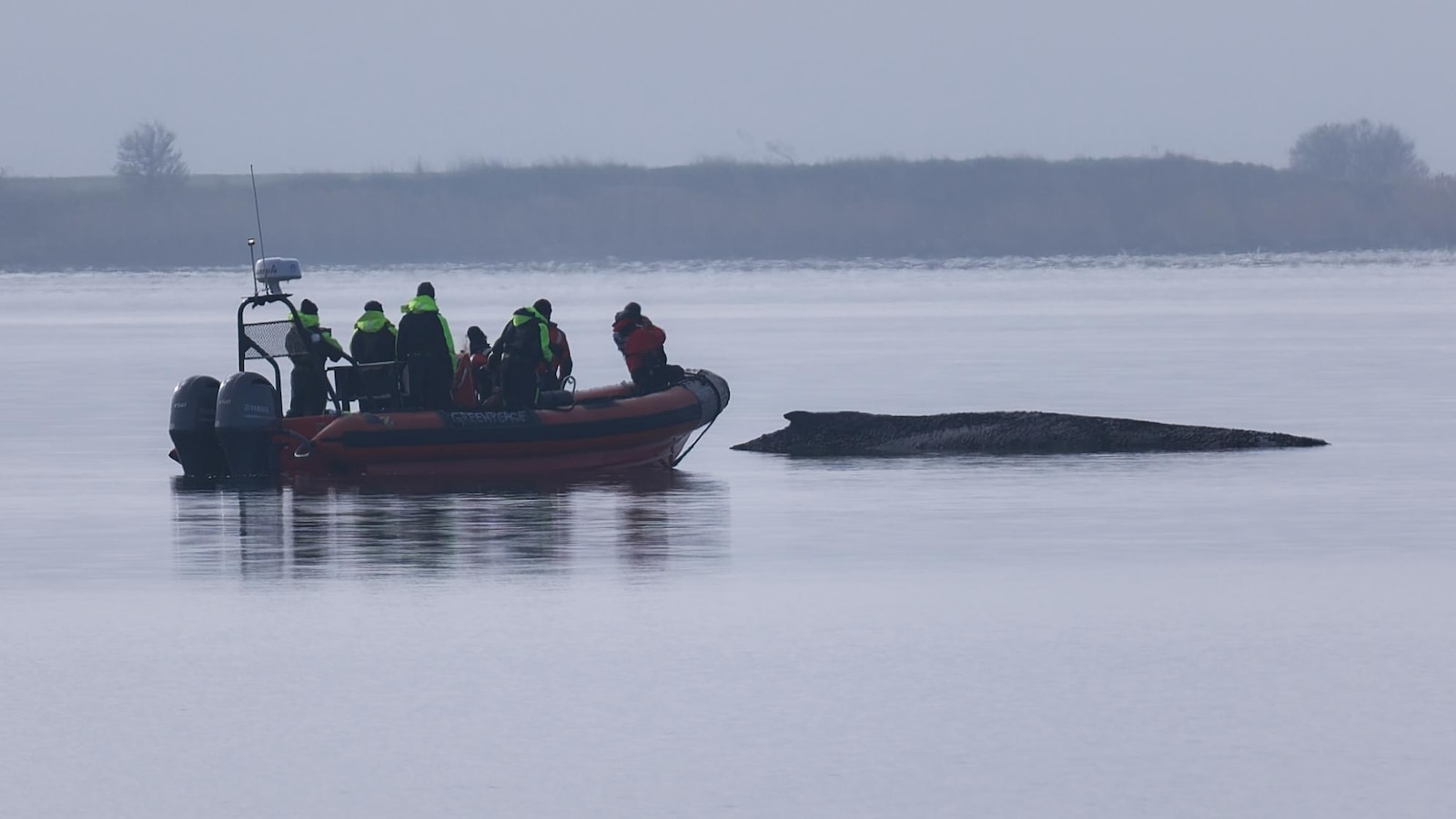
In what has become a heartbreaking saga that has captured the attention of an entire nation, rescue workers in Germany announced Wednesday that they have lost hope of saving a humpback whale that has repeatedly found itself trapped in the shallow waters off the country’s Baltic Sea coast. The massive marine mammal, affectionately nicknamed “Timmy” by concerned onlookers and media following its plight, currently lies stranded in an inlet near the small island of Poel, close to the port city of Wismar. Despite multiple rescue attempts and days of careful monitoring by experts, the whale’s condition has deteriorated to the point where authorities now believe the animal will die in its current location. The announcement marks a somber turning point in a rescue effort that has seen dedicated teams working tirelessly to give the magnificent creature a chance at survival, only to watch helplessly as nature takes its inevitable course.
The whale’s journey into these treacherous waters began on Tuesday when it swam into the inlet at Poel, becoming stuck once again in an environment completely unsuitable for such a large ocean dweller. This latest stranding represents just one chapter in a series of increasingly dire situations for the animal. Just last week, rescue teams managed to free the whale from even shallower waters at Timmendorfer Strand, a popular resort town located approximately 50 kilometers (over 30 miles) from where the whale now rests. That earlier rescue required the use of heavy machinery, including an excavator, to help guide the massive creature back toward deeper water. However, the relief was short-lived, as the whale soon found itself in trouble once more, demonstrating either an inability or unwillingness to navigate its way out of the Baltic Sea and toward the open ocean where it belongs.
The Strategy of Compassionate Distance
In recent days, rescue coordinators and marine experts adopted a significantly different approach to helping the struggling whale, one that reflects both scientific understanding and a deep respect for the natural world. Rather than continuing with active physical interventions, authorities decided to pursue a strategy centered on giving the exhausted mammal the peace and quiet it desperately needed to potentially gather enough strength to swim away on its own. This hands-off approach wasn’t entirely passive, however. Rescue teams would occasionally approach the whale with boats, not to physically move it, but rather to motivate or encourage it to set off toward deeper waters under its own power. This delicate balance between intervention and allowing nature to take its course represents the difficult decisions that wildlife rescuers must make when dealing with large marine mammals in distress.
The decision to step back and give the whale space wasn’t made lightly, but rather came from an understanding that sometimes the stress of constant human presence and repeated physical interventions can do more harm than good. The teams hoped that by reducing disturbances, the whale might be able to conserve and rebuild its energy reserves, potentially giving it one last chance to navigate its way out of the increasingly dangerous situation. Unfortunately, as the days passed, it became clear that this strategy, while well-intentioned and scientifically sound, would not be enough to save the remarkable animal that had captured so many hearts.
Signs of Decline and the Expert Assessment
Burkard Baschek, who serves as the scientific director of the Ocean Museum Germany and has been coordinating the scientific aspects of the rescue effort, delivered the somber news at a televised press conference on Wednesday. His assessment, based on careful observation and the latest monitoring data, painted a grim picture of the whale’s condition. Baschek noted that the animal was breathing at highly irregular intervals, a serious sign of distress in marine mammals that typically maintain fairly consistent breathing patterns. Even more concerning, drone photographs taken from above showed very little activity in the sediment beneath the massive creature, which measures between 12 and 15 meters (approximately 39 to 49 feet) in length. When rescue teams approached the whale to assess its condition, the animal barely responded, showing none of the reactions that a healthy or even moderately stressed whale would typically display.
Baschek did acknowledge that after the rescue teams withdrew, the whale showed slightly more activity, but he was quick to temper any rising hopes. “But it is not activity that gives us grounds for hope,” he stated plainly during the news conference, before delivering the difficult conclusion: “We firmly believe that the animal will die there.” His words reflected the painful reality that experts had to accept after days of hoping for a different outcome. He went on to explain that while the whale had previously managed on two separate occasions to gather sufficient strength to free itself from trouble, circumstances had changed dramatically. The animal is now considerably weaker than before, and it faces the additional challenge of falling water levels in the inlet, which only make escape more difficult. “The prospects that it will free itself are very small,” Baschek said, before adding a philosophical note about the limits of human intervention: “The approach of maximum rest and respect for nature demands at some point that we let it go.”
A Nation Watches and Waits
The unfolding drama of Timmy the whale has captivated the German public in a way that few wildlife stories manage to do. Media outlets across the country have been providing detailed, almost minute-by-minute updates on the whale’s condition and location, treating the story with the kind of attention typically reserved for major national events. The animal’s acquisition of the nickname “Timmy” during its coastal journey speaks to the emotional connection that people formed with this wayward ocean giant. Social media has been flooded with expressions of concern, hope, and ultimately sorrow as the reality of the situation has become clear. The story has resonated deeply, perhaps because it represents the profound helplessness humans feel when confronted with the suffering of magnificent wild creatures, and our limitations in fixing problems that nature sometimes creates.
The whale was first spotted swimming in the region on March 3, marking the beginning of what would become a weeks-long ordeal that has now reached its tragic conclusion. From the start, marine experts puzzled over why this humpback whale would venture into the Baltic Sea, an environment that is far removed from the species’ natural habitat and fundamentally unsuited to supporting such large ocean-going mammals. Several theories have been proposed to explain this unusual behavior. Some experts believe the whale may have simply lost its way, perhaps becoming disoriented while pursuing a shoal of herring, following its food instinct into increasingly problematic waters. Others suggest the whale might have taken a wrong turn during its regular migration pattern, finding itself in unfamiliar waters and unable to correct its course. Whatever the initial cause, the result has been the same: a magnificent creature stranded far from home, struggling in an environment that cannot sustain it.
The Impossible Journey Home
From the moment the whale was first discovered in the Baltic Sea, it faced extraordinarily long odds of survival. Even under the best circumstances, with perfect health and navigation, the journey back to appropriate habitat would have been enormously challenging. To reach safety, the whale would first need to find its way out of the Baltic Sea entirely, then navigate through the narrow passages that connect to the North Sea, and finally make the journey all the way to the Atlantic Ocean, where humpback whales naturally belong. This represents a journey of several hundred kilometers (or miles), requiring sustained swimming through waters that become increasingly narrow and shallow in places, and through areas with heavy shipping traffic and other hazards. For a healthy whale with proper orientation, such a journey would be difficult enough. For an animal that has already become stranded multiple times, showing signs of exhaustion, disorientation, and declining health, the journey has proven impossible. The tragedy of Timmy’s situation lies not just in the immediate circumstances of its current stranding, but in the recognition that even the successful earlier rescues were likely only delaying an inevitable outcome, given the enormous distance and challenges the whale would have needed to overcome to reach appropriate habitat where it could truly survive and recover.