


Bitcoin ETFs Stage a Remarkable Comeback: What This Means for Crypto Investors
A Turning Tide for Bitcoin Investment Vehicles
After weathering a challenging period of five consecutive weeks watching money flow out the door, U.S. bitcoin exchange-traded funds are finally catching a break. These investment products, which allow everyday investors and institutions to gain exposure to bitcoin without directly buying the cryptocurrency, are experiencing their most impressive turnaround since mid-January. The shift is significant enough to make even skeptical market watchers take notice, with bitcoin currently trading around $67,963. What makes this development particularly interesting is how quickly sentiment can change in the cryptocurrency market – just when many analysts were questioning the long-term viability of these ETF products, investor confidence appears to be returning in force.
Following the Money: Impressive Three-Day Rally
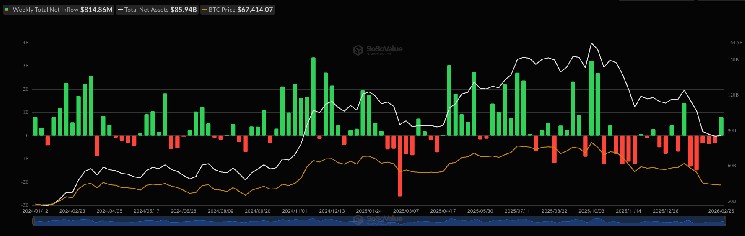
The numbers tell a compelling story of renewed investor interest. Over just three trading days, these bitcoin ETFs pulled in an impressive $1.1 billion in fresh capital, according to tracking data from SoSoValue. When you factor in Monday’s outflow against these three days of positive momentum, the funds are sitting approximately $815 million ahead for the week – making this their strongest weekly performance since the week ending January 16, when they attracted $1.4 billion. This kind of swing from persistent outflows to substantial inflows doesn’t happen by accident; it suggests something fundamental has shifted in how investors are viewing bitcoin as an asset class. Whether this represents a temporary bounce or the beginning of a sustained trend remains to be seen, but the magnitude of the reversal has certainly captured the attention of financial analysts and crypto enthusiasts alike.
BlackRock and Grayscale Lead the Charge
Looking at which funds are driving this renewed interest provides additional insight into the story. BlackRock’s iShares Bitcoin Trust, known by its ticker IBIT, has emerged as the clear leader, accounting for more than half of the three-day inflow with approximately $652 million flooding into the fund. This shouldn’t come as a complete surprise – BlackRock’s reputation as one of the world’s largest and most respected asset managers has given many institutional investors the comfort level they needed to enter the bitcoin space. Perhaps even more intriguing is what happened with Grayscale’s GBTC fund on Wednesday. Despite carrying the highest fees among all the bitcoin ETFs – a factor that had previously driven investors away in droves – GBTC posted its largest single-day inflow since it converted from its original trust structure to an ETF format. This development is particularly noteworthy because it suggests investors are becoming less fee-sensitive and more focused on gaining bitcoin exposure, regardless of the cost.
Reading the Market Signals: What the Coinbase Premium Tells Us
For those who follow cryptocurrency markets closely, certain indicators serve as reliable gauges of institutional sentiment and buying pressure from specific regions. One of the most watched metrics is the Coinbase Premium Index, which compares bitcoin prices on Coinbase – the primary exchange used by U.S. institutions and investors – with prices on the broader global market. When U.S. buyers are aggressively purchasing bitcoin, the price on Coinbase typically trades at a premium to global prices. After spending 40 days in negative territory, meaning U.S. investors were less enthusiastic than their global counterparts, this index has flipped positive again. This shift reinforces the conclusion that American demand for bitcoin is genuinely returning, not just temporarily spiking. The Coinbase Premium turning positive alongside these ETF inflows creates a compelling narrative: U.S. institutional investors and firms, who had been sitting on the sidelines or even reducing their exposure, are once again viewing bitcoin as an attractive investment opportunity worthy of capital allocation.
Growing Holdings Despite Price Volatility
The relationship between ETF holdings and bitcoin’s price presents an interesting paradox that reveals much about current market dynamics. Data from Checkonchain shows that total bitcoin holdings across all U.S. spot ETFs have climbed to 1.29 million BTC, putting their total assets under management less than 10% below the peak level reached in October. This is remarkable when you consider that bitcoin’s spot price remains 45% below its October record high. In other words, while bitcoin itself has experienced significant price depreciation, the amount of bitcoin held in ETFs has remained relatively stable and is even growing again. The largest cryptocurrency has spent this week consolidating in the mid-$60,000 range, a far cry from the highs that sparked widespread media coverage months ago. Yet investors are accumulating through ETFs regardless, suggesting that many view current prices as an attractive entry point rather than a warning sign. This disconnect between price action and accumulation patterns often occurs when longer-term investors see temporary weakness as a buying opportunity rather than a reason to panic.
The Futures Market Tells Another Part of the Story
While ETF inflows grab headlines, sophisticated market observers also pay close attention to what’s happening in bitcoin futures markets, particularly on the Chicago Mercantile Exchange (CME), where institutional traders operate. According to Glassnode data, open interest on the CME – essentially the total number of outstanding futures contracts – has continued declining, falling to 107,780 BTC. This detail might seem technical, but it actually provides important context for interpreting the ETF inflows. The CME allows institutions to execute what’s known as a “basis trade,” where they simultaneously take a long position in spot bitcoin (betting the price will rise) while taking a short position in bitcoin futures (betting the price will fall). This strategy allows them to profit from the price difference between spot and futures markets while remaining relatively neutral on bitcoin’s actual direction. The fact that CME futures open interest is declining while ETF inflows are surging suggests that the money flowing into ETFs represents genuine bullish conviction – outright long positions from investors who simply want bitcoin exposure – rather than the neutral basis trade strategy. This distinction matters because it indicates real demand and conviction rather than arbitrage plays, which could reverse quickly when the opportunity disappears. The combination of rising ETF holdings, a positive Coinbase Premium, and declining futures positions paints a picture of authentic renewed American institutional interest in bitcoin as an investment asset, setting the stage for what could be an interesting period ahead in cryptocurrency markets.