

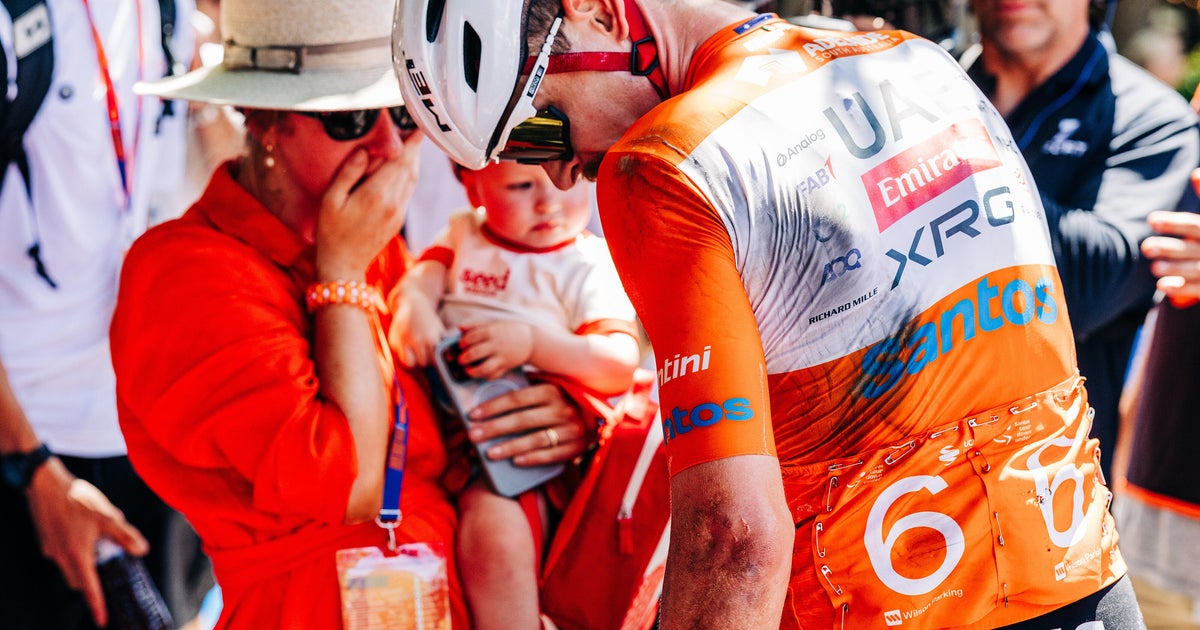

The Most Australian Crash Ever: Jay Vine’s Kangaroo Collision and Tour Down Under Victory
A Bizarre Wildlife Encounter on the Final Stage
In what has been dubbed “the most Australian crash ever seen,” professional cyclist Jay Vine experienced every rider’s worst nightmare—or perhaps every Australian cyclist’s most predictable fear—when he was knocked off his bike by a kangaroo during the final stage of the Tour Down Under. The incident occurred on Sunday during the 2026 World Tour’s opening event, with approximately 96 kilometers still remaining in the challenging 169.8-kilometer stage that wound through the picturesque hills surrounding Adelaide. Video footage captured by SBS Sport showed the dramatic moment when two large kangaroos suddenly bounded onto the road during a high-speed section of the race, causing chaos among the tightly packed group of cyclists. The scene was almost surreal: professional athletes sprawled on the ground, expensive racing bikes scattered across the asphalt, while a confused kangaroo hopped frantically across the road, trying desperately to navigate through the throng of competitors it had just disrupted. Despite the seemingly comedic nature of the incident, the consequences were serious—three riders were forced to abandon the race entirely, and tragically, one of the kangaroos involved had to be euthanized due to its injuries, while the second managed to escape apparently unharmed.
Vine’s Resilience in the Face of Mounting Adversity
What makes Jay Vine’s ultimate victory even more remarkable is the extraordinary amount of adversity he faced throughout the race, particularly in the final two stages. Entering the last stage, Vine held a comfortable lead of 1 minute and 3 seconds in the general classification, but his team had already been severely weakened by crashes the previous day. During Saturday’s fourth stage, two crucial members of his UAE Team Emirates squad had been forced to withdraw, including defending champion Jhonatan Narvaez, who had been sitting in second place at the time. Then, on Sunday morning before the kangaroo incident even occurred, Juan Sebastian Molano abandoned the tour due to fatigue, leaving Vine with only two remaining teammates for the critical final stage: Portuguese rider Ivo Emanuel Oliveira and Britain’s Adam Yates. This meant that Vine was heading into the most challenging stage of the race with minimal team support, a significant disadvantage in professional cycling where teamwork and strategy often make the difference between victory and defeat. After the kangaroo collision, many would have forgiven Vine for losing hope or at least his competitive edge, but the Australian champion demonstrated remarkable resilience and determination that would define his victory.
The Immediate Aftermath and Quick Recovery
Immediately following his collision with the kangaroo, Vine showed the kind of professional composure and physical toughness that separates champions from ordinary competitors. He got up from the crash almost instantly, quickly assessed his situation, and set about getting back into the race. He changed bikes twice in rapid succession—a necessary step to ensure he had equipment that hadn’t been damaged in the collision—and then set off in pursuit of the peloton, rejoining the main group of riders with approximately 92 kilometers still remaining in the stage. This quick response was crucial because in professional cycling, even a brief separation from the peloton can result in an insurmountable time gap that ends any hopes of overall victory. Once back in the peloton, Vine didn’t simply hide in the middle of the pack to conserve energy and protect his general classification lead; instead, he positioned himself near the front of the group for the remainder of the stage, showing both physical strength and tactical awareness. This forward position allowed him to respond to any attacks from rivals and avoid being caught behind any crashes or mechanical problems that might occur in the closing kilometers of the race.
Understanding the Kangaroo Threat in Australian Cycling
After securing his second Tour Down Under victory in three years, Vine offered insights into a danger that might seem exotic to international cyclists but is a well-known hazard for Australian riders. “Everyone asks me what’s the most dangerous thing in Australia and I always tell them it’s kangaroos,” Vine explained in his post-race comments. “They wait and they hide in the bushes until you can’t stop and they jump out in front of you. Point proven today.” He went on to describe the specific mechanics of his crash: “Two of them blasted through the peloton when we were doing probably 50 kph (30 mph) and one of them stopped and went left, right, left right, left right and I ended up hitting its backside.” This description highlights the unpredictable nature of kangaroo behavior and why they pose such a significant threat to cyclists. Unlike most animals that flee in a straight line when startled, kangaroos can change direction multiple times in rapid succession, making it nearly impossible for a cyclist traveling at high speed to predict their movement and avoid collision. The incident also affected other teams’ strategies for the stage, with Matthew Brennan of Britain’s Team Visma commenting after his stage win: “It wasn’t ideal. We had Menno [Huising] who usually coordinates a lot [of the lead out for the sprint], but he got smacked on by a kangaroo, so that wasn’t great.”
The Final Stage Challenge and Ultimate Victory
The final stage of the Tour Down Under presented a formidable challenge even without the kangaroo incident, featuring eight laps of a demanding circuit that included a slow, steep climb to the finish line in the township of Stirling. This type of finishing circuit, with its repeated climbing sections, tests both the physical endurance and mental fortitude of riders who have already completed five days of racing. Throughout the stage, there were two significant breakaway attempts—groups of riders who tried to escape from the main peloton to gain time advantage. However, both breakaways were ultimately unsuccessful, with the second group being caught by the peloton with just one kilometer remaining, setting up a dramatic finale to the race. Despite all the chaos, crashes, and wildlife encounters, Vine managed to maintain his overall lead and crossed the finish line with his 1 minute and 3 seconds advantage intact. Mauro Schmid of Switzerland, riding for Team Jayco Alula, finished in second place overall, while Harry Sweeny from EF Education-Easypost claimed third place, finishing nine seconds behind Schmid. The stage itself was won by Matthew Brennan of Britain in a sprint finish, ahead of New Zealand’s Finn Fisher-Black and Denmark’s Tobias Lund Andresen.
Reflecting on a Race Defined by Perseverance
Standing on the podium after one of the most dramatic victories in recent cycling history, Vine reflected on the rollercoaster journey that had been his Tour Down Under campaign. “This year we started off really positive and we just had more and more bad luck as the race went on,” he acknowledged. “Today was never going to be easy and I’ve been saying all week it’s not over until it’s over. But it’s proven to be not over till it’s over in this race for us.” These words capture not just the specific challenges of this particular race, but also the broader philosophy that separates champions from other competitors: the ability to persevere when circumstances turn against you, to maintain focus and determination when everything seems to be going wrong, and to find a way to succeed even when luck is decidedly not on your side. Vine’s victory serves as a reminder that in professional cycling, as in life, success often depends less on avoiding adversity than on how you respond when adversity inevitably arrives. For Vine, that meant getting up immediately after being knocked down by a kangaroo, changing bikes, chasing back to the peloton, and then having the mental and physical strength to defend his lead through the final challenging kilometers of the race. As the first event of the 2026 World Tour, the race set a high bar for drama and provided cycling fans with a story that perfectly blends the sport’s demanding nature with the unique character of Australian racing—where kangaroos aren’t just tourist attractions, but legitimate competitive hazards.