



Russian Customs Thwarts Massive Meteorite Smuggling Operation
Billion-Year-Old Space Rock Intercepted at Saint Petersburg Port
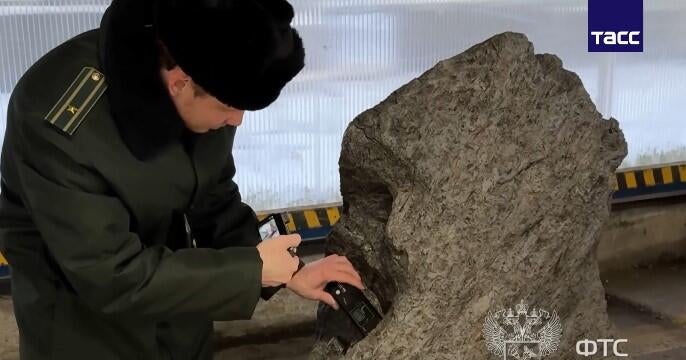
In what reads like a plot from a thriller novel, Russian customs officials have successfully intercepted an audacious attempt to smuggle a colossal piece of space history out of the country. The Federal Customs Service announced Thursday that they had prevented a massive meteorite fragment, weighing an impressive 2.8 tons, from being illegally transported to Britain. What makes this case particularly brazen is how the smugglers attempted to conceal their illicit cargo – by disguising this ancient celestial visitor as nothing more than an ordinary garden ornament. The fragment is believed to be part of the famous Aletai meteorite, one of the largest iron meteorites ever discovered on our planet, making this interception not just a legal victory but also a significant preservation of scientific heritage.
The Discovery: When a “Garden Sculpture” Turned Out to Be Worth Millions
The dramatic discovery unfolded at the bustling port of Saint Petersburg, where customs officers were conducting routine inspections of shipping containers destined for international destinations. According to the customs service statement, the “strategically important cargo” was flagged during standard security checks. Video footage released by authorities shows officers carefully prying open a wooden crate, revealing the fragment’s distinctive grey, rugged surface – a far cry from the typical garden decoration one might find at a home improvement store. The declaration documents for the shipment listed the contents as a simple garden sculpture, but something about the cargo raised red flags for the vigilant inspectors. Upon closer examination, officials discovered that both the origin and the actual value of the item bore no resemblance to what had been declared in the shipping paperwork. The fragment’s estimated worth tells the real story: approximately 323 million rubles, which translates to a staggering $4.2 million – quite the expensive garden ornament by anyone’s standards.
The Mystery Buyer and Criminal Investigation
While Russian authorities have been forthcoming about the details of the interception itself, they’ve remained notably tight-lipped about certain key aspects of the case. The Federal Customs Service’s statement conspicuously omitted any information about who exactly was attempting to import this valuable piece of cosmic history, revealing only that the fragment’s final destination was somewhere in the United Kingdom. This silence has sparked numerous questions: Was this the work of a private collector with deep pockets and questionable ethics? Could it have been destined for the black market of meteorite trading? Or perhaps a wealthy individual looking to own a piece of the cosmos, regardless of legality? What we do know is that Russian prosecutors have wasted no time in launching a criminal investigation into the attempted smuggling operation. The case highlights the shadowy world of meteorite trafficking, where objects of immense scientific value are sometimes treated as mere commodities to be bought and sold to the highest bidder, with little regard for their importance to scientific research or their legal status.
The Aletai Meteorite: A 4.5-Billion-Year-Old Treasure
To truly appreciate the significance of this interception, one must understand what the Aletai meteorite represents. This remarkable space traveler was first discovered in western China back in 1898, more than a century ago, yet scientists believe the meteorite itself is at least 4.5 billion years old – making it nearly as ancient as our solar system itself. Think about that for a moment: this chunk of iron and rock has been drifting through space since before Earth had continents, before the first single-celled organisms appeared in our oceans, even before our planet had fully formed. While researchers know when the meteorite was found, the exact timing of when it actually slammed into Earth’s surface remains a mystery, lost somewhere in the depths of geological time. What isn’t mysterious, however, is that such cosmic visitors continue to arrive on our planet with some regularity, each one offering scientists a unique window into the composition and history of our early solar system.
The Scientific and Ethical Dimensions of Meteorite Trading
The attempted smuggling of this Aletai fragment has reignited important conversations within the scientific community about the ethics of meteorite commerce. Scientists have increasingly voiced their concerns about the private sale and trade of meteorites, which they argue should be preserved for research purposes rather than ending up in private collections or, worse, lost to science entirely. These ancient rocks aren’t just valuable because of their rarity or their impressive appearance – they’re literally time capsules from the birth of our solar system, holding crucial information about the conditions that existed billions of years ago. Each meteorite carries within it clues about the composition of the early solar system, the processes that formed planets, and the building blocks that eventually led to life on Earth. When these specimens disappear into private hands, that knowledge becomes inaccessible to researchers who could use it to advance our understanding of cosmic history. The Aletai meteorite shares a similar age with another meteorite that made headlines last year when it dramatically crashed through the roof of a home in Georgia, United States – an event witnessed by dozens of people who saw it blazing across the sky as a fireball in broad daylight, demonstrating how these ancient visitors continue to arrive on Earth in spectacular fashion.
The Bigger Picture: Protecting Scientific Heritage
This interception at Saint Petersburg represents more than just the prevention of one smuggling operation – it’s a reminder of the ongoing challenges in protecting items of scientific and historical significance from illegal trade. The fact that smugglers would go to such elaborate lengths, creating false documentation and concealing a 2.8-ton rock as a garden ornament, speaks to the lucrative nature of the meteorite black market and the lengths to which some people will go to profit from these irreplaceable scientific specimens. For Russia, declaring this cargo as “strategically important” sends a clear message about how seriously they take the preservation of such artifacts. The criminal investigation now underway will hopefully shed light on the network behind this smuggling attempt and potentially prevent future incidents. As our understanding of the universe continues to expand and our curiosity about our cosmic origins grows stronger, the value – both monetary and scientific – of meteorites will likely continue to rise. This makes the work of customs officials, law enforcement, and scientific institutions in protecting these ancient visitors all the more critical. The successful interception of this Aletai fragment ensures that this 4.5-billion-year-old piece of cosmic history will remain available for scientific study rather than becoming an extraordinarily expensive conversation piece in someone’s private collection, preserving humanity’s collective heritage for future generations of researchers and space enthusiasts to study and appreciate.