


Pope Leo XIV Issues Urgent Plea for Peace in Middle East Conflict
Historic Appeal from America’s First Pontiff
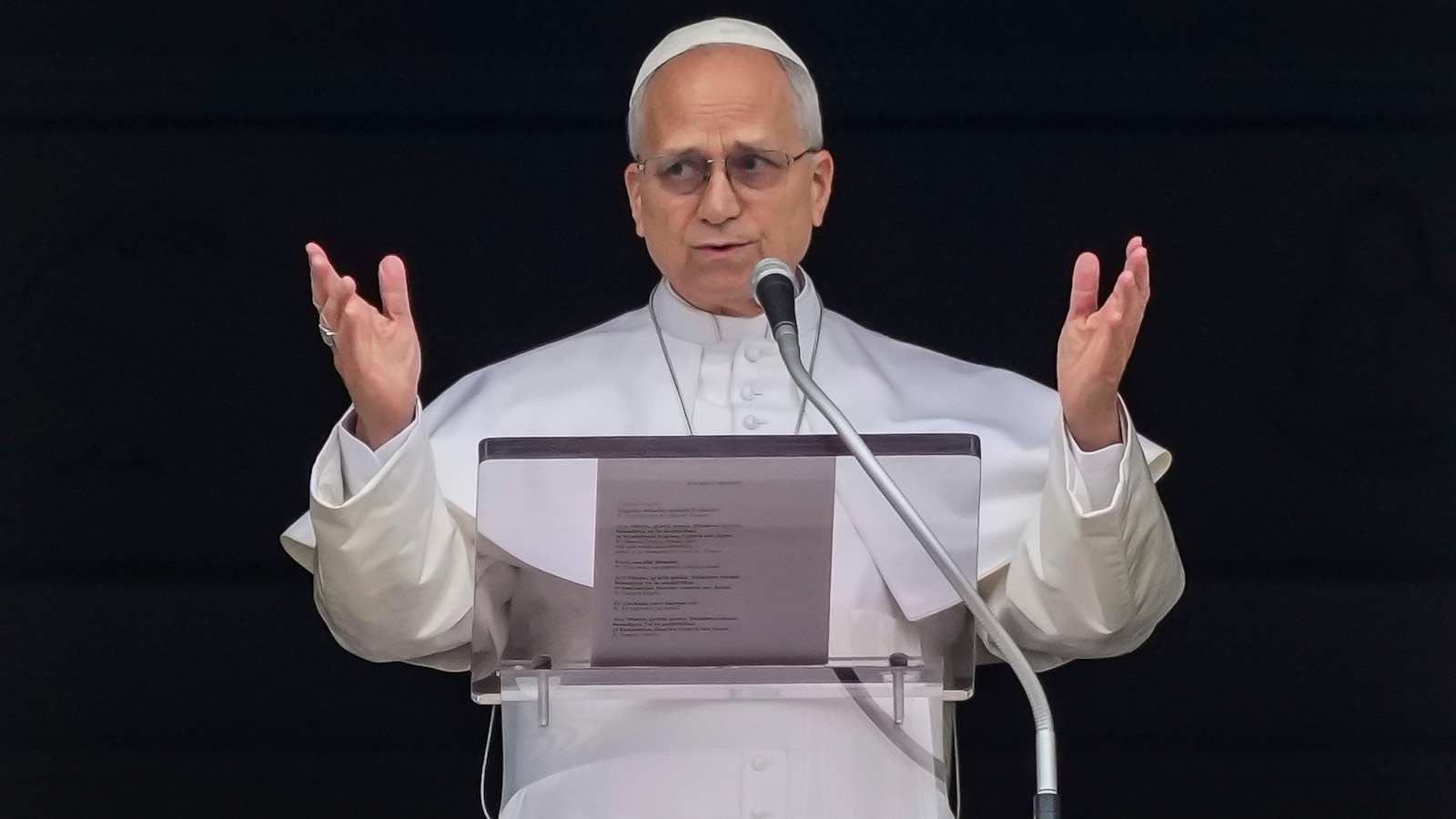
In an unprecedented moment that underscores the gravity of the ongoing Middle East crisis, Pope Leo XIV has broken his previous restraint to issue his most forceful call yet for an immediate ceasefire. Speaking from the Vatican during his customary Sunday noon blessing, the pontiff—who holds the distinction of being the first American to occupy the Chair of Saint Peter—directed his words squarely at the leaders responsible for initiating the military operations in Iran. His message was clear and uncompromising: the violence must stop, and it must stop now. “On behalf of the Christians of the Middle East and all women and men of good will, I appeal to those responsible for this conflict,” Leo declared to the gathered faithful and watching world. “Cease fire so that avenues for dialogue may be reopened. Violence can never lead to the justice, stability, and peace that the people are waiting for.” These words represent a significant escalation in the Pope’s public stance on a conflict that has already claimed hundreds of lives and threatens to destabilize an already volatile region.
The Tragedy That Cannot Be Ignored
While Pope Leo XIV carefully avoided naming the United States or Israel explicitly in his remarks—a diplomatic approach consistent with Vatican tradition—his references left little doubt about which incidents had compelled him to speak out more forcefully. The Pope specifically mentioned attacks that had targeted schools, a clear allusion to the devastating missile strike on an elementary school in the Iranian city of Minab during the opening days of the conflict. That single attack claimed the lives of more than 165 people, with a heartbreaking number of the victims being children whose lives were cut short before they truly began. The tragedy of Minab has become a rallying point for those questioning the conduct of the war, and U.S. officials have acknowledged that outdated intelligence likely led to the catastrophic error. An investigation is reportedly ongoing, though for the families burying their children, no investigation can undo the irreversible harm.
The Vatican itself has made a deliberate choice to ensure the world does not look away from the human cost of this conflict. On March 6th, L’Osservatore Romano, the Holy See’s official newspaper, ran a stark aerial photograph on its front page showing the mass grave being excavated to receive the young victims of the Minab strike. The headline accompanying this haunting image simply read “The Face of War”—three words that spoke volumes about the Church’s position on the unfolding tragedy. This editorial decision represented more than just news coverage; it was a moral statement, a visual sermon about the price being paid by the innocent. In his Sunday remarks, Pope Leo expressed his closeness to all the families who have lost loved ones in attacks “which have hit schools, hospitals and residential centers”—a litany of civilian infrastructure that should, under international humanitarian law, be protected from military action.
Lebanon’s Christians and a Broader Humanitarian Crisis
Pope Leo XIV’s concern extends beyond Iran to encompass the wider regional implications of the conflict, with particular attention being paid to Lebanon. The pontiff expressed specific worry about the situation developing there, where international aid organizations are issuing increasingly urgent warnings about an emerging humanitarian crisis. The potential suffering of millions of civilians caught in the crossfire of a war they did not choose weighs heavily on the papal conscience, but there is also a more particular concern at play. The Christian communities of southern Lebanon have long held special significance for the Vatican, representing as they do a vital and historic Christian presence in a predominantly Muslim region. These communities have survived wars, occupations, and upheavals throughout the centuries, serving as a living link to the earliest days of Christianity in the lands where the faith first took root.
For the Vatican, the preservation of these Christian communities is not merely a matter of religious demographics; it represents the continuation of a diverse, pluralistic Middle East where people of different faiths can coexist. The Christians of Lebanon and the broader region have often served as bridges between East and West, between Islam and Christianity, and their decline or displacement would impoverish not only the Middle East but the global Church as well. The Pope’s reference to them in his appeal underscores that this conflict threatens not just immediate lives but the long-term fabric of Middle Eastern society. As the war continues, these ancient communities find themselves once again vulnerable, caught between forces beyond their control, their future uncertain as military strategies play out around them.
A Delicate Diplomatic Balancing Act
The evolution of Pope Leo XIV’s public statements on this conflict reveals the extraordinarily difficult position he occupies as both a spiritual leader with global moral authority and as the first American to serve as Supreme Pontiff. For the first two weeks following the outbreak of the U.S.-Israeli military operations, Leo limited himself to more general appeals for diplomacy and dialogue, carefully avoiding language that might position him as a direct political opponent of President Donald Trump. This restraint appears to have been a calculated attempt to preserve his ability to serve as a potential mediator while avoiding the perception that he was leveraging his papal office for partisan American political purposes. The Pope’s unique background as an American means that any statement he makes regarding U.S. military action carries additional layers of complexity and will inevitably be analyzed through the lens of domestic American politics.
However, as the humanitarian toll has mounted and the images of suffering have multiplied, the Pope’s language has necessarily strengthened, even as he has maintained the Vatican’s traditional practice of diplomatic neutrality by not explicitly naming nations. This tradition serves a practical purpose: it allows the Holy See to maintain relationships with all parties and thus potentially serve as an honest broker or facilitator of dialogue. In a speech to priests on Friday, before his Sunday appeal, Leo offered what many interpreted as an indirect criticism of those prosecuting the war, asking pointedly: “Do those Christians who bear grave responsibility in armed conflicts have the humility and courage to make a serious examination of conscience and to go to confession?” The question was theological in form but unmistakably pointed in substance, challenging powerful decision-makers to consider the moral weight of their choices.
Voices Within the Church Speak More Bluntly
While Pope Leo XIV has walked this careful diplomatic line, several prominent American cardinals and the Vatican Secretary of State have felt less constrained in their criticism, perhaps providing a fuller picture of the Church’s collective concern while allowing the Pope himself to maintain a posture of potential mediation. Cardinal Robert McElroy, who serves as the Archbishop of Washington—a position placing him at the very heart of American political power—declared the war “morally unjustifiable,” a stark assessment that left no room for ambiguity. Similarly, Cardinal Blase Cupich of Chicago directed his criticism not just at the war itself but at the way it was being presented to the American public, calling it “sickening” that the White House was incorporating video game imagery into its social media messaging about the conflict. This criticism struck at something particularly troubling: the aestheticization and gamification of real violence, the transformation of actual human suffering into content designed for viral spread and engagement.
The Vatican Secretary of State, Cardinal Pietro Parolin, who serves as the Holy See’s chief diplomat, has also weighed in substantively on the conflict. He explicitly rejected Washington’s characterization of the military action as a “preventive war,” challenging the legal and moral framework the United States has offered to justify its operations. Yet even as he offered this criticism, Cardinal Parolin emphasized that the Vatican was maintaining open channels of communication with all parties. “The Holy See speaks with everyone,” he explained, “and when necessary we speak also with the Americans, with the Israelis and show them what to us are the solutions.” This statement encapsulates the Vatican’s approach: moral clarity about the unacceptability of the current situation combined with persistent diplomatic engagement aimed at finding a path toward peace. The Church’s two-thousand-year history has taught it that sometimes the path to ending violence requires talking with those perpetrating it, however difficult or morally complicated those conversations might be.
The Church’s Enduring Commitment to Peace
Pope Leo XIV’s strengthening call for a ceasefire represents more than just a response to one particular conflict; it reflects the Catholic Church’s fundamental commitment to peace as a cornerstone of its social teaching. Throughout the post-World War II era, successive popes have articulated an increasingly robust theology of peace, moving from acceptance of traditional “just war” theory toward an almost absolute rejection of modern warfare as a legitimate tool of statecraft. The Second Vatican Council’s document Gaudium et Spes declared that “the whole human race faces a moment of supreme crisis in its advance toward maturity” regarding war, and subsequent papal teaching has only reinforced this concern. In an age of precision weapons that nonetheless kill schoolchildren, of conflicts that create humanitarian disasters affecting millions, and of military actions that risk spiraling into regional conflagrations, the Church’s insistence on dialogue over violence takes on prophetic urgency.
As the conflict continues, Pope Leo XIV finds himself in the extraordinarily difficult position of trying to be a voice for the voiceless—for the children of Minab, for the Christian communities of Lebanon, for all those who suffer regardless of their nationality or faith—while also maintaining the diplomatic relationships that might allow the Vatican to contribute to an eventual resolution. His appeal for a ceasefire is unlikely to immediately change the calculations of military planners or political leaders, but it does something equally important: it reminds the world that there is a moral dimension to these decisions that transcends strategy and national interest. In calling for the violence to stop so that “avenues for dialogue may be reopened,” the Pope is asserting that there is always an alternative to war, that talking—however difficult—is always preferable to killing. Whether that message will be heeded remains to be seen, but in speaking it clearly and with growing force, Pope Leo XIV is fulfilling one of the most important duties of his office: being a witness to peace in a world that too often chooses violence.