

Betrayed and Abandoned: The Bangladeshi Workers Sold Into Russia’s War
The False Promise of a Better Life
In the verdant countryside of Lakshmipur, Bangladesh, where poverty drives families to seek work abroad, Maksudur Rahman made a decision that would nearly cost him his life. A labor recruiter approached him with what seemed like an attractive opportunity—a janitorial position in Russia paying between $1,000 and $1,500 monthly, with the tantalizing possibility of permanent residency. Having just completed a work contract in Malaysia, Rahman saw this as his next opportunity to support his family. He borrowed money to pay the hefty recruitment fee of approximately $9,800 and embarked on a journey to Moscow in December 2024, dreaming of steady work in the frigid Russian winter. What awaited him, however, was not mops and cleaning supplies, but military training, weapons, and a one-way ticket to the trenches of Ukraine. Within weeks of arriving in Russia, Rahman found himself not in a janitor’s uniform but in combat fatigues, thrust into the brutal reality of modern warfare—a victim of a sophisticated human trafficking operation that has ensnared dozens, possibly hundreds, of desperate Bangladeshi workers.
An Associated Press investigation has uncovered a disturbing pattern of deception targeting some of the world’s most vulnerable workers. Bangladeshi men, lured by promises of civilian employment, were instead forced into military service on the front lines of Russia’s war in Ukraine. Through interviews with three men who managed to escape, along with families of missing workers and documents including travel papers, Russian military contracts, medical reports, and photographs, the AP has pieced together a harrowing story of exploitation, coercion, and violence. These workers were not merely misled about their job duties—they were effectively sold into military servitude, threatened with imprisonment, violence, or death if they refused to fight. The recruiter’s promise of janitorial work or factory jobs transformed into a nightmare of drone attacks, artillery barrages, and the grim task of recovering dead bodies from battlefields. Neither the Russian Defense Ministry, the Russian Foreign Ministry, nor the Bangladeshi government responded to questions about these allegations, leaving the families of the missing and the men who escaped without official acknowledgment of their suffering.
From Workers to Soldiers: The Bait and Switch
The mechanics of the deception were brutally simple. Upon arriving in Moscow, Rahman and other Bangladeshi workers were presented with documents written entirely in Russian. Trusting the recruiters who had brought them there and believing these were standard employment contracts for cleaning services, the men signed. Only later did they discover these were actually military contracts binding them to service in the Russian army. Rahman and his companions were transported to a military facility far from Moscow, where the charade finally dropped. They were issued weapons and subjected to three days of intensive training covering firearms operation, combat advancement techniques, and basic first aid. The training continued at a barracks near the Russia-Ukraine border before the men were deployed to front-line positions, where they were ordered to dig defensive pits inside bunkers and perform the most dangerous tasks in combat zones.
The Russian approach to utilizing these unwilling foreign fighters was particularly callous. “The Russians would take a group of say, five Bangladeshis. They would send us in front and stay at the back themselves,” Rahman recalled. The Bangladeshi workers were used as a human buffer, sent ahead of Russian troops to absorb the initial risks of Ukrainian defensive fire. When Rahman protested that this was not the work he had agreed to perform, a Russian commander’s response, delivered through a translation app, made the situation horrifyingly clear: “Your agent sent you here. We bought you.” The workers had been commodified, purchased like equipment for the war effort. Those who resisted faced systematic brutality. Rahman and others were threatened with ten-year prison sentences and subjected to regular beatings. “They’d say, ‘Why don’t you work? Why are you crying?’ and kick us,” he explained. The violence served a dual purpose—punishment for resistance and coercion to ensure compliance with orders that could easily result in death.
Different Lies, Same Destination
Not all the Bangladeshi workers were recruited with promises of janitorial work. Mohan Miajee’s path to the Ukrainian front lines began with a legitimate job as an electrician at a gas-processing plant in Russia’s remote far east. When that position proved unbearable due to harsh working conditions and relentless cold, Miajee searched online for alternative employment. A Russian army recruiter contacted him with what seemed like a reasonable proposal. When Miajee expressed moral reservations about killing, the recruiter assured him that his electrical skills made him perfect for an electronic warfare or drone unit that would operate far from combat zones. It was another lie in a web of deception designed to funnel workers into the meat grinder of war.
After signing military papers in January 2025, Miajee was taken to a military camp in the captured Ukrainian city of Avdiivka. He presented the camp commander with documentation of his electrical experience and explained that his recruiter had promised him electrical work. The commander’s response shattered any remaining illusions: “You have been made to sign a contract to join the battalion. You cannot do any other work here. You have been deceived.” What followed was a regime of violence and forced labor. Miajee was beaten with shovels, handcuffed, and tortured in a cramped basement cell whenever he refused orders or made mistakes. Language barriers compounded the abuse—simple misunderstandings resulting from translation difficulties led to severe beatings. “If they told us to go to the right and we went to the left, they would beat us severely,” he explained. Rather than working with electronics, Miajee was forced to carry supplies to front-line positions and perform the grim task of collecting dead bodies from battlefields.
Escape and the Missing
Rahman’s escape came through injury—a perverse stroke of luck in a situation devoid of good fortune. During one mission to evacuate a wounded Russian soldier, Rahman’s group came under drone attack. Ukrainian drones swarmed their position, firing repeatedly. The Russian soldier supposedly guiding them fled, abandoning the Bangladeshi workers in a minefield with nowhere safe to advance or retreat. Rahman eventually sustained a leg wound serious enough to send him to a hospital near Moscow. Rather than returning to his unit after treatment, he fled directly to the Bangladeshi embassy in Moscow, which prepared travel documents allowing him to leave Russia. This escape route proved replicable—Rahman later helped his brother-in-law Jehangir Alam, who also spoke to the AP, escape using the same method of leaving hospital care after being wounded and appealing to embassy officials.
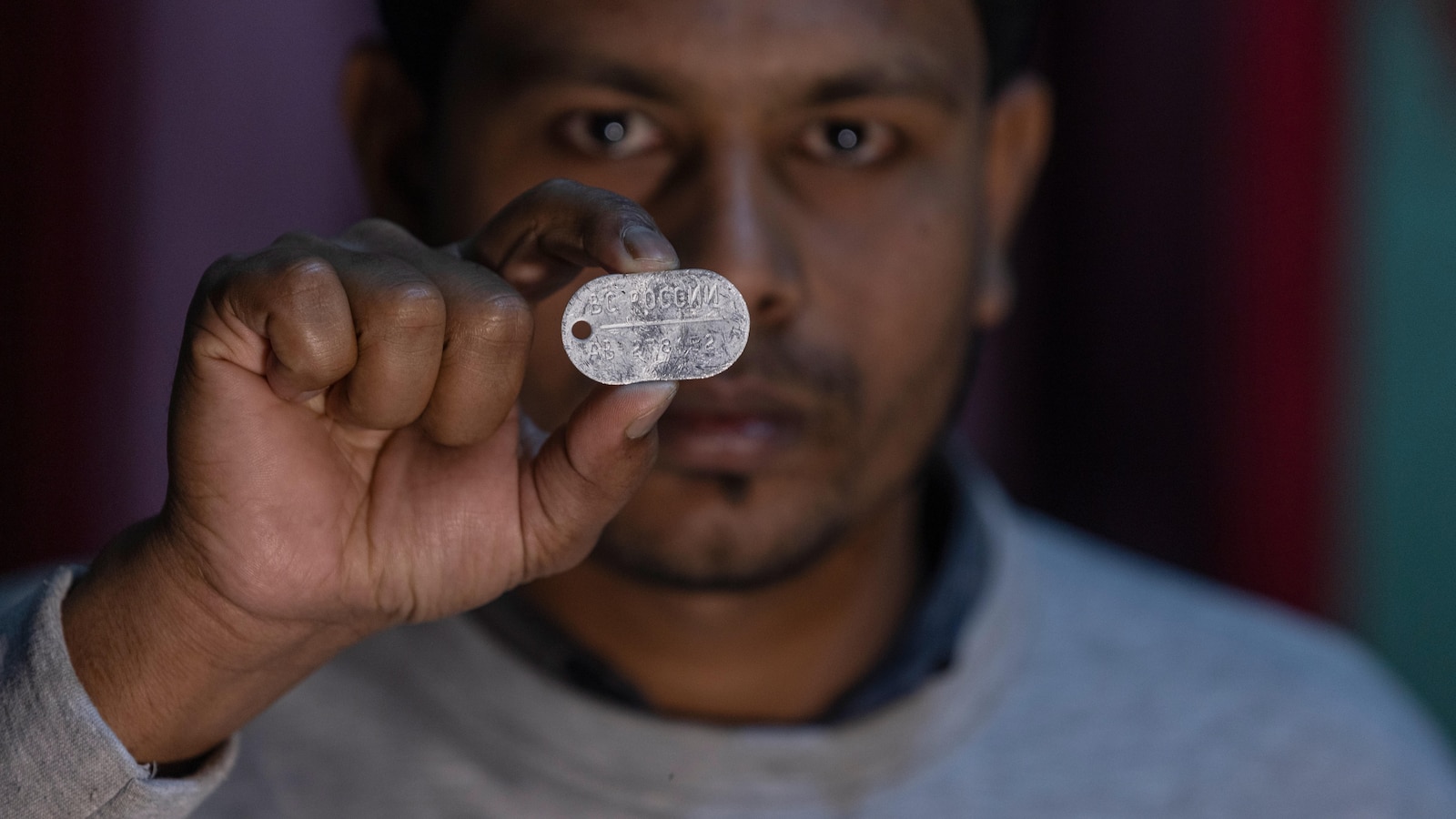
For many families back in Lakshmipur, however, there has been no such resolution. They cling desperately to whatever documents their missing loved ones managed to send before communications ceased entirely—photos of Russian business visas, military contracts, and army dog tags. These documents, verified by Russian groups helping men evade or escape military service, represent the families’ only tangible connection to sons, husbands, and fathers who vanished into the war. The contracts bear the signature of Major Vladimir Yaltsev, head of the Kostroma regional recruitment center for contract military service, signing on behalf of the Russian military. In their final messages, these men conveyed to relatives that they were being forcibly taken to the front lines in Ukraine. Then all communication stopped. The families filed complaints with police in Dhaka and made three separate trips to the capital attempting to pressure the government to investigate, but official response has been minimal.
Voices of the Families Left Behind
Salma Akdar has heard nothing from her husband, Ajgar Hussein, since March 26. In their last conversation, the 40-year-old father of two told her he had been sold to the Russian army. Hussein had left in mid-December 2024, believing he was being offered work as a laundry attendant in Russia. He had recently returned from Saudi Arabia and planned to take a break from overseas work, but the promise of opportunities in Russia proved too attractive to resist. He sold some of his land to pay the agent’s fees, a common practice among Bangladeshi workers who lack capital but possess assets that can be liquidated for recruitment costs. For two weeks, Hussein maintained regular contact with his wife and their two sons, ages seven and eleven. Then he told her he was being taken to an army camp for weapons training and instruction in carrying heavy loads up to eighty kilograms. “Seeing all this, he cried a lot and told them, ‘We cannot do these things. We have never done this before,'” his wife recounted.
For two months, Hussein was offline entirely. When he briefly reappeared, he explained they were being forced to fight in the war. Russian commanders “told him that if he did not go, they would detain him, shoot him, stop providing food,” Akdar said. When families in the village confronted the recruiting agent, demanding to know why their loved ones were receiving military training, the agent dismissed their concerns, insisting that such training was standard procedure in Russia, even for launderers. Hussein’s final message to his wife was a simple audio note: “Please pray for me.” Mohammed Siraj’s story is even more heartbreaking. His 20-year-old son Sajjad departed Bangladesh believing he would work as a chef in Russia, hoping to support his unemployed father and chronically ill mother. When Sajjad was forced into military training, he fought with his Russian commanders, insisting he had come to be a chef, not a soldier. They threatened him with jail, then with execution. In February, Siraj learned through another Bangladeshi man serving alongside his son that Sajjad had been killed in a drone attack. Unable to bear telling his wife the truth, Siraj assured her their son was doing well. But word spread through their village, and she confronted him with the lie. Soon after learning the truth, she died, calling out for her son in her final moments.
A Trafficking Network and Official Silence
The exploitation of Bangladeshi workers represents an organized trafficking operation spanning multiple countries and involving various actors profiting from human misery. In late 2024, when families approached BRAC, an organization advocating for Bangladeshi workers, reporting they could no longer reach relatives in Russia, the organization began investigating and uncovered at least ten Bangladeshi men still missing after being lured to fight. “There are two or three layers of people who are profiting,” explained Shariful Islam, head of BRAC’s migration program. Bangladeshi police investigators uncovered a trafficking ring after a worker returned in January 2025 alleging he had been deceived into fighting. The investigation revealed networks operated by Bangladeshi intermediaries with connections to the Russian government, facilitating the entry of workers into Russia under false pretenses. The AP reviewed a police report filed by one victim’s wife, who said her husband went to Russia expecting to work in a chocolate factory.
According to police investigator Mostafizur Rahman, about forty Bangladeshis may have lost their lives in the war, though the true number remains unclear. The investigation revealed that some workers now go willingly, fully aware they will end up on front lines, because the monetary compensation is too attractive to refuse in desperately poor regions like Lakshmipur. The local agent there was found to be funneling recruits to a central agent associated with a company called SP Global, which did not respond to AP inquiries and apparently ceased operations in 2025. The families of missing men report they have not received any money their loved ones may have earned. Miajee, who escaped, said he was never paid for his service. The human cost extends beyond those killed or missing. Salma Akdar, still waiting for news of her husband, expresses the anguish of those left behind: “I don’t want money or anything else. I just want my children’s father back.” Yet official silence persists—no response from Russian authorities, no substantive action from the Bangladeshi government, leaving the families of the missing in limbo, clutching documents and fading hopes that their loved ones might somehow return from a war they never chose to fight.