


Sacred Land Under Threat: Nine Tribes Unite to Stop Black Hills Drilling Project
A Historic Alliance Forms to Protect Pe’Sla
In an unprecedented show of solidarity, nine Native American tribes spanning South Dakota, North Dakota, and Nebraska have joined forces in a federal lawsuit against the U.S. government to halt exploratory drilling operations near one of their most sacred sites in the Black Hills. The legal action, filed in a South Dakota federal court, targets both the U.S. Forest Service and the U.S. Department of Agriculture, accusing these agencies of violating federal law by approving a graphite exploration project dangerously close to Pe’Sla—a spiritually significant meadow nestled in the heart of the Black Hills. Since late April, when community members first discovered that drilling had begun, a dedicated group of protesters has maintained a presence both at the drilling site and at the mining company’s headquarters in Rapid City. Frank Star Comes Out, president of the Oglala Sioux Tribe, characterized the lawsuit as “a historic demonstration of unity” among tribes that, while sharing cultural and linguistic heritage, each maintain their own distinct governments and territories. This collaboration represents a powerful statement about the importance of Pe’Sla to indigenous communities across the region.
The Cultural and Spiritual Significance of He Sapa
The Black Hills, known as He Sapa to the Sioux tribes, hold a place of profound spiritual importance that extends far beyond what casual observers might understand. According to the tribal complaint, indigenous peoples consider this region “the heart of everything that is”—a phrase that captures the deep, ancestral connection these communities have maintained with the land for millennia. Wizipan Garriott, president of the Indigenous advocacy group NDN Collective and a member of the Rosebud Sioux Tribe, emphasized this enduring relationship: “We as Lakota people have been coming and praying and holding ceremony at these places for over 2,000 years. And so us being here is a continuation of countless generations before us. And it’s important that these sacred places be protected for future generations to come.” Pe’Sla itself serves as a living ceremonial space where tribes conduct prayers, traditional ceremonies, and youth camps throughout the year. The site represents not just historical significance but an active, ongoing spiritual practice that connects present-day indigenous communities with their ancestors and their descendants yet to come.
A Landscape Shaped by Exploitation and Resistance
The current conflict over drilling rights represents just the latest chapter in a long, painful history of displacement and exploitation in the Black Hills region. This lush, pine-covered expanse covering over 1.2 million acres rises dramatically from the Great Plains in southwest South Dakota and extends into Wyoming. While the area now attracts millions of tourists annually who come to see attractions like Mount Rushmore and explore wildlife-filled state parks, this landscape bears scars from previous waves of resource extraction. The gold rush of the 1870s fundamentally transformed the region, developing it for mining operations while simultaneously displacing Native American communities who had called it home. Some portions of the landscape still show the impact of that historical exploitation. In recent years, rising gold prices have sparked renewed interest from mining companies eager to return to the Black Hills, creating fresh tensions between indigenous communities fighting to protect their sacred lands and corporate interests seeking to profit from the region’s natural resources. The tribes have taken concrete steps to reclaim their heritage, purchasing portions of Pe’Sla in 2012, 2015, and 2018, and establishing a two-mile buffer zone on public lands surrounding the site through an agreement with the Forest Service.
Legal Arguments and Environmental Concerns
The tribes’ lawsuit rests on several substantial legal grounds, arguing that federal agencies failed to follow proper procedures before approving the exploratory drilling project proposed by Pete Lien & Sons, a Rapid City-based mining company that typically supplies construction materials like limestone, sand, and gravel. According to the complaint, the Forest Service violated both the National Historic Preservation Act and the National Environmental Policy Act by greenlighting the project without conducting an environmental review and without adequately consulting with the affected tribes. The Forest Service had justified its approval by claiming the project qualified for a “categorical exclusion”—a designation for projects deemed to have minimal environmental or cultural impact, expected to last less than a year, and therefore exempt from the standard environmental review process. However, tribal opponents strongly dispute that this project meets those requirements. They point out that Pe’Sla wasn’t even included as an affected area in the agency’s assessment, despite the drilling pads’ proximity to this sacred site—some located within the established buffer zone, according to NDN Collective. Furthermore, tribal representatives and environmental advocates argue that exploratory drilling projects like this one frequently serve as preliminary steps toward much larger mining operations, making the “temporary” designation misleading and the potential long-term impacts far more severe than the Forest Service acknowledged.
Direct Action and Community Resistance
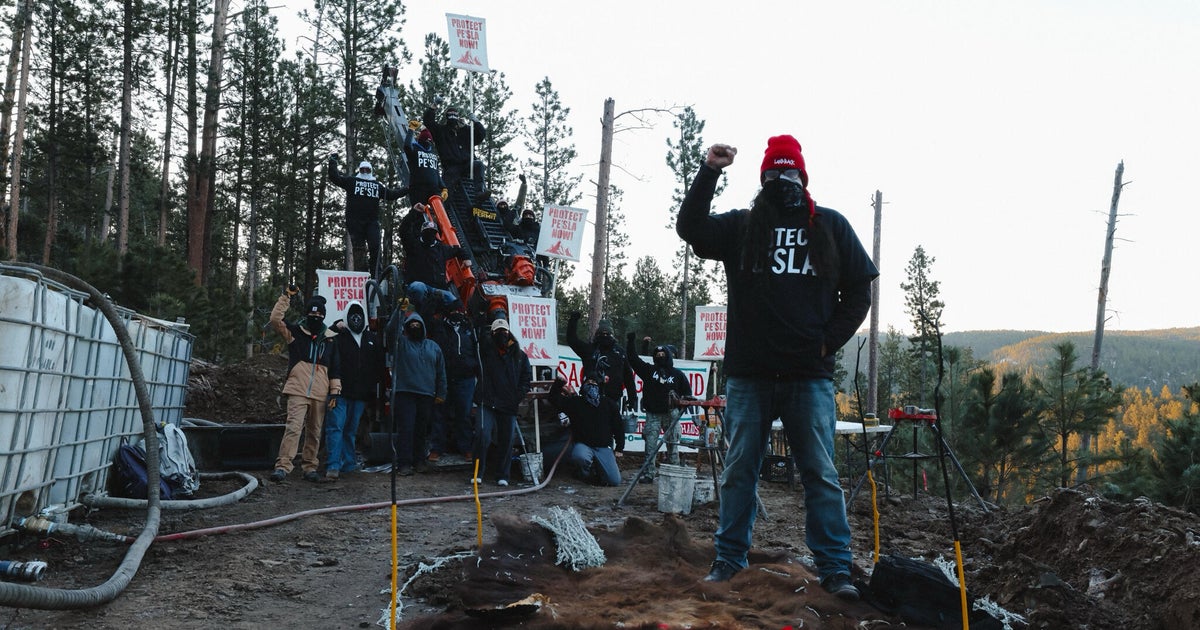
Beyond the courtroom, community members have taken direct action to protect Pe’Sla from the drilling project. When NDN Collective discovered operational drilling pads in late April, protesters quickly mobilized to the site. On one Thursday in late April, demonstrators positioned themselves near two drilling pads, some sitting atop equipment, displaying banners and signs with messages like “Protect Pe’Sla Now,” “Sacred ground not mining bound,” and wearing “Land Back” beanies—a reference to the indigenous land sovereignty movement. Their presence successfully blocked access to the drilling sites that day, and according to NDN Collective, the Forest Service informed them that drilling had been paused for the remainder of the day and contractors were sent home. The project parameters call for the company to drill up to 18 exploratory holes, each penetrating approximately 1,000 feet into the earth to collect geological samples. While it remains unclear exactly when drilling operations first began, the visible impact on the landscape became apparent only when activists discovered the active sites during their regular visits to the area. NDN Collective has pledged that protest actions will continue for as long as necessary to protect the sacred site. Garriott’s words capture the determination of the community: “As Lakota, we pray as long as we need to.” This statement reflects both the spiritual nature of their resistance and their unwavering commitment to defending Pe’Sla regardless of how long the struggle continues.
The Path Forward and Broader Implications
As of now, both the mining company Pete Lien & Sons and the Forest Service have remained largely silent on the controversy. The company did not respond to multiple requests for comment via email and voicemail. The Forest Service, for its part, issued a brief statement declining to discuss the specifics: “The Forest Service does not comment on the specifics of the case or on issues that are part of ongoing legal proceedings.” This silence leaves many questions unanswered about how the project was approved, what consultation—if any—occurred with tribal governments, and what steps might be taken to address the tribes’ concerns. In addition to the lawsuit filed by the nine tribes, NDN Collective and other environmental groups have filed their own legal action requesting a temporary restraining order and preliminary injunction to immediately halt all drilling activities while the courts consider the broader issues. The outcome of this legal battle could have implications that extend far beyond this single project, potentially setting precedents for how federal agencies must balance resource extraction interests against tribal sovereignty, cultural preservation, and environmental protection. The case highlights ongoing tensions in American society between economic development and the protection of indigenous sacred sites, between corporate interests and tribal rights, and between short-term resource extraction and long-term environmental stewardship. For the Sioux tribes and their allies, this fight represents not just opposition to one drilling project but a defense of their fundamental right to maintain their spiritual practices, protect their cultural heritage, and preserve sacred lands for future generations who will continue the ceremonies, prayers, and traditions that have sustained these communities for more than two thousand years.