


Economic Uncertainty and Political Tensions Dominate Face the Nation Discussion
Energy Crisis and Rising Gas Prices Create Economic Headwinds
This week’s “Face the Nation” focused heavily on the escalating economic concerns stemming from the ongoing standoff with Iran, which has now entered its tenth week. Gas prices have skyrocketed by 40 cents per gallon in just one week, reaching a national average of $4.45, creating significant strain on American consumers and businesses alike. The closure of the Strait of Hormuz—through which roughly 20 percent of the world’s oil supply flows—has disrupted global energy markets in ways that experts say rival or exceed the shock experienced when Russia invaded Ukraine.
White House Economic Council Director Kevin Hassett attempted to project optimism, pointing to President Trump’s tax initiatives including no tax on tips, overtime, or Social Security benefits. He argued that despite higher gas prices, real incomes are growing and that the administration is pursuing an “all-of-the-above approach” to increase energy production. However, Hassett struggled to provide clarity on the actual status of the conflict with Iran, unable to definitively answer whether the United States remains at war. He emphasized that Iran’s economy is “on the precipice of extreme calamity” with hyperinflation and potential famine, suggesting the pressure campaign is working even as American consumers bear significant costs.
The economic pain isn’t theoretical. Bank of America released analysis showing that the gas price spike has already cost consumers $19 billion, canceling out nearly half of expected tax refund increases. Spirit Airlines became the most visible casualty, ceasing operations and leaving 14,000 employees without jobs and thousands of passengers stranded. While the airline had pre-existing financial troubles, company officials directly cited “the sudden and sustained rise in fuel prices” as the final blow. Hassett defended the administration’s efforts to help Spirit, noting they explored rescue options but ultimately lacked the legal authority to intervene, while coordinating with other airlines to assist stranded passengers at reduced fares.
Federal Reserve Warns of Prolonged Inflationary Pressures
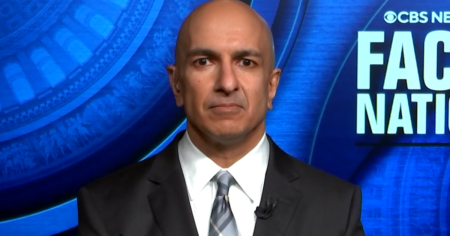
Minneapolis Federal Reserve President Neel Kashkari offered a more sobering assessment of the economic landscape. As one of three regional Fed presidents who dissented against the consensus view at the recent Federal Reserve meeting, Kashkari made clear that future rate cuts are no longer guaranteed and rate hikes may even be necessary. His concern centers on the uncertainty emanating from the Middle East and how long the Strait of Hormuz remains effectively closed. Kashkari emphasized that even if the strait reopened immediately, supply chains could take six months or longer to return to normal functioning.
The Fed official painted a picture of an economy facing compound pressures. While the labor market has shown some stability—with unemployment holding around 4.3 percent—Kashkari warned that a prolonged energy shock could force Americans to cut back on other spending to afford gas, potentially triggering economic slowdown and labor market weakness. He stressed the challenge facing the Federal Reserve is fundamentally about uncertainty regarding the inflation outlook, which stems directly from what happens in the Middle East. The institution is closely monitoring both inflation data and developments in the region, prepared to adjust monetary policy as circumstances evolve.
When asked about incoming Fed Chair nominee Kevin Warsh’s suggestion that the Fed needs a “serious shaking up,” Kashkari diplomatically welcomed fresh examination of Fed tools and communication methods, including the controversial “dot plot” that signals future rate expectations. He acknowledged that different moments call for different inflation measurement tools and expressed openness to dispassionate analysis of what works best. However, on the looming fiscal crisis—with national debt now exceeding 100 percent of GDP—Kashkari punted responsibility back to Congress and the executive branch, noting that while he doesn’t see an immediate crisis, the debt trajectory is clearly unsustainable and ultimately requires political solutions beyond the Fed’s mandate.
Energy Industry Leader Predicts Extended Market Disruption
Chevron CEO Mike Wirth provided perhaps the most detailed and concerning assessment of the energy crisis during his interview, which was conducted just before his meeting with President Trump and other oil executives at the White House. Wirth explained that the global energy system has lost its critical “shock absorbers”—the inventory buffers normally held in tanks, ships, and strategic reserves that help moderate price spikes. These inventories have been drawn down over recent months, making the system far more vulnerable to disruptions and price volatility.
Wirth was notably reluctant to predict when prices might return to pre-conflict levels, repeatedly emphasizing the difficulty of forecasting in such abnormal market conditions. He explained that even if the Strait of Hormuz reopened today, restoring normal flow would take considerable time due to the complex logistics of global energy distribution. Oil fields that have been shut in can’t simply be turned back on like a faucet—they involve complex subsurface dynamics requiring careful management. Additionally, refineries throughout the Middle East have suffered missile and drone damage that will take weeks, months, or in some cases years to repair.
The Chevron chief executive highlighted particularly acute shortages of jet fuel, especially in Europe where 75 percent of imported jet fuel typically comes from Middle Eastern refineries that aren’t currently operating. He predicted that aviation would be “one of the first places it will be felt most broadly,” with airlines already announcing flight schedule adjustments and fare increases. Beyond transportation fuels, Wirth noted shortages of LPG for cooking in South Asia and various petroleum products across regions, creating not just price pressures but actual scarcity. He suggested that behavioral changes—both reduced consumption and hoarding—would further complicate market dynamics, drawing parallels to the 1970s oil embargo when Americans kept their gas tanks as full as possible out of fear of shortages.
Congressional Democrats Challenge Administration’s Foreign Policy and Domestic Priorities
Colorado Democratic Congressman Jason Crow brought a military veteran’s perspective to questions of troop deployments and defense spending, sharply criticizing recent administration decisions. He objected to Defense Secretary Hegseth’s order to withdraw a U.S. brigade from Germany, noting that bipartisan laws require certain conditions be met before moving troops around Europe. Crow suggested the decision was made emotionally—in response to German Chancellor comments about Iran humiliating the United States—rather than based on strategic national security considerations. The congressman questioned why the president would move thousands of troops simply to retaliate against a foreign leader for an unflattering comment.
On the broader Iran situation, Crow argued that America has confused tactics with strategy, focusing on operational questions about blockades and drone countermeasures rather than defining clear strategic objectives. He invoked the costly lessons of Iraq and Afghanistan, where the United States spent trillions of dollars without achieving sustainable outcomes—replacing the Taliban with the Taliban in Afghanistan, and Saddam Hussein with ISIS in Iraq. Crow insisted that before Congress approves the administration’s $1.5 trillion defense budget request, there needs to be clarity about what America is actually trying to accomplish in the Middle East and how the current approach will avoid becoming another endless, unsuccessful conflict.
Crow also broke with his Democratic colleague Jim Himes, the ranking member on House Intelligence, regarding Section 702 surveillance reauthorization. While Himes called it “the most important foreign intelligence tool America has” and saw no evidence of Trump administration misuse, Crow insisted he would only support short-term extensions. His reasoning centered on the administration’s pattern of ignoring legal decisions and court rulings—including what he described as a February attempt by politicized Justice Department officials to indict him and other members of Congress for stating what the law requires of service members. Crow argued that giving the administration a three-year runway on powerful intelligence tools would eliminate Congress’s leverage if abuses occur down the line.
Voting Rights Battle Intensifies After Supreme Court Decision
Georgia Democratic Senator Raphael Warnock described last week’s Supreme Court decision on Louisiana redistricting as “a massive and devastating blow, not only to our democracy, but particularly to people of color in the South.” The 6-3 ruling struck down a congressional map gerrymandered to create a second majority-black district, with the conservative majority saying the decision updated the legal framework while liberal justices warned it would “eviscerate” Section 2 of the Voting Rights Act. The decision makes it harder to bring lawsuits claiming gerrymandering discriminates along racial lines unless there’s proof of discriminatory intent—a standard Warnock called misleading and historically ignorant.
Warnock connected this ruling to the Court’s 2013 Shelby v. Holder decision that gutted Section 5 of the Voting Rights Act, which had required certain states to get federal preclearance before changing voting rules. He cited data showing that since Shelby, the racial voter turnout gap has widened rather than narrowed, growing twice as fast in states previously covered by Section 5. The senator characterized current voting restrictions as “21st Century Jim Crow tactics in new clothes”—closing polling places in black and brown communities, purging voter rolls, and creating longer wait times that data shows disproportionately impact minority citizens. Now, with the new ruling, he argued that even voters who overcome these barriers will have their voices muted through manipulated district lines.
When pressed on whether he supports his own party’s redistricting efforts in states like California and Virginia, Warnock acknowledged supporting what he called a defensive response to President Trump “instituting an arms race in redistricting” by demanding states like Texas create more Republican seats. While stating he “hates partisan gerrymandering,” Warnock said Democrats “could not unilaterally disarm” and pointed to legislation he’s introduced to ban partisan gerrymandering—though he noted no Republicans have signed on. He pushed back hard against black Republican congressmen who’ve suggested representation by race doesn’t matter, arguing this view ignores American history and the importance of diverse perspectives in policymaking. Warnock insisted that when the Senate becomes an “increasing monolith,” it hurts democracy itself and makes it harder to craft policies that serve all Americans.