
The White House Correspondents’ Dinner Attack: A Detailed Timeline of a Planned Assault
Three Weeks of Calculated Preparation
The attack on the White House Correspondents’ Dinner wasn’t a spontaneous act of violence—it was a carefully orchestrated plan that began unfolding three weeks before the event itself. According to federal prosecutors, Cole Allen’s journey toward what they describe as “an anti-democratic act of political violence” started on April 6, just over a month after President Trump made a historic announcement. On March 2, the President had posted on his Truth Social account that he would attend the White House Correspondents’ Dinner for the first time as president, a decision that would ultimately set a devastating chain of events in motion. That afternoon in early April, while still at his home in California, Allen began his digital reconnaissance, searching for “white house correspondents dinner 2026” on his cellphone and carefully reviewing the White House Correspondents’ Association website. On that same day, he took a concrete step toward carrying out his plan by booking a room at the Washington Hilton—the very venue where the prestigious dinner would be held—for April 24-26. This wasn’t impulsive behavior; it was methodical planning by someone who prosecutors allege was determined to carry out an assassination attempt that could have changed American history forever.
The Cross-Country Journey and a Window Into His Mind
On April 16, Allen continued his research, using his phone to access multiple articles about the upcoming dinner, including information about the event’s host, CBS News senior White House correspondent Weijia Jiang, as well as details about the schedule and who would be attending. He purchased a one-way Amtrak train ticket from Los Angeles to Washington, D.C., with a connection through Chicago, and on April 21, he arranged for a rideshare to take him from his home in Torrance to Los Angeles Union Station to begin his cross-country trip. What makes this journey particularly chilling is the glimpse it provides into Allen’s state of mind during those final days. While traveling across America by train, Allen kept detailed notes on his phone, documenting his observations and thoughts in a way that seemed almost touristic in nature. His notes included poetic descriptions like “the southwest desert in spring Distant wind turbines looming like snowy mountains across the hazy NM desert,” reflections that “Chicago is cool; kinda like an Iowa small town was scaled up to LA size,” and observations about Pennsylvania’s “woods are awesome (look like vast fairy lands filled with tiny trickling creeks in spring apparently.” These seemingly innocent travel observations stood in stark contrast to his other activities during the journey—using the train ride to research the White House Correspondents’ Dinner and the President’s plans, including viewing an article ominously titled “Trump’s Plans for ‘Mic-Drop’ Media Confrontation Are Leaked: The president is planning a rage-fueled moment at the White House Correspondents’ Association dinner.”
Arrival in Washington and Final Preparations
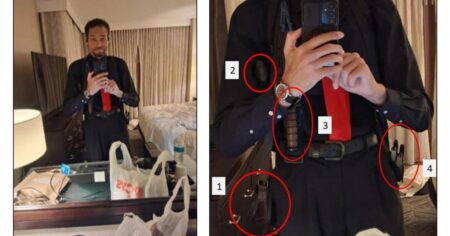
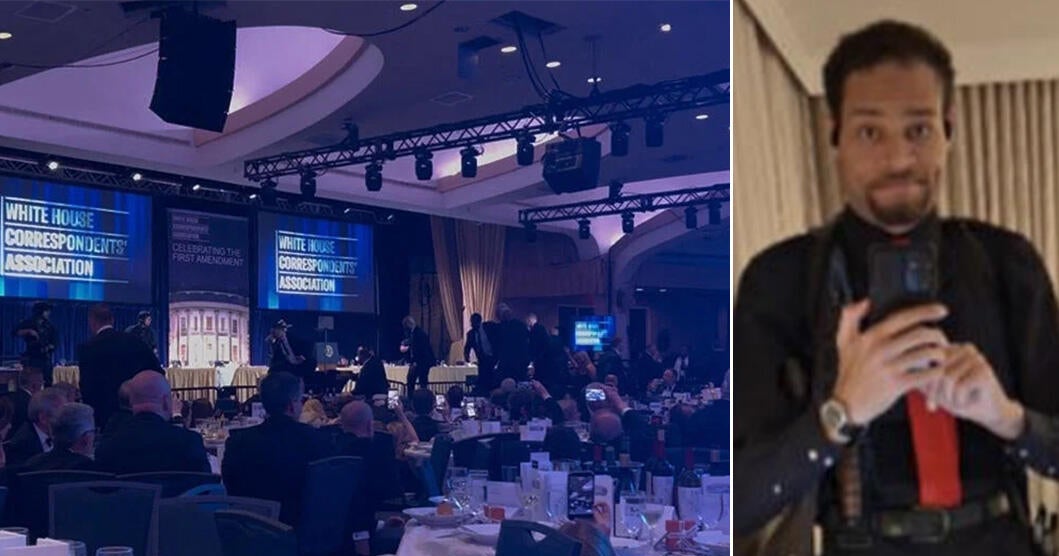
After changing trains in Chicago on April 23, Allen continued on the next leg of his journey, still consuming content related to the event, including an article titled “Social Scene: Your Guide to the 2026 White House Correspondents Dinner Weekend.” He arrived in Washington, D.C. on Friday, April 24, at 1:10 p.m., taking the Metro to the Washington Hilton and checking into his pre-booked room around 3:15 p.m. Saturday, April 25—the day of the dinner—saw Allen entering and leaving his hotel room multiple times, and at approximately 6:26 p.m., he searched the President’s schedule using a “civic tracker” website. Then, at 8:03 p.m., just three minutes after the official start of the White House Correspondents’ Dinner, Allen stood in front of the mirror in his hotel room and took a selfie that prosecutors have now made central to their case. The image is deeply disturbing: Allen is dressed in a black dress shirt with a bright red tie tucked into his pants, armed with multiple weapons visible on his person. The bed is visible behind him, and a plastic bag can be seen on the desk in the foreground. A digitally enhanced close-up version of this photo, included in the prosecutors’ memorandum with annotations by the Justice Department, shows Allen wearing a small leather bag, a shoulder holster, a sheathed knife, pliers, and wire cutters—items that prosecutors say match those later recovered by law enforcement.
The Final Minutes Before the Attack
The prosecution’s timeline reveals just how closely Allen was monitoring the event in those final moments. Ten minutes after taking his mirror selfie, he rechecked the “Presidential Schedule – CivicTracker” webpage before leaving his hotel room just a couple of minutes later. According to the Department of Justice timeline, he remained on his phone searching for live videos of the dinner right up until he rushed the magnetometers. At approximately 8:27 p.m., he accessed a video titled “WATCH LIVE: President Trump, first lady en route to White House Correspondents’ Dinner,” and watched footage of President Trump exiting his vehicle to attend the event. At about 8:30 p.m., prescheduled emails containing a text file titled “Apology and Explanation” were automatically sent to members of Allen’s family. According to a copy obtained by CBS News, the message stated that he planned to target Trump administration officials, “prioritized from highest-ranking to lowest.” Immediately after those emails went out, prosecutors say Allen rushed the screening checkpoint on the terrace level of the Washington Hilton with a raised shotgun. A U.S. Secret Service officer witnessed Allen fire the shotgun in the direction of the stairs leading down to the ballroom where hundreds of journalists, government officials, and the President himself were gathered.
The Confrontation and Its Aftermath
While the memorandum supplies the most detailed account yet of Allen’s movements leading up to the attack, significant questions remain about what precisely happened when he appeared to run past security and shots were fired. Law enforcement sources have told CBS News that the final ballistics analysis is still pending. What is known is that one law enforcement officer fired five rounds during the confrontation, with some bullets hitting the hotel walls, but none hitting Allen himself. Surveillance video captures an officer in black clothing wearing a vest marked “Police” raising his firearm and aiming at Allen, yet Allen was not struck by any of the shots fired. Remarkably, it remains unclear whether the bullet from Allen’s own shotgun was recovered from the scene, though Acting Attorney General Todd Blanche told reporters on Monday that the shell casing from that shot remained inside the shotgun itself. Allen was ultimately apprehended and taken into custody, lying on the floor of the hotel as law enforcement personnel secured him. The photograph of this moment, with Allen prone and surrounded by officers, marked the end of what prosecutors describe as one of the most serious threats to a sitting president in recent American history.
The Legal Case and What It Means
Federal prosecutors are now seeking pretrial detention for Allen and have charged him with attempted assassination of the president—a charge that carries a maximum sentence of life imprisonment. He also faces charges of discharging a firearm during a crime of violence and transporting firearms across state lines with the intent to commit a felony. In their memorandum, prosecutors wrote that “the defendant’s actions were premeditated, violent, and calculated to cause death,” characterizing the incident as fundamentally “an anti-democratic act of political violence.” They noted that had Allen achieved his intended outcome, “he would have brought about one of the darkest days in American history,” emphasizing that “the defendant traveled across the country with the explicit aim to kill the President of the United States.” According to prosecutors, Allen was armed with a 12-gauge shotgun, a .38 caliber pistol, two knives, four daggers, and enough ammunition to take dozens of lives when he was apprehended by Secret Service officers “mere feet away from the ballroom where his primary target was located, along with other members of the Cabinet.” Allen’s lawyers have not responded to requests for comment from CBS News. This case raises profound questions about security at high-profile political events, the detection of potential threats in an era of digital planning, and the ongoing vulnerability of public figures to violence motivated by political grievances. As the legal proceedings continue, the full story of how a young man from California came to stand armed in a Washington hotel, prepared to carry out an act that could have fundamentally altered American history, will continue to unfold.