


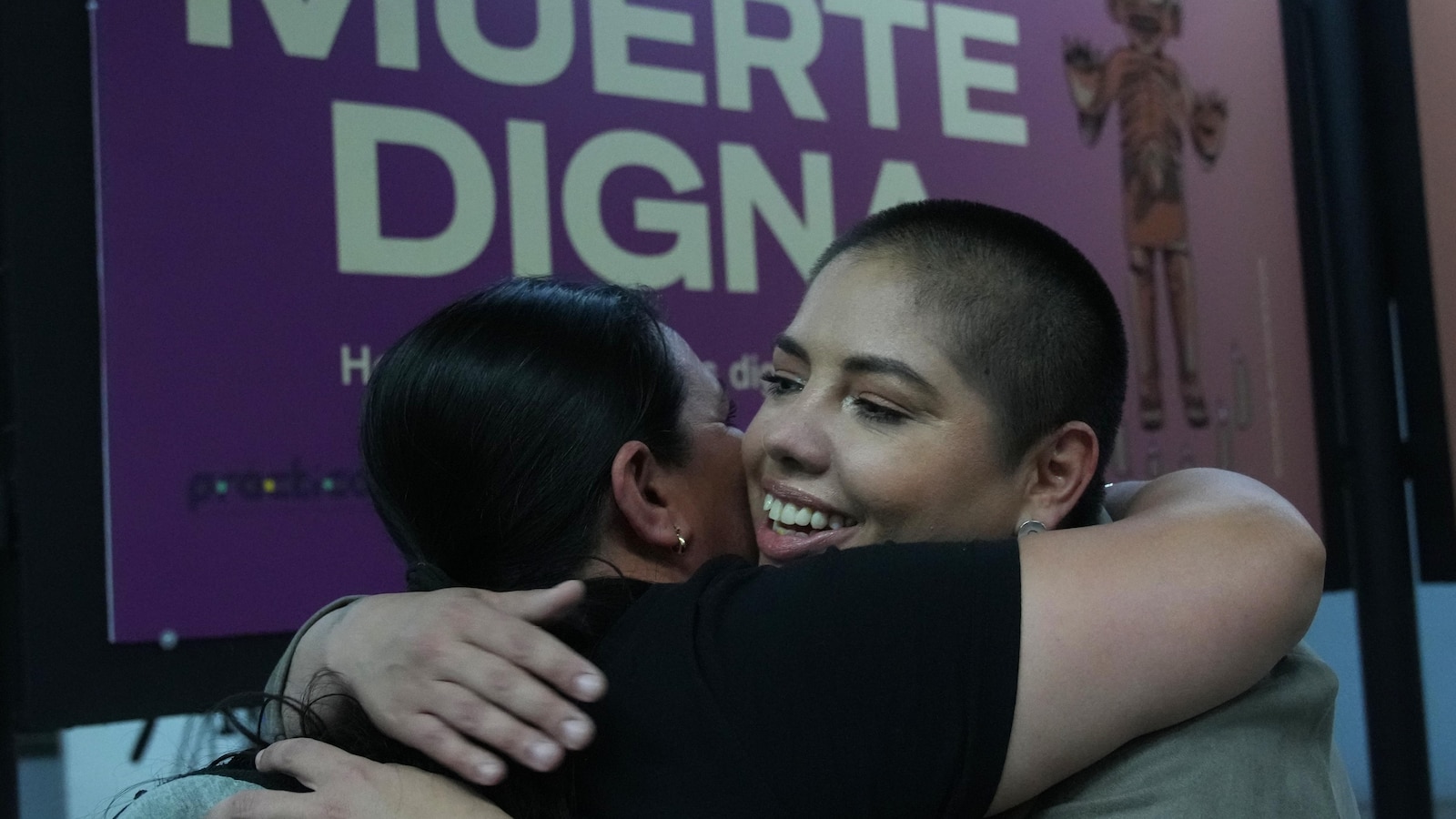

A Life Fighting for the Right to Die with Dignity: Samara Martínez’s Courageous Battle
Finding Purpose Through Pain
Samara Martínez has an unusual relationship with her illness—one she has documented through countless letters addressed to the disease that has slowly taken over her body. “Dear cursed one,” she once wrote, capturing the complex emotions of someone who has lost so much yet gained unexpected wisdom. “I hate you because you have taken things away from me, but I love you because you have been my greatest teacher.” At just 31 years old, this Mexican activist has become one of the most powerful voices in the fight to decriminalize euthanasia in her country, transforming a deeply personal struggle into a national conversation about dignity, autonomy, and the right to choose how one’s life ends.
Martínez’s health journey began when she was only 17, developing early signs of chronic kidney failure that would fundamentally reshape her future. Despite enduring chemotherapy, two kidney transplants, countless dialysis sessions, and frequent hospitalizations, doctors estimate she has approximately five years left to live. Yet rather than retreating from public life, she has embraced her platform with remarkable courage. With over half a million social media followers, Martínez regularly meets with politicians, speaks at conferences, and maintains her position as an academic in her hometown of Chihuahua in northern Mexico. Her approach to advocacy is deeply personal yet universally resonant—she doesn’t present herself as a victim seeking pity but as someone who has found unexpected strength and purpose through suffering. “I would not have taken up this fight unless I had to endure what I’ve had to, so I’ve found in it my purpose,” she explains, embodying the idea that our greatest challenges can become our most meaningful contributions.
The Legal Landscape and the Transcendence Law
The legal framework surrounding euthanasia in Mexico is currently restrictive and unambiguous. While not explicitly addressed in the Mexican Constitution, the General Health Law defines euthanasia as “mercy killing” and prohibits it along with assisted suicide. Under federal law, anyone who assists or induces someone to take their own life faces one to five years in prison, and if a person directly causes the death, the penalty can extend to twelve years. This places Mexico among the majority of Latin American countries that maintain strict prohibitions against end-of-life choices, though the regional landscape is slowly changing. Colombia stands as the only Latin American country where euthanasia is fully legal and regulated, while Ecuador decriminalized it in 2024, and Uruguay approved legislation in 2025 that is currently being implemented.
The proposal championed by Martínez is known as the Transcendence Law, a name that reflects its philosophical foundations as much as its legal implications. Presented in 2025 by lawmakers from several political groups including Morena, the party of President Claudia Sheinbaum, the legislation seeks to fundamentally reframe how Mexican society understands the end of life. Rather than maintaining the explicit ban, the proposal would redefine euthanasia as a legal, voluntary medical procedure—a right tied to human dignity and personal autonomy. The legislation argues that life should not be understood as an obligation to prolong suffering, a perspective that challenges deeply held cultural and religious beliefs. If approved, the law would allow adults to request the procedure while including provisions for conscientious objection among healthcare workers, though it would require public institutions to ensure that willing medical staff are available to perform the procedure. Patricia Mercado, a longtime advocate for women’s reproductive and labor rights who supports Martínez’s efforts, has noted the unique power of personal testimony in this debate: “Samara’s emergence—her struggle, her authenticity—brings the possibility of passing legislation closer. A testimony speaks louder than a thousand data points.”
The Evolution of Acceptance and Daily Realities
Martínez’s letters to her illness serve as a chronicle of transformation, documenting how her understanding of her condition and her life has evolved over time. Writing provides catharsis, and revisiting her past words helps her recognize strength she didn’t know she possessed. “Today I read things I wrote four years ago and think: I was so wrong,” she reflects. “But it’s nice to see how there’s more wisdom.” One particularly poignant example comes from 2021, when her doctor informed her that her kidneys could no longer function independently and presented her with two options: another transplant or relying on treatments that would artificially perform her kidneys’ function of removing waste and excess fluid from her body. At the time, the second option seemed impossible to accept. “I thought I could never live connected to a machine,” she recalls. Yet today, she undergoes peritoneal dialysis every night, connected for hours to a piece of medical equipment about the size of a printer that she must transport wherever she goes.
This acceptance didn’t come easily or without profound loss. There was a time when Martínez was active and health-conscious, playing soccer and maintaining a careful diet, believing she was building a foundation for a long, healthy life. She met her husband at university in 2013 while studying journalism, and they married five years later despite her warnings about her deteriorating health. When she was diagnosed with a broader set of complications including lupus, an autoimmune disease, she asked him directly: “Are you sure you want to do this?” He assured her that no adversity would separate them. Yet by 2024, the marriage had crumbled under the weight of her illness. But love wasn’t the only casualty—after more than a decade of severe illness, she lost her dream job at a publishing house after informing her boss she would need a week to recover from a transplant. Medical debt accumulated, forcing her to sell her home and leading her parents to take out loans to support her care. Long-time friends disappeared from her life, unable or unwilling to remain present through her struggles. Vomiting, weight gain from steroids, and frequent hospitalizations became her new normal. “An illness like this isn’t for everyone and it’s hard to embrace the pain,” Martínez acknowledges. “You can stop living and just exist, but I don’t want that.”
Confronting Doubt, Criticism, and Finding Philosophy
Even with her public strength, Martínez admits that anger and doubt have been unavoidable companions on her journey. “I consider myself agnostic, but there are moments when you look up at the sky and question God—why me?” she says honestly. Her current approach reflects a philosophical shift toward stoicism, finding gratitude in each day despite her circumstances. Yet this personal peace doesn’t shield her from external attacks. Critics frequently flood her social media with abusive messages. “I’ve been told that if God wants me to suffer, then I should suffer,” she reveals, highlighting the intersection of religious belief and personal autonomy that lies at the heart of the euthanasia debate.
Opposition to euthanasia remains formidable among conservative and religious groups in Mexico. Following the presentation of Martínez’s proposal, the Catholic Church echoed Pope Leo’s call to uphold the sanctity of life from conception to natural death. Rodrigo Iván Cortés, president of a conservative advocacy group, articulated this perspective clearly: “For us, the value of life spans every stage.” However, not all religious voices oppose Martínez’s cause. The Reverend Héctor Reyes, who collaborates with the organization “For the Right to Die with Dignity,” offers a different theological perspective. The group has defended euthanasia for nearly two decades, and Reyes frames the issue in spiritual terms that challenge conventional religious opposition. “Transcendence has everything to do with the God I believe in,” Reyes explains, urging people not to remain trapped in the image of a judgmental and punishing deity. “For me, transcendence lies in the hope that life doesn’t end with physical death.” This religious support, though minority, demonstrates that the conversation about end-of-life choices doesn’t have to be framed as believers versus non-believers but rather as different understandings of what honoring life truly means.
The Cost of Advocacy and Family Grief
The decision to become the public face of euthanasia legislation has required Martínez to ask not just herself but those closest to her to bear an extraordinary burden. When she told her parents that she would spend her remaining years fighting for euthanasia, she forced them to begin a process that no parent should have to endure. “That meant beginning to grieve while I was still alive,” she explains with painful clarity. Her father’s response captured the anguish of watching a child fight for something that acknowledges her impending death. “When my father asked me why I had to fight for this, I told him that if I didn’t do it, no one else would.” This statement reveals the isolation that often accompanies pioneering advocacy—the recognition that some battles must be fought not because they’re desired but because they’re necessary and no one else can carry them forward with the same authenticity and urgency.
Martínez has been forthright about rejecting the victim narrative and strongly opposing pity, yet she doesn’t pretend that her choice to advocate publicly has been without emotional cost. The very nature of her campaign requires her to speak openly about her deteriorating condition, her limited time, and her desire to end her life on her own terms—conversations that force everyone around her to confront mortality in uncomfortable and immediate ways. Yet she frames her advocacy not as an act of despair or cowardice but as perhaps the most courageous decision of her life. Choosing how to die, she argues, is an expression of agency in circumstances where so much has been taken from her control. It’s a reclamation of autonomy from an illness that has dictated the terms of her existence for over a decade.
A Vision of Transcendence and Legacy
As Martínez continues her fight, she acknowledges the very real possibility that she may not live to see the Transcendence Law passed. Yet she maintains that the effort itself has already been worthwhile, that pushing for change has given her remaining time profound meaning. Her vision for her final moments stands in stark contrast to the clinical setting where so many lives end. She dreams of saying her farewells by the sea, watching a sunset far from a hospital bed. She imagines a gathering to celebrate her life, surrounded by family and friends, creating space for both laughter and tears. “That’s what my life deserves,” she says with simple conviction. “A proper time to say goodbye, to laugh and cry, and leave in peace.”
This image of a dignified, chosen ending represents the heart of what the Transcendence Law seeks to provide—not an escape from life but a different relationship with death, one that honors the individual’s experience and respects their authority over their own body and story. Martínez’s letters to her illness document a journey of transformation, from hatred and questioning to acceptance and wisdom. They show someone who has not been defeated by suffering but has instead found within it unexpected gifts of resilience, purpose, and clarity. Whether or not the legislation passes, Martínez has already achieved a form of transcendence by transforming her personal struggle into a catalyst for national reflection on what it means to live and die with dignity. Her legacy will be measured not just in legal changes but in conversations started, perspectives challenged, and the courage she’s modeled for others facing similar circumstances. In fighting for the right to choose her ending, she has ensured that her life will be remembered as one lived fully and deliberately, right up until the final moment she decides to say goodbye.