


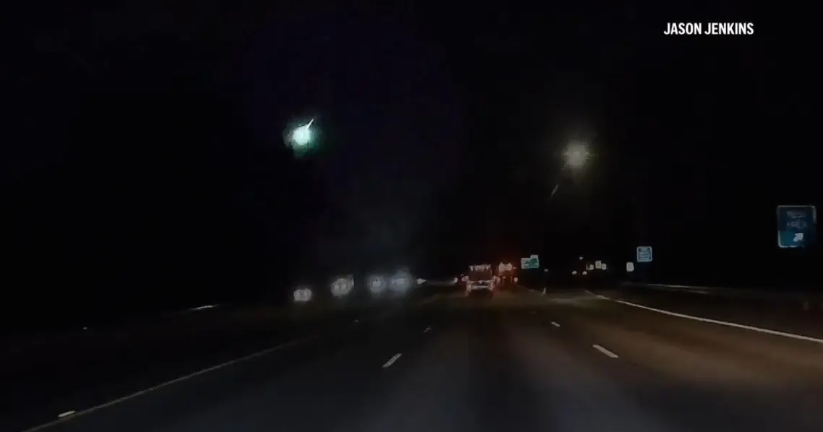

A Spectacular Light Show: Green Fireball Streaks Across Pacific Northwest Sky
An Unexpected Morning Spectacle
Jason Jenkins was simply heading to work during those quiet, dark hours before sunrise when something extraordinary transformed his ordinary Monday morning commute into an unforgettable experience. At precisely 6:06 a.m., while driving through southwestern Washington state approximately 20 miles north of Portland, Oregon, his dashboard camera captured what would become a remarkable piece of footage—a brilliant green streak blazing across the predawn sky. The sight was so stunning and unexpected that Jenkins initially struggled to comprehend what he was witnessing. His first thought was that he might be seeing a comet, though something about the proximity and intensity of the light made him quickly reconsider that conclusion. What struck him most powerfully was the sheer brightness of the phenomenon. “It kind of reminded me of a lightning strike because it was so bright,” Jenkins explained, still clearly moved by the experience. He was quick to note that even his dashboard camera, which successfully recorded the event, couldn’t fully capture the intensity of what he witnessed with his own eyes. “The video doesn’t do justice on how bright and close it seemed,” he emphasized, conveying the gap between technological recording and human perception of such a breathtaking natural event.
Understanding the Green Fireball Phenomenon
According to experts at the Oregon Museum of Science and Industry in Portland, what Jenkins witnessed was classified as a fireball—a particularly bright meteor that becomes visible at altitudes up to 80 miles above Earth’s surface. These spectacular objects are essentially larger pieces of space debris that create an especially brilliant display as they enter our atmosphere at tremendous speeds. The distinctive green color that made this particular fireball so memorable and visually striking isn’t random or uncommon in such events. Scientists explain that green fireballs typically owe their vibrant coloration to the presence of specific elements that burn and vaporize as the meteor plummets through Earth’s atmosphere at incredible velocities. Magnesium is the primary culprit behind this vivid display, emitting an intense blue-green light when subjected to the extreme heat generated by atmospheric friction during the meteor’s rapid descent. Additionally, nickel can contribute to producing similar green hues in these celestial light shows. Jim Todd, who serves as the museum’s director of space science education, expressed both professional interest and genuine enthusiasm about the Monday morning event. His description captured both the scientific significance and the simple wonder of the occurrence: “It was bright, it was green, it was spectacular. One tiny little piece of rock put on such a show this morning.” His words remind us that sometimes the most dramatic natural phenomena come from remarkably small sources—in this case, a fragment of rock from space that created a display visible across a wide area.
A Recent Wave of Celestial Visitors
Jenkins’ sighting wasn’t an isolated incident but rather part of what appears to be a recent surge in fireball activity across the United States. Over the past several days, numerous locations throughout the country have experienced similar dramatic displays, capturing public attention and generating excitement among both professional astronomers and casual sky watchers. Just over the weekend, an apparent meteor illuminated the nighttime skies over Northern California, prompting hundreds of reports from residents across that region who witnessed the spectacular event. The sighting was significant enough to be covered by CBS Sacramento, indicating the widespread nature of the observations and the public interest such phenomena generate. Even more dramatic was an incident the previous week in Ohio, where a massive 7-ton meteor created a fireball visible across an remarkably wide geographic area. The meteor didn’t simply provide a visual spectacle—it broke apart in the atmosphere with such force that it produced a thunderous boom that startled residents throughout the region. Many people who heard the explosive sound initially feared some kind of ground-based explosion or industrial accident, not realizing they were experiencing the sonic effects of a meteor’s disintegration high above them. NASA reported receiving eyewitness accounts from an impressive ten states, Washington D.C., and even the Canadian province of Ontario, demonstrating the extraordinary reach of this particular event. Bill Cooke, who heads NASA’s Meteoroid Environments Office, confirmed that the Ohio meteor was substantial enough that “some fragments, some tiny pieces of it, actually made it to the ground.”
When Space Rocks Reach the Surface
The series of recent sightings has included at least one incident where meteor fragments didn’t just light up the sky but actually made tangible contact with human structures. On Saturday, NASA tracked another significant meteor traveling at an astonishing 35,000 miles per hour as it broke apart north of Houston, Texas. Scientists estimated that before its atmospheric disintegration, this meteorite weighed approximately one ton and measured about three feet across—a substantial object by meteorite standards. As with the Ohio incident, the breaking apart of this meteor created sonic booms that were audible to residents in the surrounding area, creating momentary confusion and concern among those who heard the unexpected sounds. The Houston-area meteor made headlines not just for its impressive size and speed, but because physical evidence of its journey survived to reach the ground. One local resident reported to ABC13, a Houston television news outlet, that a piece of the meteor had actually crashed through the roof of her home—a rare and startling reminder that these celestial objects, while usually burning up completely in the atmosphere, can occasionally deliver tangible remnants of their journey to Earth’s surface. Such incidents, while uncommon, highlight the fact that Earth exists within a dynamic solar system where space debris regularly intersects with our planet’s path, mostly harmlessly but occasionally with more direct consequences.
The Challenge of Tracking and Recovery
Jim Todd emphasized that while Monday’s green fireball was widely visible due to its altitude and the darkness of the early morning sky, actually determining the ultimate fate of such meteors presents significant challenges to scientists. The video captured by Jenkins’ dashboard camera, combined with reports from other witnesses throughout the region, provides valuable data that might allow researchers to calculate the fireball’s trajectory and potentially determine whether any fragments survived to reach Earth’s surface. However, Todd was careful to manage expectations about what such calculations might yield. In the majority of cases involving even spectacular fireballs, the meteor completely vaporizes in the atmosphere, leaving nothing behind to find. Even in those relatively rare instances when fragments do survive the intense heat and friction of atmospheric entry to land on Earth’s surface, locating them presents enormous difficulties. “Even if it does survive, it looks like a common everyday rock, and nearly almost impossible to find, unless it hit a house or a street or leaves debris behind,” Todd explained. This reality means that despite the dramatic visual display and the scientific interest such events generate, most fireballs leave no recoverable physical evidence of their brief, brilliant passage through our skies—they remain only as memories and, increasingly in our modern age, as digital recordings.
The Digital Age of Meteor Watching
The increasing frequency of reported fireball sightings may not necessarily indicate that more meteors are entering Earth’s atmosphere than in previous decades, but rather reflects a technological shift in how we observe and document our world. As Todd noted, the proliferation of cameras mounted on dashboards and doorbells has dramatically increased the likelihood that remarkable celestial events will be captured on video. What previous generations might have witnessed only as fleeting personal experiences, discussed with neighbors but leaving no permanent record, are now preserved as digital files that can be shared, analyzed, and appreciated by audiences far beyond those who directly witnessed the events. Jenkins himself acknowledged this modern reality, noting that while he originally installed his dashboard camera for the mundane purpose of having evidence in case of a traffic accident, he found himself thrilled to have captured “something like that.” His experience has clearly converted him into a believer in the technology: “I won’t go without a dashcam ever again,” he declared. The event even inspired him to consider whether his good fortune in witnessing and recording such a rare sight might extend to other areas of life: “I need to go buy a lottery ticket now,” he joked. His reaction captures something essential about these encounters with the cosmos—they remind us that we live in a universe full of wonder, that extraordinary events can interrupt the most ordinary moments, and that sometimes, being in the right place at the right time with the right equipment can allow us to capture and share something truly spectacular that connects us to the vast universe beyond our daily concerns.