


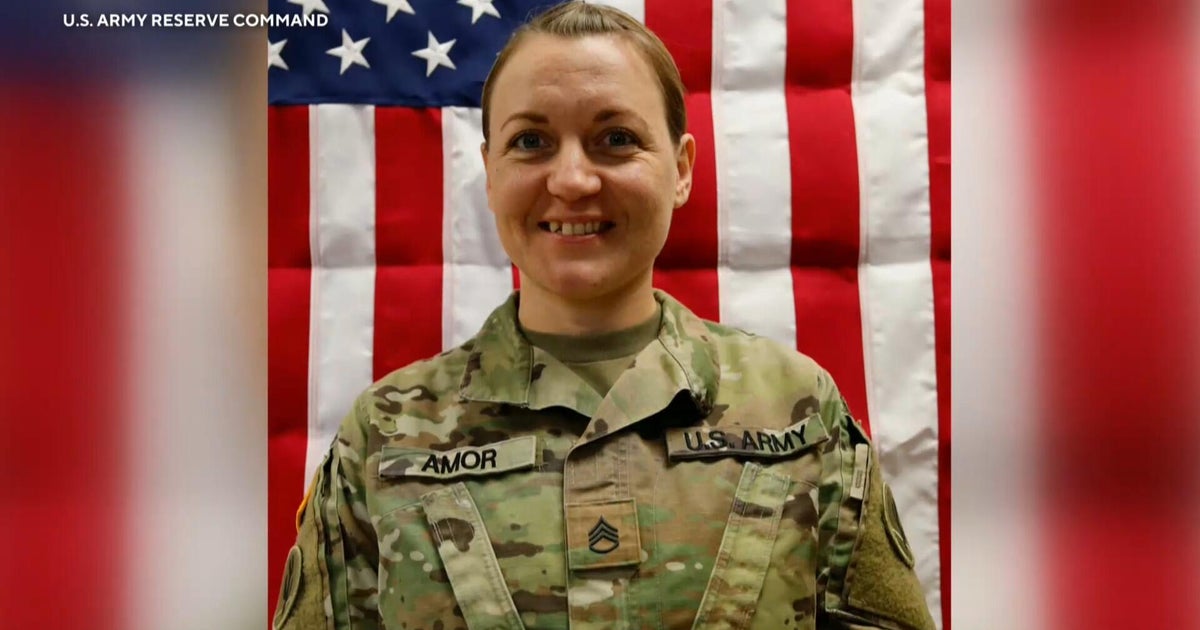

A Soldier’s Legacy: Remembering Army Sgt. 1st Class Nicole Amor
The Rock That Held Everyone Together
In the midst of unimaginable grief, Joey Amor finds himself searching for words to describe the woman who was his wife, his partner, and the mother of his children. Army Sgt. 1st Class Nicole Amor was more than just a soldier—she was, as her husband lovingly describes, “the rock” and “the glue” that held people together during their darkest moments. When chaos erupted, when fear crept in, when uncertainty clouded judgment, Nicole was the steady presence that anchored those around her. This wasn’t just Joey’s perspective; it was a sentiment echoed by every soldier who had the privilege of serving alongside her. Nicole, a resident of White Bear Lake, Minnesota, embodied the very essence of selfless service until her life was tragically cut short on March 1st during an Iranian drone strike in Kuwait. She was one of six Army Reserve soldiers from the 103rd Sustainment Command, based in Des Moines, Iowa, who lost their lives that day, just one day after the U.S. and Israel launched a major military operation in Iran. For Joey and their two children, the loss has left a void that can never truly be filled, but Nicole’s legacy of strength, compassion, and unwavering dedication continues to shine through the memories of all who knew her.
The Agonizing Wait and the Heartbreaking Confirmation
The day that changed everything started like any other for Joey Amor, until news reports began filtering through about an explosion that had struck a sustainment unit in Kuwait. As details emerged, a sinking feeling settled in Joey’s chest. He knew enough about military operations and his wife’s deployment to piece together a terrifying possibility. “When I heard it was a sustainment unit based out of Kuwait, I know enough about what’s going on over there to know there were very few left over there, I knew it was her unit,” Joey recalled, his voice heavy with the memory of those agonizing hours. In what would become their final exchange, Joey sent Nicole a text message that now carries unbearable weight: “I’m getting worried. I’m getting worried. We’re getting reports of a sustainment unit, three casualties, five injured, I’m gonna need to hear something from you today, my love.” Those words, typed in desperate hope, would remain unanswered. About an hour and a half later, the official notification came—Nicole was gone. The cruel irony wasn’t lost on Joey: his wife was just days away from returning home, from reuniting with her family, from resuming the life they had built together. Trying to articulate the emotional whiplash of that moment, Joey struggled: “I don’t know how to explain knowing before you know, and then to be told what you already know, after not being able to see your person for that long. I can’t put that into words. That was painful.” It was a pain that transcended description, a grief that arrived in waves—first the fear, then the knowing, and finally the crushing confirmation.
A Love Story Rooted in Service
Nicole and Joey’s story began more than two decades ago, their paths crossing while both served at Fort Eustis in Virginia. What started as a connection between two people dedicated to serving their country blossomed into a deep partnership that would eventually lead to marriage in 2015. Their relationship was built on shared values, mutual respect, and an understanding of the unique demands military life places on families. When Joey made the decision to leave the military in 2012, Nicole chose a different path. She insisted on staying, driven by something that had taken root deep within her soul. As Joey explained, her service “grew into a sense of duty and a sense of responsibility, a sense of pride.” But it was more than abstract concepts of duty or patriotism—at its core, Nicole’s commitment to the military was about “taking care of the one next to her.” This fundamental aspect of her character defined not just her military service but her entire approach to life. She saw service not as an obligation but as a calling, not as a job but as a way to make a tangible difference in the lives of those who depended on her. When Nicole deployed for her second tour last July, the couple’s goodbye carried the assumption that they would soon be reunited. “I’ll see you soon,” she had told him—simple words that held the promise of a future that would never come to pass. Nicole was laid to rest in Minnesota, her home state, surrounded by family, friends, and fellow service members who came to honor her sacrifice and celebrate her life.
Explaining the Unexplainable to Their Children
Perhaps no aspect of Joey’s grief is more challenging than helping his children navigate the loss of their mother. When asked how he explains Nicole’s death to them, Joey’s response reveals a father determined to honor both his children’s need for truth and their individual ways of processing trauma. “I’ve been very honest with them and transparent with them,” he said, acknowledging a painful reality that many grieving parents face. “You can only protect them from the truth for so long. And the reality is, is that there is no protecting them from the truth that their mother is gone.” Rather than offering false comfort or sugar-coating the permanence of their loss, Joey has chosen honesty, while recognizing that each child requires a different approach. “You have to handle each one differently. My daughter’s one way, my son’s a different,” he explained, understanding that grief is not one-size-fits-all, even within the same family. The weight of this responsibility—shepherding his children through unimaginable loss while drowning in his own grief—is staggering. Joey finds himself replaying final moments: the last time he saw Nicole, the last conversations their children had with their mother, those precious ordinary moments that no one knew would be the last. “And they were so comfortable because we thought she was safe,” he said, his words capturing the particular betrayal felt by military families who entrust their loved ones to their country’s care, believing that safety protocols and military might will bring them home.
Joining a Community No One Wants to Join
The Amor family now carries a designation that commands respect but comes at the highest possible cost: they are Gold Star family members. This designation, reserved for the immediate family members of service members who have died in the line of duty while serving the United States, brings them into a community bound together by shared sacrifice and profound loss. “It is a community of people that have felt what we are feeling right now, and that are still feeling this every day,” Joey reflected. “And it’s a group of families that you respect and that we all honor as the nation, but we never truly understand the weight unless you’re a part of it.” His words highlight a difficult truth: while the nation pays tribute to fallen service members and their families, the actual experience of being a Gold Star family—the daily reality of absence, the milestones celebrated without a crucial person present, the future reimagined without someone who was supposed to be there—remains incomprehensible to those who haven’t lived it. For Joey and his children, this isn’t just about attending memorial services or receiving formal recognition. It’s about waking up every day to a new normal they never asked for, about building a life around an absence that can never be filled. The Gold Star community offers something invaluable in this journey: the understanding that can only come from others who have walked this same impossible path.
Growing Hope: A Greenhouse in Nicole’s Memory
As Joey looks toward a future without Nicole, he finds solace in an unconventional memorial that perfectly captures his wife’s spirit. Operation Nikki’s Embrace, a fundraising initiative created in Nicole’s honor, aims to build gardens, greenhouses, community spaces, and support acts of service—all reflecting the values Nicole embodied throughout her life. At the heart of this project is a special greenhouse that will serve as a living tribute to Nicole’s love of gardening. “It was a calming place for her,” Joey explained, his voice softening as he recalled Nicole tending to her plants, finding peace in the simple act of nurturing growth. “She loved watching what it turned into…and it always took on a life of its own.” This greenhouse represents more than just a memorial—it’s a space where life continues, where growth happens, where beauty emerges from care and attention, much like Nicole’s approach to the people in her life. For Joey, this project offers something rare in grief: a forward-looking purpose that honors the past. “At the core of it is this little greenhouse that I will get to spend the rest of my life maintaining and growing,” he said, finding comfort in the prospect. “And I can’t be more thankful for that. It’s going to be an honor, it’s going to be a joy, it’s going to be wonderful.” In tending to this greenhouse, Joey will in some way continue the partnership he shared with Nicole, cultivating beauty and life as a testament to a woman who dedicated herself to anchoring others in their storms. Though looking forward remains painful and looking back brings heartache, this living memorial offers a bridge between grief and hope, between loss and legacy, ensuring that Nicole Amor’s impact continues to grow and flourish, touching lives just as she did throughout her remarkable journey.