


Police Officers Challenge “Hidden” Placement of January 6th Memorial Plaque
A Fight for Public Recognition
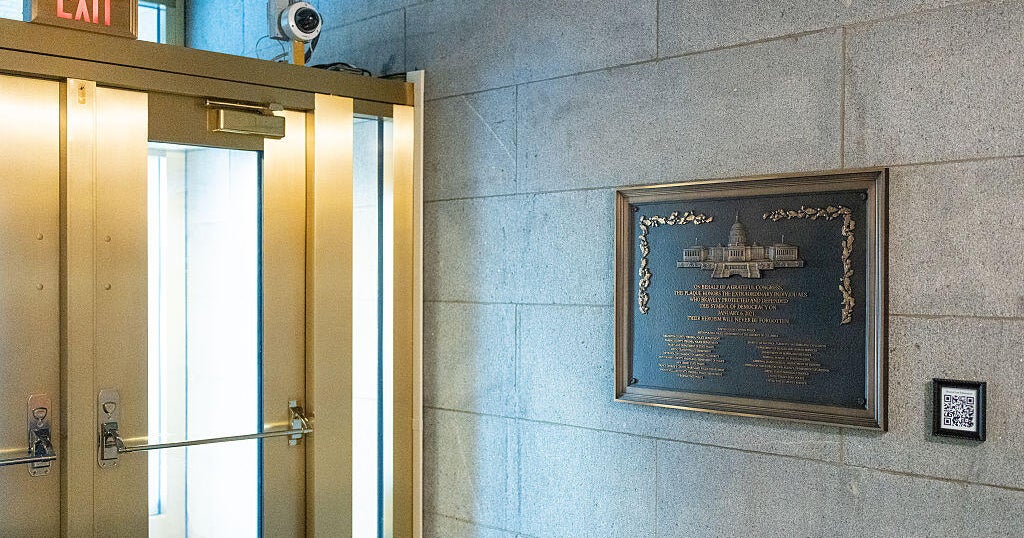
In a legal battle that highlights ongoing tensions surrounding the January 6th Capitol riot, two law enforcement officers are pushing back against what they view as an inadequate attempt to honor those who defended democracy on that chaotic day. Former Capitol Police Officer Harry Dunn and current D.C. Police Officer Danny Hodges have returned to court, arguing that officials haven’t truly fulfilled their legal obligation to properly display a commemorative plaque honoring the officers who protected the U.S. Capitol during the 2021 insurrection. The officers’ lawsuit centers on a fundamental question: What does it mean to truly honor someone’s service and sacrifice? After years of delays and political wrangling, the plaque was finally installed—but under circumstances that the plaintiffs argue defeat its entire purpose. Hung in the early morning hours of a Saturday at 4 a.m., tucked inside a pair of doors along the Capitol’s west front, the memorial’s placement strikes the officers as deliberately obscure, almost as if those responsible wanted to fulfill the letter of the law while avoiding its spirit.
The Problem with a “Hidden” Honor
The heart of the officers’ argument is both simple and profound: honor, by its very nature, must be public. A memorial that nobody sees isn’t really a memorial at all—it’s just a plaque in storage with a slightly better view. According to their court filing, the current location is effectively “no different than the basement the plaque was kept in for years.” This isn’t just about bureaucratic compliance or technical interpretation of the law; it’s about the fundamental meaning of recognition and remembrance. When we honor people for their bravery and service, especially those who put their lives on the line to protect our democratic institutions, that recognition needs to be visible and accessible to the public. Dunn and Hodges argue that Capitol administrators are violating the law by failing to place the plaque in a location that’s truly open and accessible to visitors. The current placement, they contend, undermines the entire purpose of the memorial. It’s worth noting that even Senator Thom Tillis, a Republican from North Carolina who fought to have the plaque installed in the first place, has suggested that its current placement might not be permanent—an acknowledgment that perhaps even supporters of the installation recognize its current location as less than ideal.
Years of Delays and Political Foot-Dragging
The journey of this memorial plaque tells a larger story about how polarized our politics have become, and how even honoring police officers—typically a bipartisan priority—has become entangled in partisan disputes when connected to January 6th. Democrats in both the House and Senate have repeatedly complained about what they characterize as delays and foot-dragging by Republican leaders in getting the plaque hung. The memorial was supposed to be installed by March 2023 according to the law that mandated its creation, yet it languished for years before its recent, controversial placement. This delay hasn’t just frustrated lawmakers; it has deeply affected the police responders who lived through the violence of that day and their families who have advocated persistently for proper recognition of their loved ones’ service. For these families and officers, the plaque represents more than just a piece of metal with words on it—it’s a tangible acknowledgment of the trauma they endured, the sacrifices they made, and the importance of what they protected that day. When that recognition is delayed year after year, or when it’s finally provided in what appears to be a half-hearted manner, it sends a painful message about how their service is valued.
The Legal Question: What Does “Western Front” Mean?
Beyond the philosophical arguments about the nature of honor and public recognition, the lawsuit raises specific legal questions about compliance with the law. The officers’ suit, which names the architect of the Capitol as a defendant, argues that the legislation requiring the plaque’s installation included specific language about where it should be placed. According to their interpretation, the law “requires the memorial to be displayed on the Capitol’s ‘western front,’ an exterior part of the building,” rather than tucked inside somewhere. This distinction matters because the western front of the Capitol is one of its most publicly accessible and visible areas—exactly the kind of location where a memorial intended for public viewing should logically be placed. If the law indeed specifies an exterior location on the western front, then placing it inside doors, regardless of whether those doors are technically on the western side of the building, would represent a failure to comply with the law’s requirements. This legal argument provides the foundation for the officers’ request to have a judge allow their civil lawsuit to proceed, potentially forcing Capitol administrators to relocate the plaque to a more appropriate and publicly accessible location.
The Broader Context of January 6th Remembrance
This dispute over a memorial plaque sits within the larger, still-evolving national conversation about how we remember and understand January 6th, 2021. That day saw violent protesters breach the Capitol in an attempt to prevent the certification of the 2020 presidential election results, leading to injuries among law enforcement officers, deaths, and a profound shaking of America’s democratic foundations. For many, the events of that day represent an unprecedented attack on American democracy; for others, the narrative is more complex or contested. These competing perspectives have made almost everything related to January 6th politically fraught, from congressional investigations to criminal prosecutions to, apparently, even the simple act of hanging a plaque to honor the police officers who defended the building. The officers who responded that day found themselves in an impossible situation, facing down crowds that included people who typically position themselves as supporters of law enforcement. The trauma and complexity of that experience deserve recognition that rises above partisan politics—yet this lawsuit demonstrates how difficult it has become to achieve even that basic level of agreement and respect.
Moving Forward: What Comes Next
As Dunn and Hodges ask the judge to allow their lawsuit to proceed, the case raises important questions not just about this specific plaque, but about how we honor public service in an era of deep political division. The officers aren’t asking for special treatment or lavish recognition—they’re simply asking that the memorial be placed where people can actually see it, where it can serve its intended purpose of honoring those who protected the Capitol and what it represents. The potentially temporary nature of the current installation, as suggested by Senator Tillis’s comments, adds another layer of uncertainty to the situation. Will the plaque eventually be moved to a more prominent location? Is the current placement merely a stopgap measure while a more permanent solution is developed? Or does it represent the final resolution of years of debate, with administrators hoping that technically fulfilling the law’s requirements will be enough to close the matter? The answers to these questions will emerge as the legal process unfolds, but the fundamental issue at the heart of this case transcends legal technicalities: when we honor those who serve and protect us, that honor should be genuine, public, and unambiguous. Anything less diminishes not just the memorial itself, but our collective commitment to recognizing sacrifice and bravery, regardless of the political context in which they occur.