


Federal Judge Blocks Trump Administration’s Removal of Slavery Exhibit at Historic Philadelphia Site
Court Rules Against “Orwellian” Erasure of Historical Truth
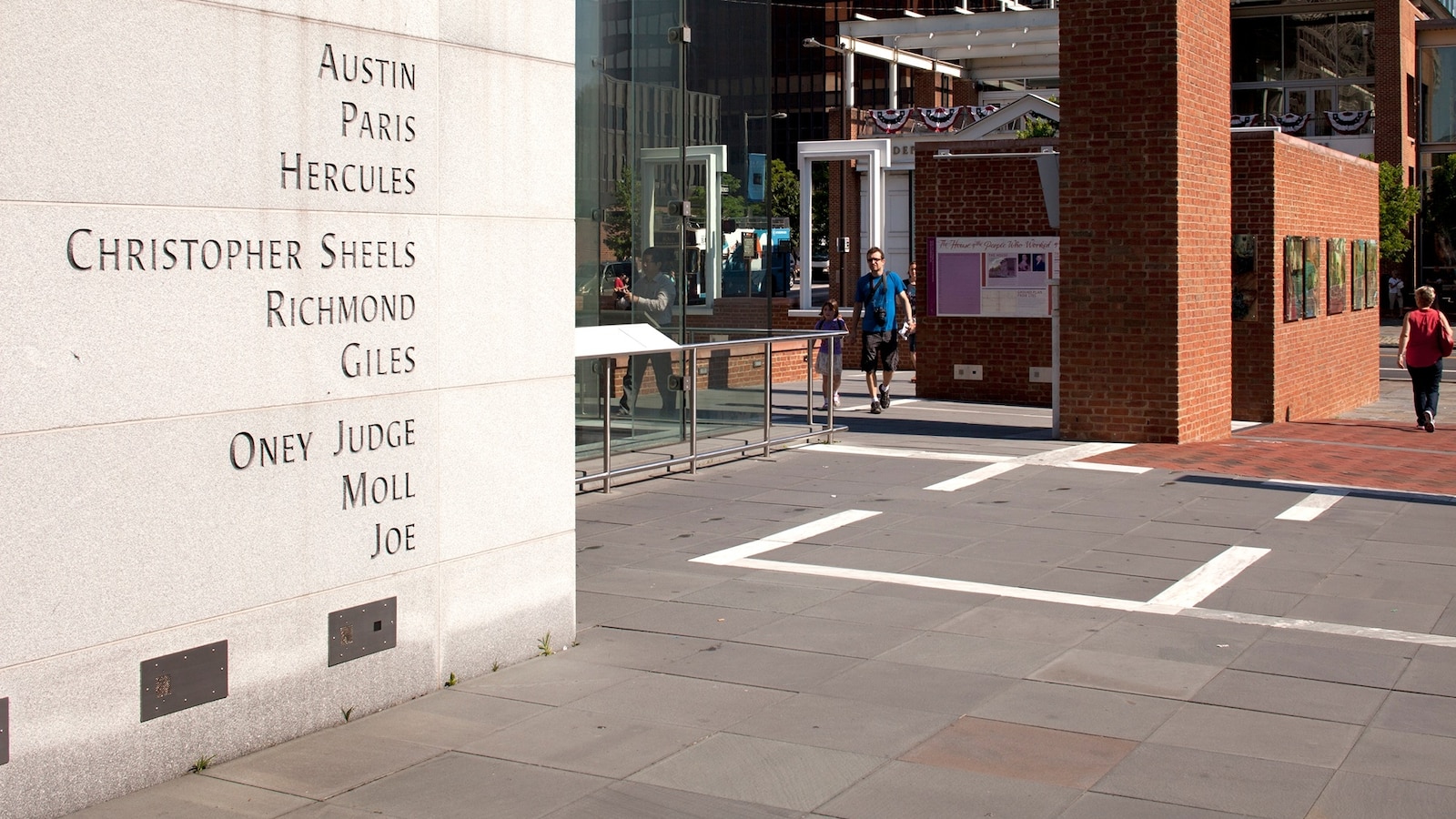
In a strongly worded ruling that invoked George Orwell’s dystopian masterpiece “1984,” U.S. District Judge Cynthia Rufe delivered a decisive blow to the Trump administration’s efforts to reshape historical narratives at federal sites. On Monday, Judge Rufe issued a preliminary injunction preventing the administration from continuing its removal of slavery-related exhibits at the President’s House Site in Philadelphia’s Independence National Historical Park. The outdoor exhibit, which opened its doors in 2010, marks the location where George Washington’s presidential residence once stood—a house that was also home to nine enslaved individuals who lived and worked there under the first president’s ownership. The National Park Service had removed 34 educational panels and video presentations that told the stories of these enslaved people, stripping away crucial historical context from a site meant to educate the public about America’s complex founding era. Judge Rufe’s order mandates that the Trump administration restore the exhibit to its original state, ensuring that these important historical narratives are not erased from public view and memory.
The Executive Order Behind the Removal
The controversy stems from President Donald Trump’s executive order titled “Restoring Truth and Sanity to American History,” issued on March 27, 2025. This directive instructed the Interior Department to systematically remove what the administration characterized as “divisive, race-centered ideology” and narratives from federal cultural institutions across the country. According to a Department of the Interior spokesperson who spoke with ABC News last month, the removal of the slavery exhibit at the President’s House Site was undertaken specifically to comply with this presidential mandate. The executive order represents part of a broader effort by the Trump administration to reshape how American history is presented at federally controlled museums, monuments, and historic sites. The administration’s position suggests that discussions of slavery and racial history constitute divisive ideology rather than essential historical fact. This approach has sparked intense debate about who has the authority to determine which aspects of American history deserve public recognition and how the complex, often troubling elements of the nation’s past should be presented to contemporary audiences seeking to understand the full scope of the American story.
Philadelphia’s Legal Challenge and the Judge’s Reasoning
The city of Philadelphia filed a lawsuit challenging the removal of the slavery exhibit, arguing that the federal government had overstepped its authority and violated established procedures for managing the historical site. Judge Rufe, who was appointed to the federal bench by President George W. Bush, found the city’s arguments persuasive and ruled that the changes to the exhibit were made arbitrarily, without proper justification or procedure. In her opinion, issued symbolically on President’s Day, the judge concluded that the National Park Service should have consulted with the city before making such significant amendments to the exhibit, given Philadelphia’s statutory and longstanding interests in the completion and integrity of Independence National Historical Park and the President’s House Site specifically. Judge Rufe wrote powerfully that “the removal of the slavery displays, therefore undermines the City’s statutory and long-running interests in the completion of Independence National Historical Park and the President’s House.” Her ruling emphasized that government agencies cannot simply decide what historical truth is based on the preferences of new leadership, regardless of what the actual evidence shows. The judge firmly stated that “an agency, whether the Department of the Interior, NPS, or any other agency, cannot arbitrarily decide what is true, based on its own whims or the whims of the new leadership, regardless of the evidence before it.”
Orwellian Comparisons and Constitutional Concerns
Perhaps the most striking aspect of Judge Rufe’s opinion was her repeated comparison of the Trump administration’s actions to the authoritarian government depicted in George Orwell’s classic novel “1984.” In that dystopian work, the totalitarian regime maintains a “Ministry of Truth” that constantly rewrites historical records to align with the current political narrative, operating under the paradoxical motto “Ignorance is Strength.” Judge Rufe drew explicit parallels between this fictional scenario and what she saw happening in reality, writing: “As if the Ministry of Truth in George Orwell’s 1984 now existed, with its motto ‘Ignorance is Strength,’ this Court is now asked to determine whether the federal government has the power it claims—to dissemble and disassemble historical truths when it has some domain over historical facts. It does not.” The judge’s use of Orwell’s work wasn’t merely literary flourish but rather a pointed warning about the dangers of allowing any administration to control historical narratives based solely on political preferences. She challenged the government’s assertion that “it alone has the power to erase, alter, remove and hide historical accounts,” finding such a claim fundamentally incompatible with American principles of truth and transparency. In one particularly powerful passage, Judge Rufe observed that “the government here likewise asserts truth is no longer self-evident, but rather the property of the elected chief magistrate and his appointees and delegees, at his whim to be scraped clean, hidden, or overwritten. And why? Solely because, as Defendants state, it has the power.”
The Historical Significance of the President’s House Site
The President’s House Site holds unique importance in American history, serving as a tangible connection to both the nation’s founding ideals and its original sins. George Washington occupied this Philadelphia residence during his presidency, when the city served as the nation’s capital before Washington, D.C. was established. While the house itself no longer stands, the outdoor exhibit created in 2010 was carefully designed to acknowledge the full historical truth of what occurred there—including the uncomfortable reality that the father of American independence kept human beings in bondage. The exhibit featured 34 educational panels and video presentations that told the stories of the nine enslaved individuals who lived and worked at the President’s House: their names, their lives, their labor, and their humanity. A memorial wall specifically honors these nine people, ensuring that their existence and contributions are not forgotten or erased from the historical record. This approach to historical interpretation represents modern best practices in public history, which emphasize telling complete and honest stories that include previously marginalized voices and perspectives. The removal of these elements doesn’t change the historical facts—Washington did enslave people, and they did live at this location—but it does change what visitors learn when they visit this important historical site, potentially leaving them with an incomplete and sanitized version of America’s founding era.
Implications for Historical Truth and Public Memory
Judge Rufe’s decision carries implications that extend far beyond a single exhibit in Philadelphia, touching on fundamental questions about historical truth, governmental authority, and public memory in a democratic society. The ruling establishes important legal precedent suggesting that federal agencies cannot arbitrarily alter historical presentations at public sites simply because new political leadership prefers a different narrative. This protection for historical integrity becomes especially crucial during times of political polarization, when competing visions of American history often reflect deeper disagreements about national identity and values. The judge’s decision affirms that while political administrations may come and go, historical facts remain constant and cannot be dismissed as “divisive ideology” simply because they make some people uncomfortable or complicate preferred narratives about national greatness. The restoration of the President’s House slavery exhibit represents a victory for those who believe that confronting difficult historical truths makes a nation stronger, not weaker, and that education about the full scope of American history—including its injustices—is essential for informed citizenship. As communities across America continue to debate how historical sites, monuments, and museums should address topics like slavery, racism, and other challenging aspects of the past, Judge Rufe’s ruling provides important guidance, suggesting that decisions about historical interpretation should be based on evidence and established procedures rather than political whims. The case reminds us that in a democratic society, the past belongs to all citizens, not just to those currently in power, and that protecting historical truth from political manipulation requires eternal vigilance and, when necessary, judicial intervention.