



The Heartbreaking Fall of a Legend: Lindsey Vonn’s Olympic Dream Ends in Tragedy
A Courageous Decision to Compete Despite Injury
At 41 years old, Lindsey Vonn had already cemented her legacy as one of the greatest alpine skiers in history. When she came out of retirement to compete in the 2026 Winter Olympics, it was a story that captured the imagination of sports fans worldwide. Just a week before Sunday’s downhill race, Vonn had suffered a devastating blow during a World Cup event in the Swiss Alps—a complete rupture of her left anterior cruciate ligament (ACL). For most athletes, this type of injury would immediately end their season and any Olympic aspirations. But Vonn wasn’t most athletes. Despite the severity of the injury, she made the bold decision to compete, relying on a knee brace and sheer determination to get her through the race. In a social media post the night before her fateful run, Vonn addressed those who questioned her decision to return to competitive skiing after six years away from the sport. She explained that her motivation was pure and simple—she loved ski racing. This wasn’t about seeking attention, money, or trying to find meaning in her life. Vonn knew exactly who she was and what she was capable of achieving, even with a body that had endured countless injuries throughout her illustrious career.
The Crash That Silenced the Mountain
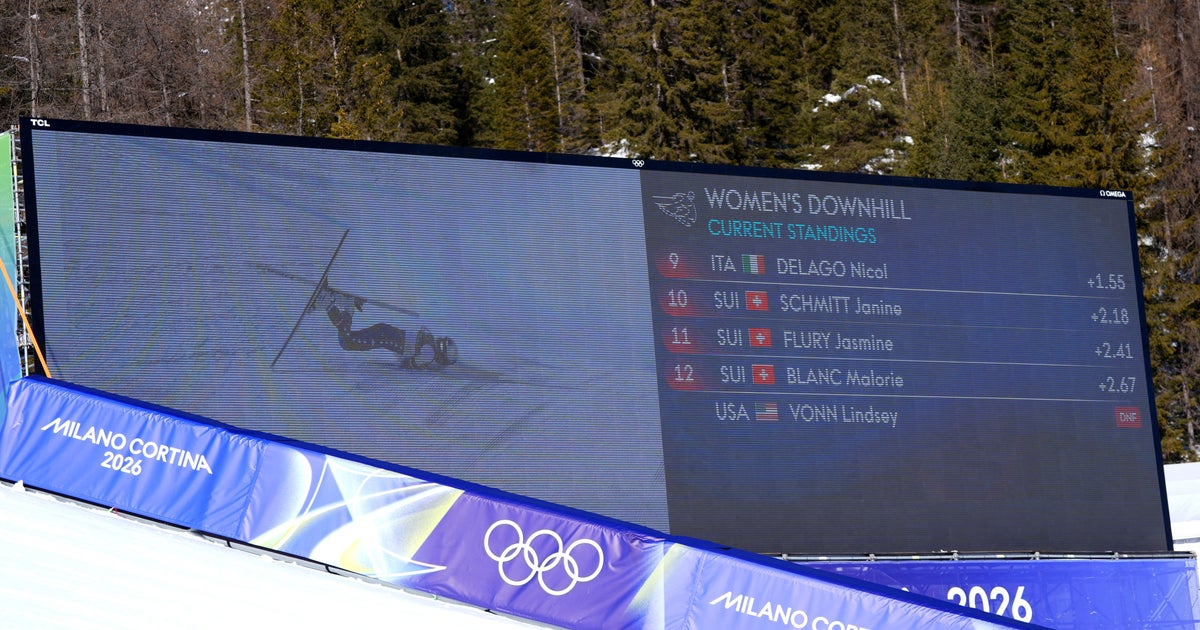
Seconds into what was supposed to be her triumphant Olympic return, disaster struck. As Vonn hurtled down the course at Cortina d’Ampezzo, she appeared to clip a flag marking the side of the run. In an instant, everything went wrong. The legendary skier lost control, flew sideways through the air, and crashed violently to the ground, hitting her head. The cheering crowd immediately fell silent as they watched the horrifying scene unfold. Vonn lay motionless on the snow, responsive but unable to get up. What made the moment even more harrowing were the sounds that echoed across the mountain—Vonn could be heard screaming that she couldn’t remove her skis, a sign of how serious her condition was. Medical personnel rushed to her side, working carefully to stabilize the injured athlete before placing her on a stretcher. As a helicopter arrived to airlift her from the course, the reality of the situation became clear to everyone watching. This wasn’t just another fall—this was potentially the end of Vonn’s remarkable comeback story, and possibly the final chapter in her competitive skiing career.
A Family’s Anguish and a Crowd’s Silent Prayers
Among the spectators watching from the stands was Vonn’s father, Alan Kildow, whose reaction spoke volumes about the pain of watching his daughter suffer such a catastrophic injury. As medical personnel worked on Vonn, Kildow stared down at the ground, unable to watch the scene unfolding before him. Also in attendance was celebrity fan Snoop Dogg, who joined the hushed crowd in watching quietly as emergency responders worked to remove the star skier from the course where she had created so many wonderful memories throughout her career. The emotional impact of the crash rippled through the spectators who had come from around the world to witness what they hoped would be a triumphant moment in sports history. Thomas Pronske from Austin, Texas, who was watching from the sidelines, expressed what many were feeling: “I hope she’s OK. It did not look good.” Having torn his own ACL, Pronske understood the pain Vonn was experiencing. He had traveled to the Olympics specifically to see Vonn, inspired by her incredible comeback story and her ability to overcome adversity. His mother, Maria Pronske, had been so moved by Vonn’s determination that she had come to watch the event on her birthday despite having an injured knee herself. The cruel irony of witnessing her inspiration suffer such a terrible fall wasn’t lost on her as she expressed her sympathy and prayers for Vonn’s recovery.
The Impact on Teammates and the Skiing Community
The crash didn’t just affect Vonn and her family—it sent shockwaves through the entire Team USA skiing community. Crista Kosher, cousin of American skier Jacqueline Wiles, described seeing Vonn airlifted off the mountain as “absolutely devastating.” She explained that Vonn and Wiles had raced together for years, developing a mentor-mentee relationship that went far beyond simple teammates. Watching a friend and mentor go down in such a dramatic fashion presented an enormous emotional challenge for everyone on the team. Charles Christianson, a retired ski racer from Park City, Utah, called the crash “absolutely heartbreaking” but also acknowledged that it was entirely consistent with who Vonn was as a competitor. He noted that everyone had come to celebrate Vonn’s incredible career, and while the outcome was tragic, it was “true to form” for the champion skier. Vonn had never been one to play it safe or hold back. She knew the risks involved in competing with a fully ruptured ACL, but acceptance of risk is fundamental to ski racing at the highest level. Christianson observed the determination in Vonn’s eyes as she left the starting gate—she was charging hard, committed to either reaching the podium or giving everything she had trying. The respect shown by the crowd and fellow competitors demonstrated just how important Vonn had been to the sport throughout her career.
A History of Competing Through Pain
What made Vonn’s decision to compete with a ruptured ACL somewhat less surprising was her history of pushing through severe injuries. Before her retirement in 2019, Vonn had competed with a torn lateral collateral ligament, three tibial fractures, and a bone bruise—and still managed to win a bronze medal. Her body had become something of a medical marvel, already containing one titanium knee (though notably, not the knee that was currently injured). This history of resilience and toughness had earned her admiration from fans and fellow athletes alike, but it also raised questions about the wisdom of competing in such a compromised physical state. The day before the race, a Team USA official had privately admitted that their biggest fear was exactly what ended up happening—a bad crash involving Vonn during the race. Given all the media attention surrounding her comeback story, the image of her being airlifted off the course was their worst-case scenario, both for Vonn’s health and for the narrative surrounding her return to competition. Yet despite these concerns, Vonn had shown promising form in Saturday’s training run, posting the third-fastest time behind teammate Breezy Johnson before the session was called off due to bad weather. Her coach, Aksel Lund Svindal, had been cautiously optimistic, noting that while it was a solid run, Vonn would need to find “one more gear” on race day when the competition intensified and everyone pushed harder.
The End of an Unforgettable Journey
In her social media post the night before the race, Vonn had reflected on the journey that brought her back to Olympic competition. She acknowledged that getting to these Olympics had been an odyssey, one that many people hadn’t believed possible from the start. A partial knee replacement had given her the chance to compete one more time, and she had seized that opportunity with both hands. When people asked why she would put herself through such an ordeal, her answer was refreshingly straightforward—she simply loved ski racing. It was that pure passion for the sport, rather than any external motivation, that drove her comeback. Vonn had been clear that she wasn’t uncertain about life outside of sport, wasn’t searching for meaning, attention, or financial gain. She knew herself completely and understood what she was capable of achieving. That self-knowledge and confidence had carried her through an extraordinary career that included 82 World Cup victories and three Olympic medals. Now, as she was airlifted away from what might be her final competitive run, that same courage and determination remained on full display. While the outcome wasn’t what anyone had hoped for, Vonn’s willingness to take the risk, to push herself one more time despite the odds, embodied everything that made her a legend in her sport. The image of her being carried off the mountain may have been heartbreaking, but it also served as a powerful reminder of the incredible dedication and bravery required to compete at the highest levels of alpine skiing.