


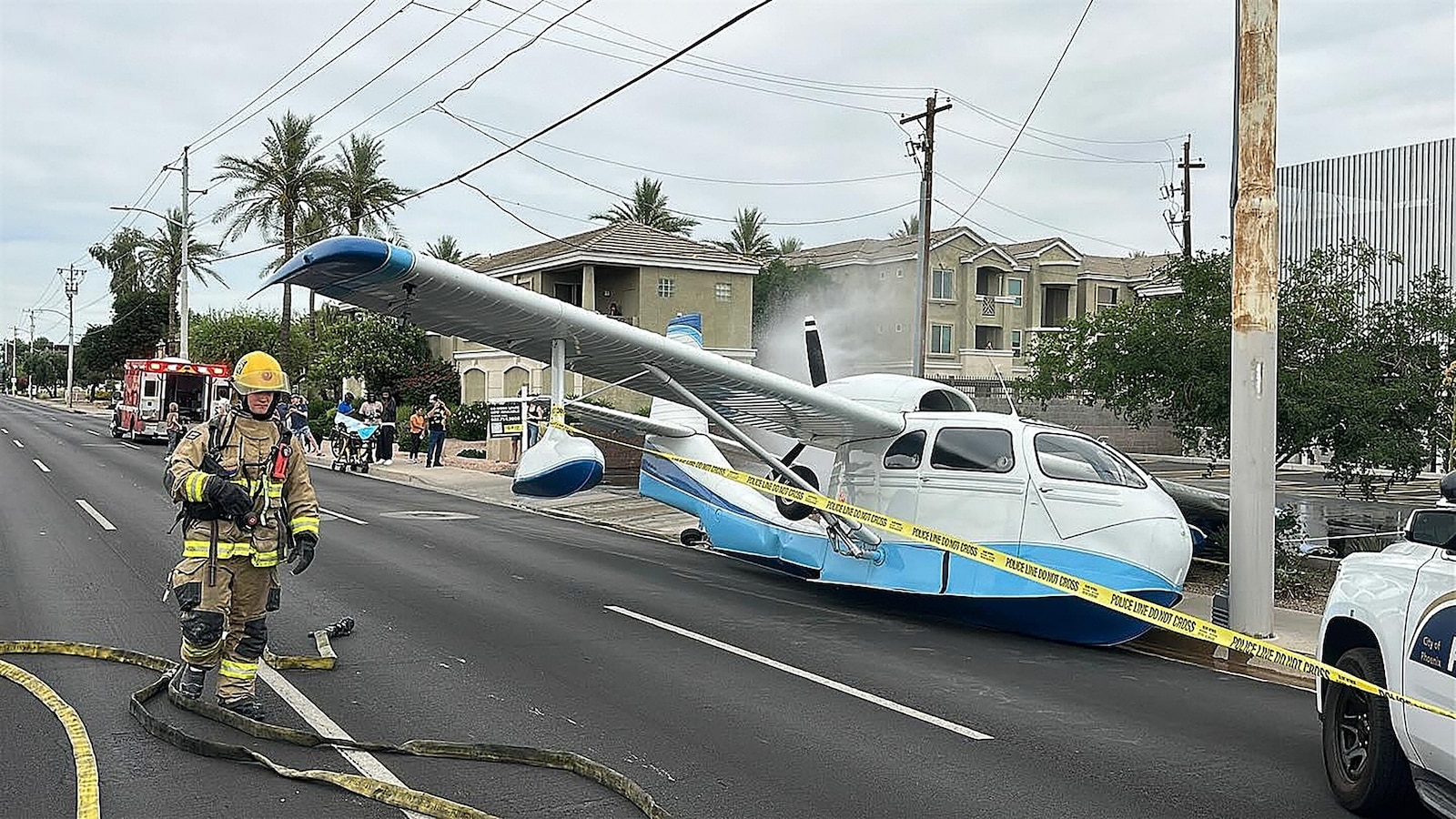

Miracle on 7th Street: Veteran Pilot’s Quick Thinking Saves Lives in Phoenix Emergency Landing
A Routine Flight Turns Into a Life-or-Death Situation
What began as an ordinary Sunday afternoon flight from a private airport near Phoenix, Arizona, quickly transformed into a terrifying emergency that would test the skills of even the most experienced aviator. Retired airline captain Mike Tragarz, a pilot with over forty years of flying experience, found himself facing every pilot’s nightmare when the engine of his rare amphibious seaplane began failing shortly after takeoff. With two passengers depending on him and precious little time to make critical decisions, Tragarz would need to draw upon every lesson learned throughout his extensive career. The incident, which unfolded on a busy Phoenix street over the weekend, serves as a powerful reminder of how quickly things can go wrong in aviation and how the combination of experience, quick thinking, and calm decision-making can mean the difference between tragedy and survival.
The aircraft involved was no ordinary plane—it was a Republic RC-3 Seabee, a distinctive amphibious aircraft manufactured in the 1940s with the unique capability of landing on both water and traditional runways. These vintage planes are increasingly rare, making this incident particularly notable in aviation circles. As Tragarz lifted off from the private airport with his two passengers, everything seemed normal. The weather conditions were typical for Phoenix, and there was no indication of the drama that was about to unfold. However, less than twenty minutes into what should have been a routine flight, the situation began to deteriorate rapidly, setting the stage for what officials would later describe as a miraculous outcome given the circumstances.
When Every Second Counts: The Emergency Unfolds
The crisis escalated with frightening speed, leaving Tragarz with virtually no time to contemplate his options or second-guess his instincts. As he later recounted to ABC News Phoenix affiliate KNXV, he was in the process of dialing in the frequency for Sky Harbor—Phoenix’s major airport—to declare an emergency when the engine began losing power dramatically. For any pilot, this represents one of the most terrifying scenarios imaginable: being caught between recognizing a problem and having the time to properly address it. The altitude was dropping, the engine was failing, and the ground was approaching rapidly. In such moments, years of training and experience must take over, allowing muscle memory and ingrained decision-making processes to guide actions when there’s no time for lengthy deliberation.
Tragarz’s decades of experience immediately kicked in as he assessed the rapidly evolving situation. He made the critical decision to stop attempting to communicate with air traffic control and instead focus entirely on the immediate task at hand: finding a suitable place to put the struggling aircraft down before it fell from the sky. “I just stopped everything and said to these guys, ‘We’re going to land, we’re going down. I’ve got to find a place to land,'” Tragarz recalled, describing the moment when he communicated the gravity of the situation to his passengers. His calm but direct communication likely helped prepare his passengers mentally for what was about to happen, possibly contributing to their ability to remain composed during the emergency and exit the aircraft quickly afterward.
A Split-Second Decision With Lives in the Balance
As the plane continued losing altitude, Tragarz scanned the urban landscape below, desperately searching for any option that might offer a chance of survival. Phoenix’s busy streets, residential neighborhoods, and commercial areas presented numerous hazards—power lines, buildings, traffic, pedestrians—all potential obstacles that could turn an emergency landing into a catastrophic crash. Then he spotted it: 7th Street, one of Phoenix’s major north-south arterials, appeared momentarily clear of traffic. “I looked down there and saw 7th Street, and it was clear,” he explained. “And I said, ‘Well, that’s where we’re going.'” This split-second decision—to aim for a busy city street rather than attempt to reach an airport or find an open field—demonstrates the type of rapid risk assessment that experienced pilots are trained to perform but hope they’ll never need to execute in a real emergency.
The choice to land on a street is never ideal, but in urban environments with limited alternatives, sometimes it represents the best of several dangerous options. Tragarz had to consider numerous factors in the mere seconds available to him: the width of the street, the presence or absence of overhead power lines, traffic conditions, the direction of the road relative to his aircraft’s heading, and whether he had enough altitude and glide distance to reach the targeted landing zone. The fact that he successfully navigated all these considerations while managing a failing aircraft speaks volumes about his skill and composure under pressure. The amphibious design of the Seabee, with its boat-hull fuselage, may have provided some additional structural protection during the unconventional landing, though it was designed for water landings rather than pavement.
The Dramatic Landing Captured on Camera
The extraordinary moments of the emergency landing were captured by surveillance cameras in the area, providing a dramatic visual record of the incident that would later circulate widely on news outlets and social media. The footage shows an ordinary car driving through the frame—a regular person going about their Sunday afternoon, completely unaware of the emergency unfolding above. Seconds later, the seaplane appears, skidding down the street in the opposite direction from the car, demonstrating just how close this incident came to potentially involving unsuspecting motorists. The plane continued down 7th Street before striking a water main and finally coming to a stop, the impact causing water to spray into the air. The video serves as a sobering reminder of the inherent risks associated with urban emergency landings and how quickly normal life can intersect with crisis.
Despite what the surveillance footage shows was clearly a violent and jarring landing—the plane skidding along pavement it was never designed to touch, colliding with infrastructure, and coming to an abrupt halt—the outcome was remarkably positive. All three occupants of the aircraft were able to exit on their own power, without requiring extraction by emergency responders. Phoenix Fire Department personnel who responded to the scene found the pilot and passengers standing near the damaged aircraft, shaken but without serious injuries. This outcome prompted officials to characterize the incident as miraculous, particularly given the numerous ways it could have resulted in tragedy. The fact that no pedestrians, motorists, or property on the ground were seriously affected added to the fortunate nature of the outcome.
Praise, Perspective, and Professional Humility
In the aftermath of the dramatic landing, one of the passengers spoke with KNXV and offered effusive praise for Tragarz’s handling of the emergency. “He saved us. He made [the] right decision at [the] right time. Everything was just perfect,” the grateful passenger stated, acknowledging that their survival was directly attributable to the pilot’s skill and judgment. Such testimonials highlight the immense responsibility that pilots carry every time they take passengers into the air and the trust that those passengers place in the pilot’s abilities. For Tragarz, this incident represented the culmination of a lifetime of training and experience being put to the ultimate test—and proving adequate to the challenge.
Characteristically for experienced professionals, Tragarz himself downplayed both his role and the damage to the aircraft when speaking with reporters after the incident. With a touch of humor, he minimized the situation by telling KNXV, “The only thing we have damaged here are the seats,” though the aircraft clearly sustained more significant damage from its unconventional landing. This type of understated response is common among veteran pilots, who tend to view emergency procedures as simply part of the job rather than opportunities for heroism. Tragarz also offered a philosophical reflection that resonates throughout the aviation community: “Every landing you can walk away from is a good one. And yeah, it wasn’t smooth, it wasn’t pretty, but yeah, we’re very fortunate.” This perspective—valuing survival above all else and maintaining humility even in the face of praise—speaks to a professional mindset developed over decades of flying.
When asked about what enabled him to handle the emergency so effectively, Tragarz offered a simple but profound observation: “Experience does pay off. I have to say that.” His more than four decades in aviation—likely encompassing thousands of flight hours, numerous aircraft types, and extensive training in emergency procedures—provided the foundation that allowed him to make split-second decisions with lives hanging in the balance. While modern aviation emphasizes technology and sophisticated systems, this incident underscores the enduring importance of human judgment, experience, and skill. No autopilot or computer system could have threaded the needle that Tragarz managed that Sunday afternoon, identifying a brief window on a busy street and successfully putting the plane down without loss of life. The National Transportation Safety Board has announced it will investigate the cause of the engine failure, which will hopefully provide insights that might prevent similar incidents in the future. For now, though, three people are alive to tell the tale of their emergency landing on a Phoenix street, thanks to a veteran pilot who kept his cool when everything started going wrong.