

Texas Man Charged After Gunfire Near White House During Vice Presidential Motorcade
A Chaotic Scene on the National Mall
In a frightening incident that unfolded in one of Washington D.C.’s most visited areas, federal prosecutors have brought serious charges against a Texas man who allegedly opened fire near the White House grounds, injuring an innocent bystander. Michael Marx, a 45-year-old resident of Midland, Texas, now faces a trio of federal charges that could result in substantial prison time: assaulting federal officers with a dangerous weapon, using and discharging a firearm during a crime of violence, and unlawful possession of a firearm by a convicted felon. The incident, which occurred on May 4th near the iconic Washington Monument, sent shockwaves through the nation’s capital and raised fresh questions about security in areas frequented by high-ranking government officials and thousands of tourists daily.
The timing of the incident made it particularly alarming. Vice President JD Vance’s motorcade was departing from the White House and passing through the intersection of 15th Street and Independence Avenue SW when the shooting occurred. This area, situated in the heart of the National Mall, is typically packed with tourists visiting America’s most famous monuments and museums. The fact that someone would discharge a firearm in such a crowded location, with families and children present, amplifies the severity of the situation. U.S. Attorney Jeanine Pirro didn’t mince words when describing the alleged actions, stating that the government would prove Marx “carried an illegal firearm into the heart of Washington, D.C., opened fire at Secret Service officers near a crowded intersection, and shot an innocent bystander who was simply crossing the street with his family.” The message was clear: such reckless endangerment of public safety would be prosecuted to the fullest extent of the law.
How the Incident Unfolded
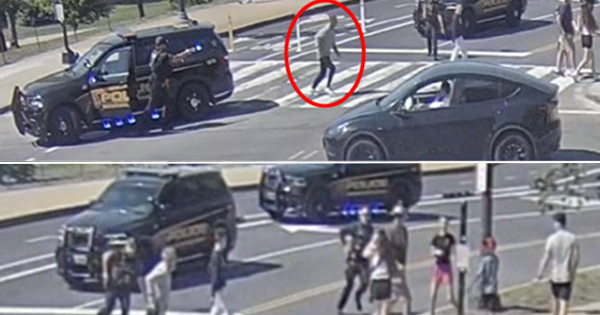
According to a detailed affidavit filed by a Secret Service agent in federal court, the confrontation began when a plainclothes agent noticed Marx walking along the sidewalk in a suspicious manner. The agent observed that Marx appeared to be concealing a firearm on the right side of his body, prompting immediate action. Uniformed Secret Service officers quickly responded to the location, encountering Marx among a group of pedestrians at a busy intersection. Surveillance camera footage, which was included in the court filing, captures the tense moments as three marked Secret Service vehicles pulled up to the crosswalk where Marx and other civilians were present.
As Secret Service officers approached Marx, the situation rapidly escalated. According to the affidavit, Marx reached into his waistband and pulled out a firearm while simultaneously running across the street. This action would have immediately been recognized by the trained officers as a lethal threat, particularly given the proximity to the Vice President’s motorcade. Once Marx reached the other side of the street, he allegedly turned and fired his weapon in the direction of a Secret Service officer. Tragically, a civilian witness who happened to be standing behind the officer was struck in the leg by the gunfire. This unnamed victim, who was simply in the wrong place at the wrong time, became an unintended casualty of what authorities describe as a dangerous and unprovoked attack on federal law enforcement.
The Secret Service officer, trained to respond to exactly these types of threats, returned fire. The officer’s shots struck Marx multiple times, hitting him in the hand, left arm, and upper abdomen. While these injuries required immediate medical attention, Marx survived the encounter and was transported to a local hospital for treatment. The quick response by the Secret Service likely prevented further casualties and stopped what could have become an even more tragic situation in one of the most symbolically important areas of the nation’s capital.
Disturbing Statements and Criminal History
The details that emerged after Marx was subdued paint a troubling picture of his state of mind during the incident. According to the affidavit, while Marx was being transported to the hospital for treatment of his gunshot wounds, he made several disturbing statements to law enforcement. He allegedly said “F**k the White House” and repeatedly shouted “Kill me, kill me, kill me.” These statements suggest either extreme distress, possible mental health issues, or potentially some ideological motivation behind his actions. Investigators will likely examine these statements closely as they build their case and try to understand what drove Marx to allegedly commit such a dangerous act in the heart of the nation’s capital.
Adding another layer of seriousness to the charges, prosecutors revealed that Marx was legally prohibited from possessing a firearm due to his criminal history. According to charging documents, Marx was convicted of drug trafficking in Florida back in 2011. Under federal law, individuals convicted of felonies are generally prohibited from owning or possessing firearms. Additionally, Marx did not have a license to carry a gun in Washington D.C., where gun laws are particularly strict. The combination of these factors means that Marx was allegedly breaking multiple laws simply by having the weapon in his possession, even before he reportedly fired it at federal officers.
The Broader Context of Security Challenges
This incident highlights the ongoing security challenges faced by the Secret Service and other federal law enforcement agencies tasked with protecting high-ranking government officials in public spaces. Unlike in many other countries where leaders travel through closed-off routes or maintain significant distance from the general public, American officials often travel through areas accessible to tourists and residents. The National Mall, in particular, represents a unique security challenge because it is both a symbol of American democracy and one of the most visited tourist destinations in the country. Balancing public accessibility with security needs is a constant challenge for law enforcement.
The fact that a plainclothes agent spotted Marx before the shooting began demonstrates the multiple layers of security that surround presidential and vice-presidential movements. However, even with vigilant agents and rapid response, an innocent bystander was still injured. This reality underscores how difficult it can be to prevent violence in crowded public spaces, even with highly trained security personnel present. The incident will likely prompt reviews of security protocols and procedures, particularly regarding how to handle potential threats in areas crowded with civilians who could be caught in crossfire.
Legal Proceedings and Potential Consequences
As of Wednesday afternoon, when the charges were announced, no future court appearance had been scheduled for Marx according to public court dockets. This is not unusual in federal cases, particularly when a defendant may still be hospitalized or when initial proceedings are being arranged. Marx will eventually face a federal judge who will determine conditions for his detention pending trial, given the serious nature of the charges against him. Federal prosecutors will almost certainly argue that Marx poses a danger to the community and a flight risk, making him a candidate for detention without bond until his case is resolved.
The charges Marx faces carry severe potential penalties. Assaulting federal officers with a dangerous weapon is a serious federal offense that can result in decades of imprisonment. Using and discharging a firearm during a crime of violence carries mandatory minimum sentences that must be served consecutively to any other sentence imposed. Being a felon in possession of a firearm is itself a federal crime with substantial penalties. If convicted on all counts, Marx could potentially face life in prison. The prosecution, led by U.S. Attorney Jeanine Pirro’s office, appears prepared to pursue the case aggressively, emphasizing both the threat to federal officers and the danger posed to innocent civilians. As the case moves forward through the federal court system, it will serve as a stark reminder of the risks faced by law enforcement officers protecting our nation’s leaders and the innocent people who can become victims when violence erupts in public spaces.