


Life Under Russian Occupation: The Hidden Crisis in Ukraine’s Controlled Territories
A Territory Under Siege
Nearly four years after Russia launched its full-scale invasion of Ukraine, approximately 20% of Ukrainian territory remains under Moscow’s control. Within these occupied regions, an estimated 3 to 5 million people continue to endure what can only be described as a humanitarian nightmare. These residents face daily struggles with basic necessities that many of us take for granted—adequate housing, clean water, reliable electricity, heating during brutal winters, and access to healthcare. The situation has become so dire that even Russian President Vladimir Putin himself has been forced to acknowledge the “many truly pressing, urgent problems” plaguing the illegally annexed regions of Donetsk, Luhansk, Kherson, and Zaporizhzhia. These territories were seized by Moscow in the months following the invasion that began on February 24, 2022, in what the international community has universally condemned as a violation of international law and Ukrainian sovereignty.
The reality for those living under occupation extends far beyond physical hardship. Russian authorities have systematically imposed their citizenship, language, and culture upon unwilling residents, forcibly rewriting the identities of entire communities. This cultural erasure begins in the classrooms, where school curricula and textbooks have been replaced with Russian versions that present a distorted narrative of history and current events. For many Ukrainians who have managed to escape these occupied territories, the stories they tell paint a picture of a population living in constant fear. The threat of being accused of sympathizing with Kyiv hangs over everyone like a dark cloud. Those suspected of maintaining loyalty to Ukraine face imprisonment, torture, and in some cases, death. According to Oleksandra Matviichuk, head of the Nobel Peace Prize-winning Center for Civil Liberties, Russia has established “a vast network of secret and official detention centers where tens of thousands of Ukrainian civilians” are held indefinitely without charge—a practice that flies in the face of international humanitarian law. Despite repeated allegations from U.N. human rights officials regarding the torture of civilians and prisoners of war, Russian officials have consistently refused to comment or address these serious accusations.
Personal Stories of Terror and Escape
The human cost of occupation becomes painfully clear through the experiences of people like Inna Vnukova and her family. When Russian forces swept through the Luhansk region, Vnukova spent the initial days of occupation hiding with her family in a damp, cold basement in their village of Kudriashivka. Outside their makeshift shelter, Russian soldiers terrorized residents, establishing checkpoints throughout the village, looting homes, and creating an atmosphere of constant fear punctuated by the horrifying sounds of continuous shelling. “Everyone was very scared and afraid to go outside,” Vnukova recalled during an interview from Estonia, where she has since built a new life. The occupation forces specifically targeted individuals who had worked as officials or civil servants—people like Vnukova and her husband, Oleksii Vnukov, who had been a court security officer.
In mid-March 2022, facing impossible choices that no family should ever have to make, Vnukova made the agonizing decision to flee with her 16-year-old son, Zhenya, and her brother’s family. This meant temporarily leaving her husband behind—a separation that could have easily become permanent. Their escape was harrowing: they drove toward the nearby town of Starobilsk, waving a white sheet from their car windows as mortars exploded around them, hoping that this universal symbol of surrender might protect them from being targeted. Oleksii stayed behind for nearly two more weeks, during which Russian soldiers threatened to kill him on two separate occasions before he finally managed to escape and reunite with his family. Reflecting on those left behind, including the couple’s parents, Oleksii’s words carry the weight of survivor’s guilt: “The people there aren’t living, they’re just surviving.” Their village, which once had a population of 800, now shelters only about 150 people—a community decimated by war and occupation.
Today, the Vnukov family has started over in Estonia. Inna works in a printing house, while Oleksii has found employment as an electrician. Their son Zhenya is now 20 years old, and they have welcomed a new addition to their family—a 1-year-old daughter named Alisa, born into freedom but carrying the legacy of her family’s trauma. Their story, while ultimately one of survival and resilience, represents just one of millions disrupted by the invasion.
The Destruction of Mariupol and Its Aftermath
Perhaps no single city symbolizes the devastating brutality of Russia’s invasion more than Mariupol. Russian forces besieged this strategically important port city for weeks before it finally fell in May 2022. The bombing of the Donetsk Academic Regional Drama Theater on March 16, 2022, stands as one of the war’s darkest moments—an Associated Press investigation determined that nearly 600 people in and around the building were killed, making it the single deadliest known attack against civilians in the entire conflict. The word “CHILDREN” had been written in large letters outside the theater in Russian, clearly visible from the air, yet the building was bombed nonetheless. Most of Mariupol’s pre-war population of approximately half a million people fled the city, but many had no choice but to hide in basements and cellars, hoping to survive the relentless bombardment.
A former actor from Mariupol, now living in Estonia, shared his experience of hiding for months with his parents in these underground shelters. He spoke to journalists on the condition of anonymity, fearing that revealing his identity could endanger his 76-year-old parents who remain in the occupied city. These elderly parents faced an impossible choice: they took Russian citizenship in order to access necessary medical care and to receive a one-time payment equivalent to $1,300 per person as compensation for their destroyed home. This choice illustrates the cruel dilemma facing many residents—accept the occupier’s authority and benefits, or maintain principle while potentially suffering or dying from lack of basic services.
Housing remains a critical problem in Mariupol, even though the current population is roughly half of what it was before the war. In a bitter irony, new apartments are being sold to Russian newcomers encouraged to relocate to the occupied territories, while those who lost their homes in the bombardment receive no priority for this housing. Complaints about this policy have been sent via video directly to Putin, though it’s unclear what, if any, response has resulted. The situation is further complicated by the fact that not everyone in the occupied territories opposes Russian control. The former actor estimates that about half of his old theater troupe’s members support the Kremlin. Still, the atmosphere of fear and suspicion pervades even family communications—his parents have asked him not to send postcards written in Ukrainian because “it could be dangerous,” a chilling reminder that language itself has become politicized and potentially life-threatening.
Crumbling Infrastructure and Daily Survival
Years of warfare combined with systematic neglect and inadequate Russian administration have left municipal services in the occupied territories in a state of near-collapse. The challenges facing residents go far beyond the dramatic violence of the battlefield—they face a grinding daily struggle against failing infrastructure during one of the harshest winters on record. In Alchevsk, a city in the Luhansk region, over half of all homes are without heat during bitterly cold winter months when temperatures regularly plunge well below freezing. Local authorities have established five warming stations where residents can go to prevent freezing to death, but this solution is woefully inadequate for a population accustomed to modern heating systems.
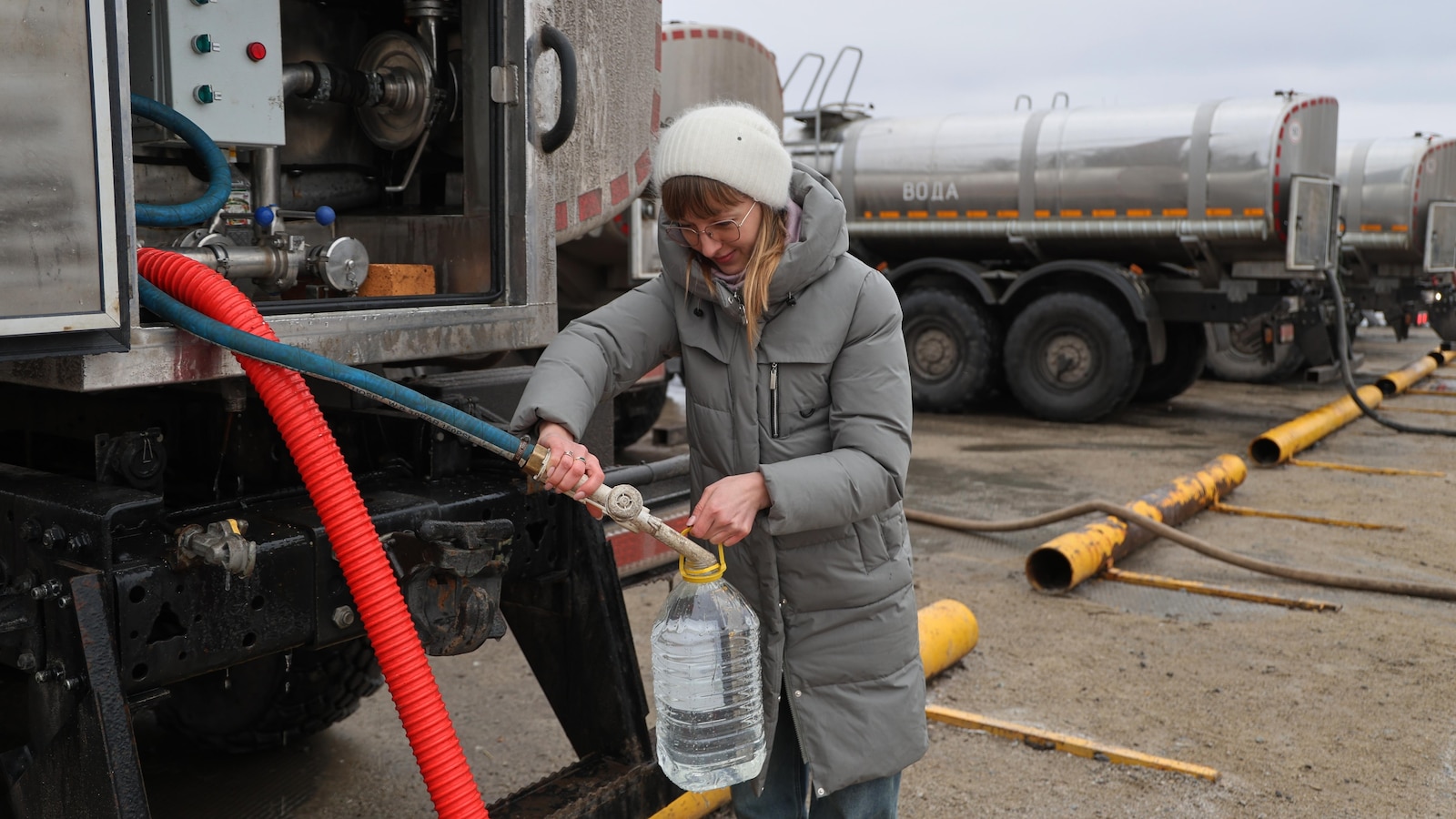
In the Donetsk region, the water supply system has deteriorated to the point where water trucks must fill barrels outside apartment blocks—a scene more reminiscent of a developing country than 21st-century Europe. One resident, speaking anonymously for fear of repercussions, described how these barrels freeze solid during winter, creating both a practical problem and a source of community tension. “There’s constant squabbling over water,” she explained, highlighting how the breakdown of basic services erodes social cohesion and turns neighbors against each other in competition for scarce resources.
The northeastern city of Sievierodonetsk illustrates the demographic catastrophe unfolding in these regions. Once home to 140,000 people, the city suffered massive damage during the fighting and now has only about 45,000 residents, most of them elderly or disabled—those who were unable or unwilling to flee. The medical infrastructure has collapsed to the point where only a single ambulance crew serves the entire city. The hospital struggles to maintain operations, relying on Russian medical workers who rotate in for temporary assignments rather than establishing permanent care. A 67-year-old former engineer from the city, also speaking anonymously for fear of retribution, painted a picture of a community in slow-motion collapse, where the remaining residents are largely those with no other options.
The Occupation’s Systematic Repression
Moscow has launched various initiatives to encourage Russians to relocate to the occupied territories, offering financial incentives and benefits designed to change the demographic makeup of these regions. Teachers, doctors, and cultural workers are promised substantial salary supplements if they commit to living in the occupied areas for at least five years. This policy serves multiple purposes: it addresses the severe shortage of professionals in these devastated regions, provides a veneer of normalization, and gradually replaces the Ukrainian population with Russian citizens, potentially making future reintegration with Ukraine more difficult.
The experience of Stanislav Shkuta, a 25-year-old from Nova Kakhovka in the Kherson region, illustrates the danger facing anyone suspected of Ukrainian sympathies. Shkuta narrowly escaped arrest on several occasions before finally reaching Ukrainian-controlled territory in 2023. He vividly recalls an incident when Russian soldiers stopped a bus he was riding. “Men and women were asked to strip to the waist to see if they had Ukrainian tattoos,” he explained—a humiliating search designed to identify those with patriotic symbols. During the inspection, Shkuta “turned white with fear, wondering if I’d cleared everything on my phone,” knowing that a single Ukrainian flag image or message supporting Kyiv could result in arrest or worse. Now safely in Estonia, Shkuta maintains contact with friends who remained in Nova Kakhovka, and their reports indicate that life has significantly worsened. Suspected Ukrainian sympathizers are routinely stopped on the street for questioning, and surprise door-to-door inspections keep the population in a constant state of anxiety.
Mykhailo Savva of the Center for Civil Liberties in Ukraine has documented how “Russian special services continue to identify disloyal Ukrainians, extract confessions, and continue to detain people.” Residents face random document checks, mass searches of homes and businesses, and an atmosphere where trust has been weaponized—neighbors may inform on neighbors, and even family members may be suspicious of one another. Human rights organizations have documented Russia’s use of “filtration camps” early in the war, facilities designed to identify potentially disloyal individuals through interrogation and screening. Particular targets included anyone who had worked for the Ukrainian government at any level, those who had helped the Ukrainian army in any capacity, individuals with relatives serving in the military, as well as journalists, teachers, scientists, and politicians—essentially anyone with influence or a public platform.
The Scale of Human Rights Violations
According to Ukrainian Human Rights Ombudsman Dmytro Lubinets, approximately 16,000 civilians have been illegally detained by Russian authorities in the occupied territories. However, he acknowledges that this figure could be substantially higher because many detainees are held incommunicado—their families don’t know where they are, whether they’re alive or dead, or what charges, if any, have been brought against them. This practice of forced disappearance is a violation of international humanitarian law and creates a climate of terror that extends far beyond those actually detained. When people can simply vanish without trace or accountability, everyone becomes vulnerable, and resistance becomes nearly impossible.
Despite acknowledging some of these problems, Putin’s response has been inadequate to the scale of the crisis. In a September address, he stated, “I know how difficult it is now for the residents of the liberated cities and towns. There are many truly pressing, urgent problems.” He specifically mentioned the need for reliable water supplies and access to healthcare, announcing the launch of a “large-scale socioeconomic development program” for the occupied regions. However, the gap between these promises and the reality on the ground remains vast. The fundamental issue is that no amount of Russian investment can make up for the destruction caused by the invasion itself, nor can it address the underlying injustice of the occupation. The residents of these territories didn’t ask to be “liberated” by Russia—they were subjected to a brutal military invasion and now find themselves trapped in a humanitarian crisis with no clear end in sight, caught between the trauma of the past, the hardship of the present, and an uncertain future that depends on the outcome of a war still raging around them.