



American Triumph Tinged with Tragedy: Breezy Johnson’s Golden Moment at Milano Cortina
The 2026 Milano Cortina Winter Olympics delivered both jubilation and heartbreak for the United States ski team on Saturday, as Breezy Johnson captured America’s first gold medal of the Games in the women’s downhill while her teammate and skiing legend Lindsey Vonn suffered a devastating crash that may have ended her illustrious career. The contrasting fortunes of these two athletes on the same sun-drenched Italian mountainside encapsulated the brutal beauty of alpine skiing—a sport that demands absolute courage and can deliver both glory and crushing disappointment within seconds.
A Golden Run Down the Olympia delle Tofana
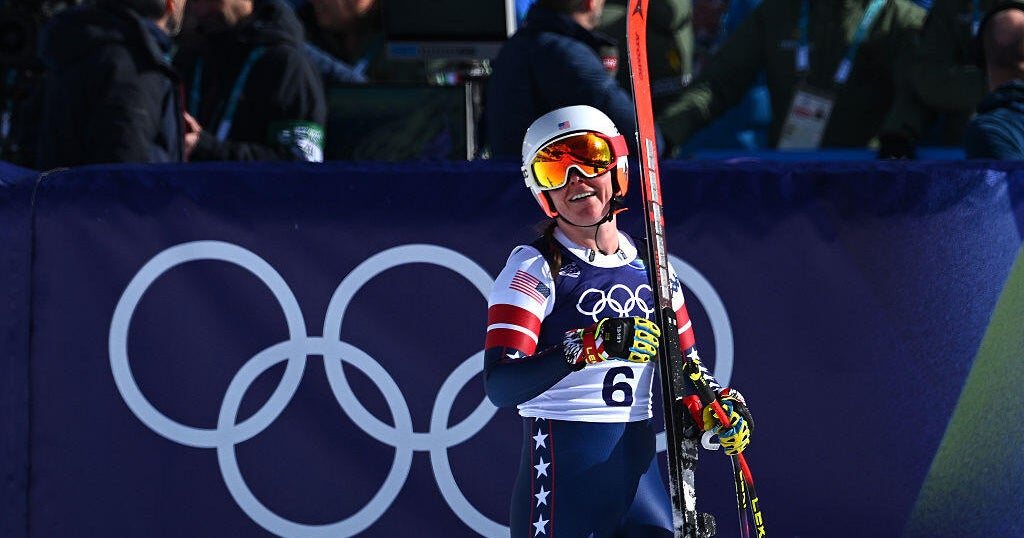
At 30 years old, Breezy Johnson delivered the performance of her life on one of the most iconic downhill courses in the world. Racing as the sixth competitor down the Olympia delle Tofana course in Cortina, Johnson dominated from start to finish, posting a time of 1:36.10 that none of her rivals could match. Her aggressive yet controlled run on the challenging Italian slope showcased years of dedication, technical mastery, and the kind of fearless commitment that separates Olympic champions from the merely talented. As she crossed the finish line and saw her name atop the leaderboard with a green light indicating the fastest time, Johnson’s reaction was one of controlled elation—the kind that comes from an athlete who has endured hardship and knows the value of the moment.
The gold medal is Johnson’s first Olympic medal of any color, making it all the more special. She became only the second American woman ever to win Olympic gold in the downhill, joining Lindsey Vonn, who accomplished the feat at the 2010 Vancouver Games. The significance of this achievement cannot be overstated in the context of American alpine skiing history. Germany’s Emma Aicher took the silver medal, while Italy’s Sofia Goggia claimed bronze in front of her home crowd, but the day belonged to Johnson. As she stood on the podium during the medal ceremony with the American flag being raised and the national anthem playing, Johnson was visibly emotional, tears streaming down her face as the weight of her accomplishment washed over her. “I had a good feeling about today. I sort of still can’t believe it yet,” she said afterward. “I don’t know when it will sink in.”
The Long Road Back from Adversity
Johnson’s path to Olympic gold was anything but straightforward, making her victory even more remarkable. Her journey included significant obstacles that would have ended the careers of athletes with less determination. Most notably, she missed the 2022 Beijing Olympics due to a knee injury that required extensive rehabilitation. The physical setback was devastating for an athlete in her prime competitive years, forcing her to watch from the sidelines as her teammates and rivals competed for Olympic glory without her. But Johnson’s challenges extended beyond physical injury.
In a controversy that threatened to derail her career entirely, Johnson received a 14-month ban for missing three anti-doping examinations and violating “whereabouts” rules—regulations that require athletes to keep anti-doping authorities informed of their location to facilitate random testing. The ban, which expired in December 2024, cast a shadow over her reputation and kept her away from competition during what should have been peak years. For many athletes, such a suspension would have marked the beginning of the end, but Johnson refused to let it define her. She maintained her innocence regarding any intentional wrongdoing, served her time away from competition, and returned with renewed focus. Her comeback was validated when she won the world championship last February, proving that her talent remained intact and setting the stage for her Olympic triumph.
Lindsey Vonn’s Heartbreaking Crash
While Johnson was experiencing the highest high of her career, her teammate Lindsey Vonn was enduring one of the lowest moments in a career that has seen both tremendous triumph and terrible crashes. Vonn, who at 40 years old had come out of retirement to compete in what many believed would be her final Olympics, was considered a gold medal favorite despite her age and extensive injury history. However, just a week before the downhill race, she ruptured her ACL, casting serious doubt on her participation. In a display of the toughness that has defined her career, Vonn chose to compete anyway, hoping that her experience and technical skill could overcome her physical limitations.
The attempt ended in disaster just 13.4 seconds into her run. Vonn cut the line too tightly on the opening traverse of the course, and her right ski pole snagged a gate, jerking her violently off balance. What happened next was every skier’s nightmare—she lost complete control, was spun around in the air, and crashed hard on the unforgiving snow. The sound of her screaming echoed across the mountain, a chilling reminder of the physical toll these athletes endure. Medical personnel quickly surrounded her as she lay on the course, and spectators and competitors alike held their breath, hoping for the best but fearing the worst.
Following standard protocol for serious injuries during alpine competition, Vonn was carefully strapped to a gurney and airlifted from the mountain by helicopter. The dramatic images of the helicopter carrying away one of skiing’s greatest champions sent shockwaves through the skiing community and beyond. While the full extent of her injuries wasn’t immediately known, the crash raised serious questions about whether the 82-time World Cup winner had competed in her final race. For an athlete who has given so much to the sport, who has crashed and come back countless times, who postponed retirement because of her enduring love for skiing, the possibility that her career might end this way was almost too painful to contemplate.
A Community United in Mixed Emotions
The collision of Johnson’s triumph with Vonn’s tragedy created an emotionally complex atmosphere for the American team. Johnson, in her moment of greatest achievement, couldn’t help but think of her fallen teammate. “I hope it’s not as bad as it looked,” she said, her voice heavy with concern. “Sometimes, because you love this course so much, when you crash on it and hurts you like that, it hurts that much worse. My heart just goes out to her.” These words revealed the tight-knit nature of the skiing community, where competitors are simultaneously rivals and sisters, sharing the unique experience of hurtling down mountains at speeds that most people can’t imagine.
The other American competitors in the race, Jacqueline Wiles and Isabella Wright, finished in 5th and 21st places respectively. While Wiles can be proud of her top-five finish at the Olympic level, both were undoubtedly processing the same mixture of emotions—happiness for Johnson’s gold, concern for Vonn, and the ever-present awareness that they, too, are just one mistake away from a similar fate. This emotional complexity is part of what makes alpine skiing so compelling and so difficult, both for the athletes who compete and the fans who watch.
The Essence of Alpine Skiing’s Risk and Reward
Saturday’s events at Cortina perfectly encapsulated everything that makes downhill skiing one of the most thrilling and dangerous sports in the Winter Olympics. The margins between victory and disaster are measured in hundredths of a second and fractions of inches. A slight miscalculation, a momentary lapse in concentration, or simply bad luck can transform a gold medal run into a career-ending crash. The athletes who choose this sport do so knowing these risks, driven by a love of speed, a need to test themselves against the mountain and the clock, and the pursuit of those perfect runs where everything comes together.
Breezy Johnson experienced that perfection on Saturday, threading the line between aggression and control to produce a run that no one could match. Lindsey Vonn, trying to summon that same magic one more time despite a broken body, discovered once again that sometimes the mountain wins. Both outcomes are part of the sport’s nature. As the Olympics continue and the skiing world processes these dramatic events, Johnson will rightfully celebrate her gold medal—the culmination of years of work, the reward for perseverance through injury and suspension, and the fulfillment of an Olympic dream. At the same time, the skiing community will rally around Vonn, hoping for her recovery and celebrating a career that has inspired countless athletes, regardless of how it ends. In the space of a single race, we witnessed both why athletes are drawn to this magnificent, unforgiving sport and why those who love it accept that heartbreak and triumph are often inseparable companions on the mountain.