


The Supreme Court Battle Over Mail-In Ballot Deadlines: What’s at Stake for American Democracy
A Constitutional Question That Could Reshape Voting Across America
The United States Supreme Court is preparing to hear arguments in a case that could fundamentally alter how millions of Americans cast their votes in future elections. The dispute, known as Watson v. RNC, centers on a seemingly straightforward question: Can states count mail-in ballots that are postmarked by Election Day but arrive in the days following? While this might sound like a simple administrative matter, the implications reach far beyond Mississippi, the state at the heart of this legal battle, and could affect voting procedures in more than a dozen states across the country.
At its core, this case pits state sovereignty against federal election standards, raising questions about who ultimately controls the mechanics of American democracy. Mississippi’s law, like similar statutes in thirteen other states and the District of Columbia, allows election officials to count ballots that arrive up to five days after Election Day, as long as they bear a postmark showing they were mailed on or before the designated election date. The Republican National Committee, Mississippi’s state GOP, and the state’s Libertarian Party have challenged this practice, arguing it conflicts with federal laws dating back to the 1800s that established a uniform Election Day—the Tuesday after the first Monday in November. Their position is straightforward: if Congress set a specific day for federal elections, then all voting activities, including the receipt of ballots, must be completed by that date. This legal challenge comes against a backdrop of intense political rhetoric about voting by mail, with former President Trump continuing to characterize mail-in voting as fundamentally corrupt and pushing for severe restrictions or elimination of the practice altogether. The outcome of this Supreme Court case could determine not just how votes are counted in Mississippi, but could potentially upend voting procedures nationwide, affecting everything from routine elections to how overseas military personnel participate in American democracy.
The Legal Battle: From District Court to the Supreme Court
The journey of this case through the federal court system reveals the complexity and controversy surrounding the issue. Initially, a U.S. district court upheld Mississippi’s grace period law, reasoning that when Congress originally enacted federal election-day statutes in the nineteenth century, the term “election” was commonly understood to mean the final choice of a candidate by the voter—the act of marking and submitting a ballot, not necessarily when election officials received it. This interpretation supported the state’s position that as long as voters made their choices by Election Day, the timing of when those choices reached election offices was an administrative matter within state control.
However, the case took a dramatic turn when it reached the U.S. Court of Appeals for the 5th Circuit. A three-judge panel reversed the lower court’s decision, concluding that federal law supersedes Mississippi’s deadline because “election” day should be understood as the day by which ballots must not only be cast by voters but also received by state election officials. The appellate court’s reasoning was stark: “While election officials are still receiving ballots, the election is ongoing: The result is not yet fixed, because live ballots are still being received.” This interpretation fundamentally redefined what constitutes an election, shifting focus from the voter’s act of choosing to the complete administrative process of collecting all votes.
Mississippi Secretary of State Michael Watson, a Republican who is defending the state’s law despite his party affiliation, appealed to the Supreme Court, which agreed to hear the case in November. Watson’s defense rests on principles of federalism—the constitutional framework that divides power between federal and state governments. He argues that the Constitution’s Elections Clause explicitly gives states the authority to set rules for federal elections, with offices at state and local levels overseeing their administration. According to this view, Mississippi and other states with post-Election Day deadlines have made legitimate policy choices that reflect local needs and circumstances. Watson contends that an “election” is fundamentally about voters making their choice of federal officers, and under Mississippi law, all voters must make that choice by Election Day, regardless of whether they vote in person or by mail. “It does not matter—as far as the federal election day statutes are concerned—that election officials in Mississippi may receive some ballots after election day,” Watson argues. “Only ballot casting is essential to an election.” This distinction between when a vote is cast and when it is received forms the crux of the state’s defense and raises profound questions about the nature of voting in modern America.
The Republican Challenge: Uniformity, Integrity, and the Definition of Election Day
The Republican National Committee’s challenge to Mississippi’s law reflects broader conservative concerns about election administration and what they characterize as a need for uniformity and security in the voting process. Their lawyers argue that the election ends definitively when the ballot box closes, not when voters individually make their selections. In this view, the term “election” refers to the entire public process of selecting candidates for federal office, which must conclude on the date Congress established. Election Day, they contend, encompasses both the submission and receipt of ballots, and both activities must be completed by the federally mandated date.
Jason Snead, executive director of the Honest Elections Project, a conservative organization advocating for election reform, frames the issue as a matter of congressional authority and historical practice. “When you look at what Congress did and why, and if you look at the way elections were conducted for most of the nation’s history after those laws went into effect, up until just the last few years it was widely understood that ballots had to be in the hands of election officials, and they had to be in the hands of those officials before Election Day was over in order to be counted,” Snead explains. From this perspective, the recent emergence of grace periods represents a departure from traditional American election practices and undermines the uniformity Congress sought to create in the nineteenth century.
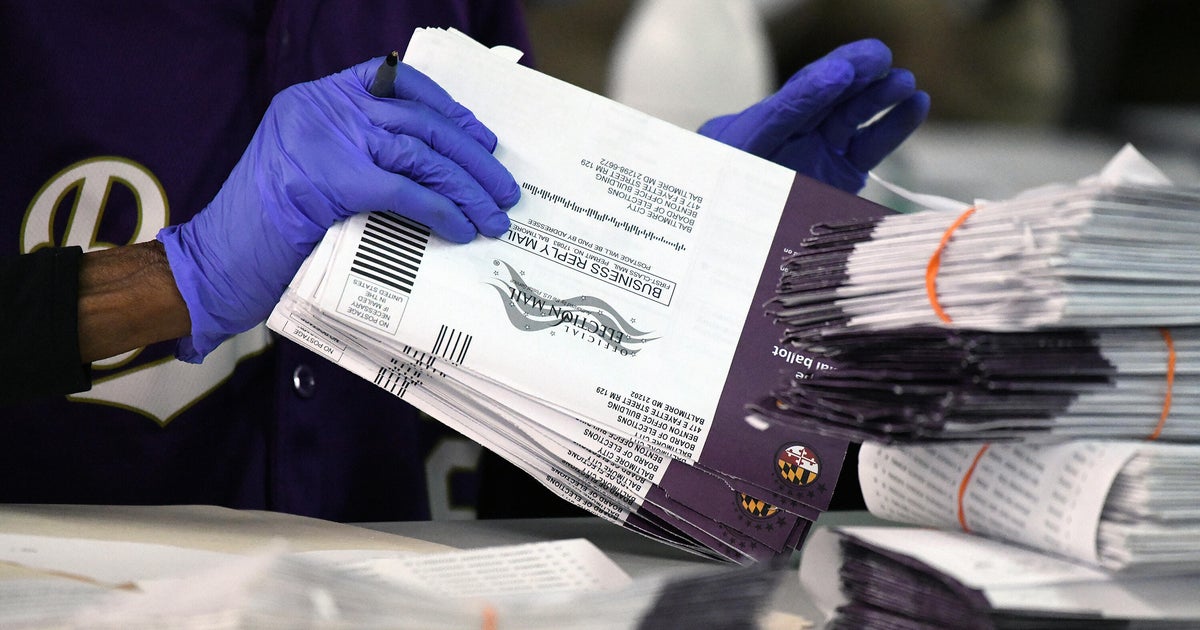
The RNC’s challenge also raises concerns about fraud and public confidence in elections, arguments that have gained prominence in recent years despite limited evidence of widespread voting irregularities. The Republicans argue that laws allowing officials to count late-arriving ballots “invite fraud and create the appearance of fraud” and have “hampered the efficiency and integrity of elections.” These claims echo rhetoric from former President Trump, who has relentlessly attacked mail-in voting and pressured Republicans in Congress to pass restrictive voting legislation like the SAVE America Act, which would require proof of citizenship to register and photo identification to vote. At least one GOP senator, Eric Schmitt of Missouri, has proposed amendments that would effectively end mail ballots entirely, with limited exceptions. However, election law experts strongly dispute claims of widespread mail-voting fraud. David Becker, a CBS News election law contributor and executive director of the Center for Election Innovation and Research, explains the reality: “If someone is really interested in going to jail, they should submit a fraudulent mail ballot because they have committed a federal and state crime, and they have created an extensive paper trail relating to their crime. It will get caught and they will get prosecuted and there’s evidence of that in those very rare cases where it occurs.” The extensive documentation required for mail voting—signatures, postmarks, barcodes—makes it one of the most traceable and therefore fraud-resistant forms of voting available, making claims of widespread abuse largely unsupported by evidence.
The Potential Consequences: Military Voters and Democratic Access
Perhaps the most concerning aspect of this case for voting rights advocates is its potential impact on military and overseas voters, a constituency that has traditionally enjoyed bipartisan support. Currently, twenty-nine states and the District of Columbia accept at least some military and overseas ballots that arrive after Election Day, recognizing the unique challenges faced by Americans serving abroad or living in foreign countries. There are nearly four million servicemembers and U.S. citizens living abroad who rely on mail ballots to participate in American democracy, and many depend on the grace periods now under legal challenge.
If the Supreme Court adopts the 5th Circuit’s interpretation that all ballots must be received by Election Day, the implications for these voters could be severe. David Becker articulates the dilemma: “If the Supreme Court decides to read into the Constitution a requirement that election officials have ballots in their hands by Election Day, I don’t know how they carve out an exception for military and overseas voters. There’s nothing in the Constitution that says that.” This concern is not merely theoretical—military mail from overseas can be unpredictable, subject to delays from military operations, international postal systems, and the simple logistics of moving mail across continents and oceans. The people who serve American interests abroad, whether in uniform, in embassies, or in private sector positions supporting national interests, could find themselves effectively disenfranchised through no fault of their own.
Beyond military voters, the case threatens to create chaos for election administration more broadly. Four states—Kansas, North Dakota, Ohio, and Utah—have already passed laws eliminating grace periods in anticipation of potential legal challenges, now requiring mail ballots to be received by Election Day to be counted. If the Supreme Court invalidates grace periods nationally, officials in the remaining states would face the daunting task of rapidly implementing new procedures and educating voters about changed requirements, potentially just months before the November midterm elections. Kristin Connelly, clerk-recorder and registrar of voters for Contra Costa County, California, where ballots postmarked by Election Day can arrive up to seven days later, emphasizes the practical challenges: “For those minority of states, red and blue, that allow for grace periods for mail ballots to be received, that would require some radical changes on their part and a huge burden of voter education, because voters are going to have to understand these new terms and understand that they shouldn’t be putting ballots into a mailbox close to an election.” In California’s November 2024 election, Contra Costa County alone received over 12,000 mail ballots during the seven-day grace period, of which more than 11,000 were properly postmarked and counted—votes from thousands of citizens that would have been discarded under the rules the RNC advocates. Connelly questions the wisdom of such disruption: “I question what problem they’re trying to solve. This is not making things more secure. This is making things more chaotic.”
The Broader Context: Three Election Cases Reshaping American Democracy
The Watson v. RNC case is one of three election-related disputes the Supreme Court is hearing in its current term, together forming a trilogy of cases that could fundamentally reshape voting rights and campaign finance in America. The second case challenges federal limits on coordinated spending between political committees and candidates, potentially opening new avenues for money to flow into political campaigns. The third raises questions about the constitutionality of race-based redistricting, with implications that could further weaken the Voting Rights Act and impact minority representation in Congress. Taken together, these cases represent the most significant examination of election law by the Supreme Court in years, coming at a time of intense partisan conflict over voting rights and election integrity.
This convergence of cases reflects deeper tensions in American democracy about who should control elections and how accessible voting should be. The Trump administration has firmly sided with the RNC in the ballot deadline case, with Solicitor General D. John Sauer arguing in a friend-of-the-court brief that federal law prohibits states from counting ballots received after Election Day: “[I]n setting a uniform ‘election day’ for the Nation, Congress mandated what those words have always required: On election day, the ballot box must close, and every vote must have been received.” This position aligns with President Trump’s broader agenda to gain more control over federal elections, including an executive order signed last March seeking to overhaul U.S. elections, though portions have been blocked by a federal judge. The administration’s involvement signals that this case is about more than administrative details—it represents competing visions of American democracy itself. One vision emphasizes uniformity, centralized control, and what proponents describe as election security through restrictive measures. The other prioritizes state flexibility, voter access, and recognition that in a vast, diverse nation, one-size-fits-all approaches may disenfranchise legitimate voters, particularly those facing geographical or logistical challenges in participating in democracy.
Looking Ahead: The Midterms and the Future of American Voting
The Supreme Court’s decision, expected by late June or early July, will arrive just months before the November midterm elections, creating potential for significant disruption if the Court sides with the RNC. Election officials across the fourteen states with grace periods would face an extraordinarily compressed timeline to revise procedures, update technology systems, print new informational materials, and most critically, educate voters about changed requirements. The challenge is compounded by the fact that many states conduct primary elections in the spring and early summer, meaning voting procedures could differ between primaries and the general election—a scenario election administrators consider a worst practice that confuses voters and suppresses participation.
Some potential workarounds exist if grace periods are eliminated. Counties could increase the number of ballot drop boxes, allowing voters to bypass the U.S. Postal Service entirely and hand-deliver their mail ballots by the Election Day deadline. However, as Connelly points out, this solution comes with its own difficulties: “If you’re from a smaller county, having to educate voters about this change would be really difficult.” Rural counties, which may span vast geographical areas with limited resources, would face particular challenges in establishing and maintaining sufficient drop box locations to serve dispersed populations. Moreover, drop boxes have themselves become politically controversial, with some states imposing restrictions on their use following the 2020 election.
The case ultimately poses fundamental questions about the balance of power in American federalism and the practical realities of modern voting. Connelly articulates the state perspective: “There is a role to play for the federal government, but in terms of states deciding how things should best work, I would hope that, in this case that’s going to be heard by the Supreme Court, there is actual deference given to the lawmakers in Mississippi who decided [that ballot-receipt deadline] works for them.” This view recognizes that Congress has enacted crucial legislation governing federal elections, including the Voting Rights Act and the Help America Vote Act, but maintains that states remain best positioned to enact policies reflecting their particular circumstances and voters’ needs. The outcome will determine whether American election administration moves toward greater uniformity and federal control or maintains the tradition of state and local flexibility that has characterized the system throughout most of the nation’s history. For millions of voters—from military personnel serving overseas to rural residents relying on slow mail service to working parents juggling multiple responsibilities—the Supreme Court’s decision will have concrete impacts on their ability to participate in American democracy, making this seemingly technical case about postmarks and deadlines one of the most consequential voting rights cases in years.