


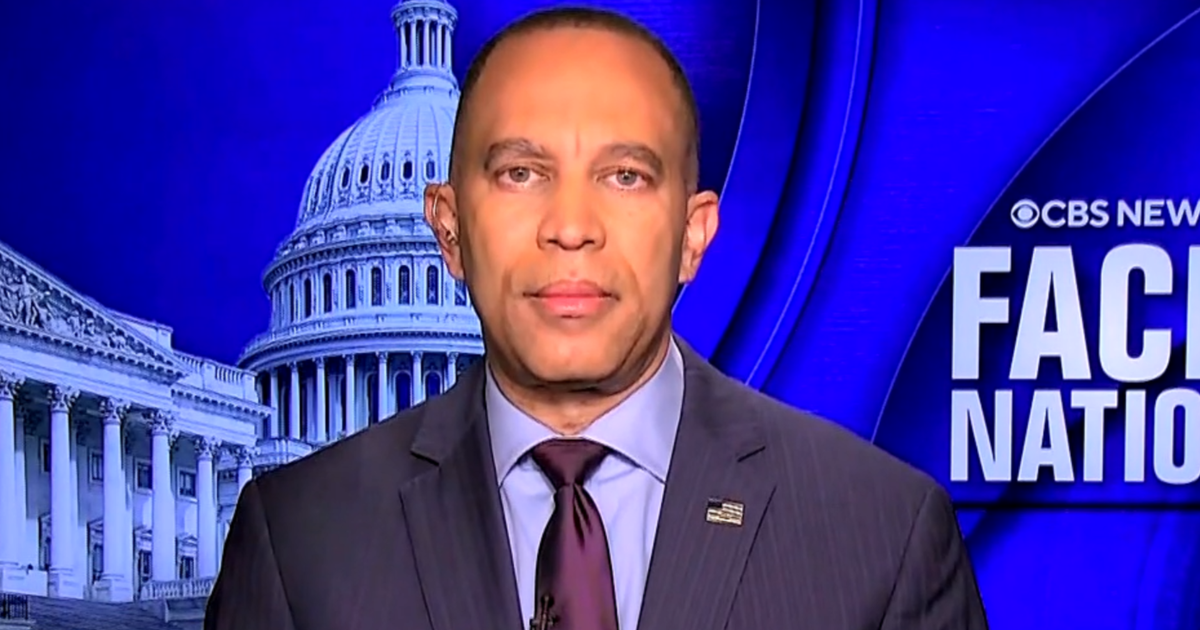

House Minority Leader Hakeem Jeffries Discusses Government Shutdown and Democratic Strategy
Democrats Stand Firm on Immigration Enforcement Reform
In a recent interview on “Face the Nation,” House Minority Leader Hakeem Jeffries made it clear that congressional Democrats aren’t backing down from their demands for immigration enforcement reform, even as the partial government shutdown continues. Speaking from New York City, Jeffries outlined what he called a “simple value proposition” – that taxpayer dollars should be used to improve Americans’ lives, not to “brutalize or kill them.” His reference to the tragic deaths of Rene Nicole Good and Alex Pretti in Minneapolis underscored the emotional weight behind the Democratic position. The party is demanding significant changes to how Immigration and Customs Enforcement (ICE) operates, including requiring agents to wear visible identification and body cameras, removing masks, ending racial profiling, and obtaining judicial warrants before entering private property. These aren’t just policy preferences for Democrats; Jeffries characterized them as essential safeguards to ensure that immigration enforcement is “fair, just, and humane.” When pressed repeatedly on whether he would compromise on any of these points to reopen the Department of Homeland Security, Jeffries remained steadfast, saying Democrats are willing to have “good faith conversations” but insisting that any changes must be “dramatic, bold, meaningful and transformational.”
The Stalemate Continues With No End in Sight
The gulf between Democrats and Republicans on this issue appears vast, with little indication of imminent resolution. Republicans have rejected most of the Democratic reform proposals, with the exception of showing some flexibility on body cameras. Tom Homan, the administration’s point person on immigration enforcement, has been particularly unwilling to budge on key issues like warrants and the use of masks by ICE agents. The administration argues that assaults against ICE officers have skyrocketed by over 1,300% in the past year, jumping from 19 incidents to 275, which they say justifies protective measures like masks. However, Jeffries counters this by pointing out that no other law enforcement professionals in America – not police officers, county sheriffs, or state troopers – operate with their faces covered. He questions why ICE agents, whom he describes as “untrained,” should be “unleashed on American communities with this type of lawlessness, violence and brutality.” The shutdown has affected critical agencies including FEMA, the Coast Guard, and TSA, yet both sides appear willing to let it continue rather than compromise on their core principles. With the State of the Union address scheduled for the following week, questions arose about whether it should proceed during a partial shutdown, though Jeffries expressed hope that a resolution might be reached before then.
Demanding Accountability and Common-Sense Reforms
At the heart of the Democratic position is a demand for accountability that Jeffries argues should be standard for any law enforcement agency. He emphasized several specific reforms that Democrats consider non-negotiable. First, judicial warrants should be required before ICE agents can enter private property or remove people from their homes – a protection Americans expect from every other law enforcement entity. Second, there must be independent investigations when state and local laws are violated, with state and local authorities having the power to criminally investigate and prosecute offenders. Jeffries made clear that Democrats “cannot trust Kristi Noem or Pam Bondi to conduct an independent investigation,” suggesting that federal oversight alone is insufficient. Third, Democrats want certain sensitive locations – including houses of worship, schools, hospitals, and polling sites – to be off-limits to immigration enforcement actions. Finally, and perhaps most importantly, Jeffries argued that ICE should focus its efforts on violent felons who are in the country unlawfully, rather than what he characterized as “violently targeting law-abiding immigrant families.” This last point, he noted, is “completely inconsistent with what Donald Trump promised the American people he would do.” The disconnect between campaign promises and current enforcement practices has become a central theme in the Democratic messaging.
National Security Concerns and Congressional Oversight
Beyond the immigration enforcement standoff, Jeffries raised serious concerns about the administration’s approach to national security matters and its relationship with Congress. As a member of the Gang of Eight – congressional leaders who receive classified national security briefings – Jeffries expressed frustration with what he described as the administration’s slowness in providing information to Congress. With reports that the Pentagon is planning for potentially weeks-long military operations against Iran if diplomacy fails, Jeffries emphasized that Congress, as a separate and co-equal branch of government, has constitutional authority that must be respected. He reminded viewers that the power to declare war is exclusively granted to Congress in Article I of the Constitution, not to the executive branch. The Democratic leader accused administration officials of being “extremists” who don’t believe Congress is truly co-equal, a criticism that reflects broader Democratic frustrations with what they see as executive overreach. Rather than focusing on potential military conflicts, Jeffries argued that President Trump should keep his promise to address the “affordability crisis” facing Americans. He pointed out that Trump had promised costs would go down “on day one,” but that promise remains unfulfilled while the administration pursues other priorities.
Democrats Eye Midterm Gains Across the Political Map
Despite being in the minority, Jeffries expressed remarkable confidence about Democratic prospects in the upcoming 2026 midterm elections. Democrats need to net just three seats to regain control of the House of Representatives, and Jeffries stated flatly: “It’s happening. Democrats are going to take back control of the House, and the only question is, what’s the margin?” This isn’t mere bluster; Democrats are pointing to recent electoral victories in unlikely places to support their optimism. The Democratic Congressional Campaign Committee currently considers 44 of the 435 House seats to be in play, including five recently added districts in parts of the country where Democrats don’t typically win – South Central Virginia, a South Carolina district, southern Minnesota, central Colorado, and Montana’s at-large seat. Jeffries cited several recent victories that suggest a shifting political landscape: Democrats won the Miami mayor’s race for the first time in 30 years by 20 points; they flipped a Texas State Senate seat that Trump had won by 17 points, with the Democratic candidate winning by 14 points (a 31-point overperformance); and they won a Louisiana House seat by 24 points that Trump had carried by 13 points (a 37-point swing). These results, Jeffries argued, show Democrats winning “across the country, in blue states and purple states and red states.”
The Democratic Message: Economic Focus and Immigration Justice
When asked to predict specific seat gains, Jeffries declined to give a number, saying he’s “not in the prediction business” but rather in “the let’s win on behalf of the American people so we can end this national nightmare business.” This framing – characterizing the current administration as a “national nightmare” – encapsulates the Democratic strategy for the midterms. Jeffries believes Democrats are winning because voters recognize that Democrats are “the only ones focused on driving down the high cost of living, fixing our broken health care system and making sure that immigration enforcement is fair and just.” It’s worth noting that while Democrats demand reform of immigration enforcement practices, they’re not calling for an end to enforcement itself. Jeffries encouraged Americans to exercise their constitutional rights to freedom of assembly, speech, and expression peacefully, as he said was “overwhelmingly done in Minneapolis.” The Democratic position attempts to thread a needle: supporting immigration enforcement while insisting it be conducted humanely and lawfully. Whether this message resonates with voters more than Republican arguments about border security and public safety will likely determine whether Jeffries’s confidence in Democratic electoral prospects is justified. For now, both parties seem dug in on their positions, with the shutdown continuing and broader questions about governance, accountability, and the direction of the country remaining unresolved.