


A Son’s Tribute on Ice: Maxim Naumov’s Olympic Journey of Love and Loss
Skating Through Heartbreak to Honor His Parents’ Memory
When American figure skater Maxim Naumov stepped onto the ice at the Milano Ice Skating Arena on a cold Tuesday night, he carried more than just the hopes of a nation—he carried the memory of his late parents, former pairs world champions Evgenia Shishkova and Vadim Naumov. The 24-year-old athlete delivered what can only be described as a performance straight from the heart, fulfilling a dream that had once been shared by three people who loved skating more than anything else in the world. His parents had been among the 67 souls lost in the tragic crash of American Airlines Flight 5342, which collided with a military helicopter near Ronald Reagan National Airport on January 29, 2025, before plunging into the frigid waters of the Potomac River. The devastating accident claimed more than two dozen members of the figure skating community, leaving an unfillable void in the hearts of families, friends, and the entire skating world. For Maxim, the loss was unimaginable—but instead of letting grief consume him, he chose to transform it into something beautiful, channeling his pain into the very sport that had brought his family together.
The Last Conversation and a Promise Kept
Among the most poignant details of Naumov’s Olympic journey is the nature of his final conversation with his parents. They had talked about what it would take for him to make it to the Olympics—a discussion that now carries profound weight in light of what happened just days later. When Naumov arrived at the kiss-and-cry area after his performance, he brought with him a treasured photograph, one that captured a moment of pure joy from his childhood: a little boy standing between his beaming parents as he stepped onto the ice for the very first time. The image tells a thousand words about the bond they shared and the foundation they laid for his career. “I’ve been inspired by them since day 1, ever since we stepped on the ice together,” Naumov said, his voice thick with emotion. But this wasn’t about simply remembering them in a passive way—it was about feeling them there with him, almost as tangible guides in his performance. “It’s not necessarily thinking about them specifically, but their presence. Feeling their presence. With every glide and step that I made on the ice, I couldn’t help but feel their support, almost like a chess piece on a chess board,” he explained. That metaphor—of being guided like a chess piece—speaks to the ongoing influence his parents have on his life, even in their physical absence.
A Performance That Defied Expectations and Touched Hearts
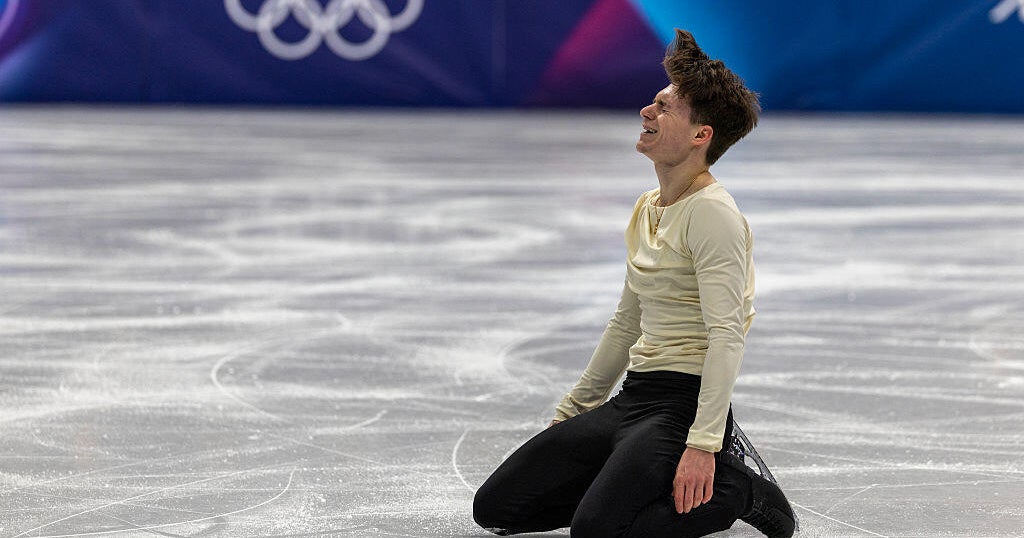
Nobody expected Maxim Naumov to be a medal contender at these Olympics. Going into the competition, he was considered a long shot to even crack the top ten, let alone approach the podium. But on this particular night, rankings and predictions seemed irrelevant. What mattered was the story being told on the ice, and the courage it took to tell it. Naumov opened his short program with a quad salchow—a jump requiring tremendous technical skill and mental fortitude—executed beautifully as his godmother, Gretta Bogdan, watched from the stands with tears in her eyes. He followed up with a flawless triple axel, then nailed a triple lutz-triple toe loop combination that showcased not just his athletic ability but the hours of dedicated training that had brought him to this moment. As Chopin’s “Nocturne No. 20” filled the arena with its haunting, melancholic beauty, the audience seemed to collectively hold its breath. And when the final notes faded and Naumov slid to a stop on his knees, looking skyward with an expression of pure emotion, there wasn’t a dry eye in the house. The crowd erupted, rising as one to give him a standing ovation that acknowledged not just the quality of the performance, but the extraordinary circumstances under which it was delivered. “Look at what we’ve done,” he whispered to his parents, a moment so intimate yet shared with thousands. “I didn’t know if I was going to cry, smile or laugh, and all I could do was look up at them. And man, I still can’t believe what just happened. I think it’s going to take me a few hours or maybe a few weeks to know,” he said afterward, still processing the magnitude of what he’d accomplished.
The Tragedy That Changed Everything
The crash that took Naumov’s parents was more than just a personal tragedy—it was a catastrophic loss for the entire American figure skating community. The plane had been carrying 11 young skaters, two other coaches, and several family members who had all been attending a development camp in Wichita, Kansas, following the 2025 national championships. These were people full of dreams, potential, and passion for a sport that demands everything from its practitioners. Naumov’s parents were coaches at the prestigious Skating Club of Boston, which alone lost six members in the midair collision. The ripple effects of this disaster touched countless lives, leaving families shattered and a close-knit community reeling. Maxim himself had flown out earlier, having just finished in fourth place at nationals for the third consecutive year—a result that must have felt frustrating at the time but now seems trivial in comparison to what he would soon face. The early weeks and months following the crash were, in his own words, indescribably difficult. “I can’t describe how difficult it was at the very beginning, and through month after month of really just trying my hardest to keep a positive mindset, and focus on day to day,” he told CBS News Boston during his Olympic training. But rather than abandoning the sport, he found that skating became a lifeline, a tool that actually helped him process his grief and move forward. “Thankfully, skating became a tool that actually helped me overcome that,” he explained, demonstrating remarkable resilience and maturity.
Finding Strength in Shared Dreams
What kept Maxim Naumov going during the darkest days was the idea of fulfilling the Olympic dream he had shared with his parents. This wasn’t about proving anything to critics or achieving personal glory—it was about honoring a promise, completing a journey they had begun together. When he finished third at the U.S. championships in January 2026, just over a year after losing his parents, his spot on the Olympic team was virtually secured. It was a bittersweet moment of triumph, knowing they wouldn’t be there to see it in person. As he prepared to compete in Milan, Naumov’s approach was refreshingly honest and human. “To be honest, I wasn’t thinking about executing anything perfectly or anything like that. I wanted to go out there and just give my heart out. Leave everything out there. Have no regrets. And that’s exactly what I felt,” he said. This mentality—focusing on emotional authenticity rather than technical perfection—may paradoxically have been what allowed him to skate so well. His score of 85.65 was enough to advance to the men’s free skate, giving him another opportunity to honor his parents’ memory on Friday night. The Skating Club of Boston community rallied around him with incredible support. “To deal with the tragedy that he’s dealt with, and like he said, get up and do the day. And that’s what he’s done. He’s done one day at a time,” said Katharine Steeger, the club’s director of membership services. “To have Max start us off with such an amazing skate for him, it’s just, there’s really no words.” This marked the first time since 2014 that the Skating Club of Boston had sent athletes to the Olympics, with Naumov joined by figure skating pair Emily Chan and Spencer Akira Howe.
A Community United in Support and Remembrance
The atmosphere in the arena on that Tuesday night was electric with emotion and solidarity. As Naumov’s program concluded, dozens of American flags waved throughout the crowd, a patriotic display that also served as a tribute to all those lost in the tragedy. At one end of the arena, a particularly poignant banner appeared—a large flag reading “Tomorrow’s Champions” with the logo of the Skating Club of Boston. The phrase holds special significance: “Tomorrow’s Champions” is the name of the skating school that Naumov’s parents founded, and which their son now oversees, continuing their legacy of nurturing young talent and passing on their love of the sport to the next generation. “From the time that my name was announced in the warm-up to right before the skate, I felt it—just the crowd, the energy, the roar. It’s like a buzz, you know? In your body. I couldn’t help but just embrace it. Embrace that love,” Naumov said, clearly moved by the outpouring of support. The story of Maxim Naumov at the Milan Cortina Olympics transcends sports. It’s a testament to the human capacity for resilience, the power of honoring those we’ve lost by living fully, and the profound connections that bind families together even when death tries to tear them apart. In choosing to compete, to push through unimaginable grief, and to transform sorrow into something beautiful on the ice, Naumov gave the world a gift—a reminder that love endures, that dreams matter, and that the people who shape us are never truly gone as long as we carry them in our hearts and honor them with our actions. His parents would undoubtedly be incredibly proud.