

British Court Rules Palestine Action Ban Unlawful in Landmark Free Speech Case
A Victory for Protest Rights, Though the Fight Continues
In a significant decision that has reignited debate about the boundaries between activism and terrorism, Britain’s High Court delivered a mixed ruling on Friday regarding the controversial ban on Palestine Action, a pro-Palestinian protest group. The three-judge panel, consisting of Victoria Sharp, Jonathan Swift, and Karen Steyn, determined that the government’s decision to classify Palestine Action as a terrorist organization was unlawful and disproportionate. However, in a twist that tempers the victory for civil liberties advocates, the judges decided to keep the ban in place temporarily while the government pursues an appeal. This decision highlights the ongoing tension in democratic societies between maintaining national security and preserving fundamental freedoms like peaceful protest and free speech.
The court’s reasoning centered on a careful evaluation of what constitutes terrorist activity worthy of such severe legal consequences. The judges concluded that “the nature and scale of Palestine Action’s activities” simply didn’t reach the “level, scale and persistence” that would justify banning the organization outright. In their written judgment, they explicitly stated their satisfaction “that the decision to proscribe Palestine Action was disproportionate.” This language is particularly significant in British legal terms, as it suggests the government overstepped its authority by using anti-terrorism powers designed for groups like al-Qaida and ISIS against activists whose methods, however disruptive, don’t rise to that level of threat. The ruling represents a rare judicial pushback against the government’s expanding use of terrorism laws to address protest activities that authorities find troublesome or damaging.
The Human Cost: Thousands Arrested for Holding Signs
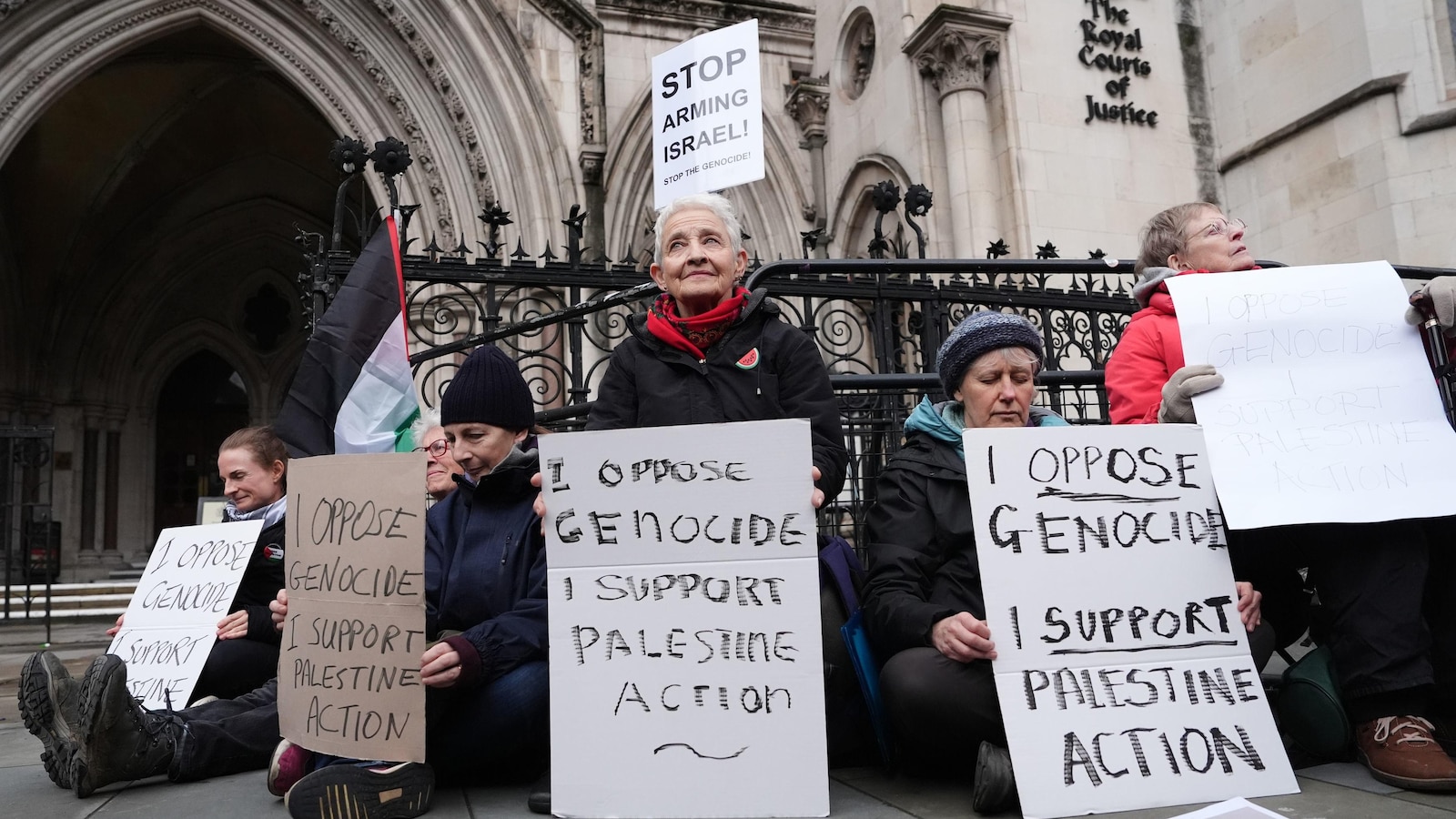
The real-world impact of the Palestine Action ban has been dramatic and, to many observers, deeply troubling from a civil liberties perspective. Since the British government declared Palestine Action a terrorist organization last year—placing it in the same category as genuinely violent extremist groups like al-Qaida and Hamas—more than 2,000 people have been arrested simply for holding signs that read “I support Palestine Action.” These weren’t individuals caught vandalizing property or breaking into military facilities; they were people exercising what they believed to be their right to peaceful protest and free expression. The severity of the potential punishment makes the situation even more striking: under the proscription, membership in or support for Palestine Action became a crime punishable by up to 14 years in prison—a sentence comparable to those handed down for serious violent offenses.
This mass arrest campaign has sent shockwaves through Britain’s activist community and beyond. Civil liberties organizations have condemned what they see as a fundamental attack on the right to protest and freedom of speech. The arrests have affected ordinary citizens who may have had no direct connection to Palestine Action’s more controversial direct actions but who wanted to express solidarity with the Palestinian cause or opposition to British military involvement in the Gaza conflict. For these individuals and the groups defending them, the government’s approach represents an alarming precedent where expressing support for a political position or activist group can result in terrorism charges. The situation illustrates how anti-terrorism legislation, originally justified as necessary to combat violent extremism, can expand to encompass forms of political dissent and activism that previous generations would have considered protected speech.
What Palestine Action Actually Does: Direct Action and Its Consequences
To understand the controversy, it’s essential to examine what Palestine Action actually does and why the government considered the group dangerous enough to ban. Palestine Action was founded in 2020 with a specific focus: conducting direct action protests at military and industrial sites in the United Kingdom that the group believes are complicit in what they view as Israeli oppression of Palestinians. Their tactics go well beyond traditional peaceful protest—they’ve broken into facilities owned by Elbit Systems UK, an Israeli weapons manufacturer, and have caused what officials estimate to be millions of pounds in property damage. The incident that appears to have triggered the government’s decision to ban the group occurred in June of last year, when activists broke into a Royal Air Force base to protest British military support for Israel’s war against Hamas in Gaza. During that action, protesters sprayed red paint into the engines of two military tanker planes and caused additional damage with crowbars—actions that government officials argue pose serious risks to national security.
From the government’s perspective, these aren’t harmless acts of civil disobedience but calculated attacks on critical infrastructure that could potentially compromise Britain’s defense capabilities. The damage to military aircraft, the breaching of secure facilities, and the disruption to defense operations represent, in their view, a level of activity that crosses the line from protest into something more serious. However, the court’s ruling suggests that even these dramatic actions don’t quite meet the legal threshold for terrorism. The judges acknowledged that “a very small number of its actions have amounted to terrorist action,” but crucially added that “regardless of proscription, the criminal law is available to prosecute those concerned.” In other words, existing laws against vandalism, trespass, and criminal damage are sufficient to address Palestine Action’s activities without resorting to terrorism legislation designed for groups that use violence to achieve political aims.
The Government’s Response: Digging In for an Appeal
Home Secretary Shabana Mahmood’s response to the court ruling was swift and unequivocal, signaling that the government has no intention of backing down. She stated that she was “disappointed by the court’s decision and disagree with the notion that banning this terrorist organization is disproportionate.” Her use of the phrase “terrorist organization” even after the court ruled the designation unlawful is telling—it reflects the government’s firm conviction that Palestine Action’s activities warrant the harshest legal response available. Mahmood announced her intention to “fight this judgment in the Court of Appeal,” setting the stage for a continued legal battle that could stretch on for months or even years. This determination to pursue an appeal, even in the face of a clear judicial ruling against the government’s position, reflects broader political dynamics around the Israeli-Palestinian conflict and domestic security concerns in Britain.
The government’s stance also reveals something about the political pressures facing British officials. In the current climate, where debates about the Israeli-Palestinian conflict have become increasingly polarized and emotionally charged, taking a hard line against pro-Palestinian activism may be seen as politically advantageous or necessary by some government figures. The decision to appeal keeps the ban in place for now, meaning that the immediate practical situation remains unchanged: Palestine Action remains proscribed as a terrorist organization, and people can still be arrested and prosecuted for supporting it. This creates a peculiar legal situation where a group is classified as terrorist despite a court ruling that such classification is unlawful—a temporary state of affairs, but one that could persist for a considerable time as the appeals process unfolds.
What This Means for Free Speech and Protest Rights in Britain
The Palestine Action case has become a flashpoint in larger debates about the appropriate limits of protest in democratic societies and how governments should respond to activism that includes property damage or disruption. Huda Ammori, Palestine Action’s co-founder, characterized the court’s decision as “a monumental victory both for our fundamental freedoms here in Britain and in the struggle for freedom for the Palestinian people, striking down a decision that will forever be remembered as one of the most extreme attacks on free speech in recent British history.” While her language is clearly advocacy-driven, her concerns about free speech are shared by many who don’t necessarily support Palestine Action’s specific tactics. The worry extends beyond this particular group to the precedent being set: if the government can successfully label direct action protesters as terrorists, what stops future administrations from applying similar labels to environmental activists, labor organizers, or other groups that engage in disruptive but fundamentally political activity?
The court’s ruling provides some reassurance that there are still judicial limits on how far the government can go in restricting protest rights, even when those protests cause significant disruption or damage. The judges’ careful distinction between actions that may be criminal under ordinary law and actions that rise to the level of terrorism is crucial for maintaining space for robust political dissent in a free society. However, the fact that the government felt empowered to make this proscription in the first place, and that it’s being vigorously defended on appeal, suggests that the boundaries of acceptable protest are being tested and potentially redrawn. As Britain and other democracies grapple with increasingly assertive activism on issues from climate change to international conflicts, the Palestine Action case may well be remembered as a defining moment in determining whether the right to protest—even disruptive protest—will be preserved or gradually criminalized under the expanding umbrella of anti-terrorism law. The outcome of the government’s appeal will have implications that reach far beyond this single organization, potentially shaping the landscape of political activism in Britain for years to come.