


Mexico’s Forgotten Communities: Where Vigilantes Fight Cartels in the Mountains
The Rise of Self-Defense Forces in Rural Mexico
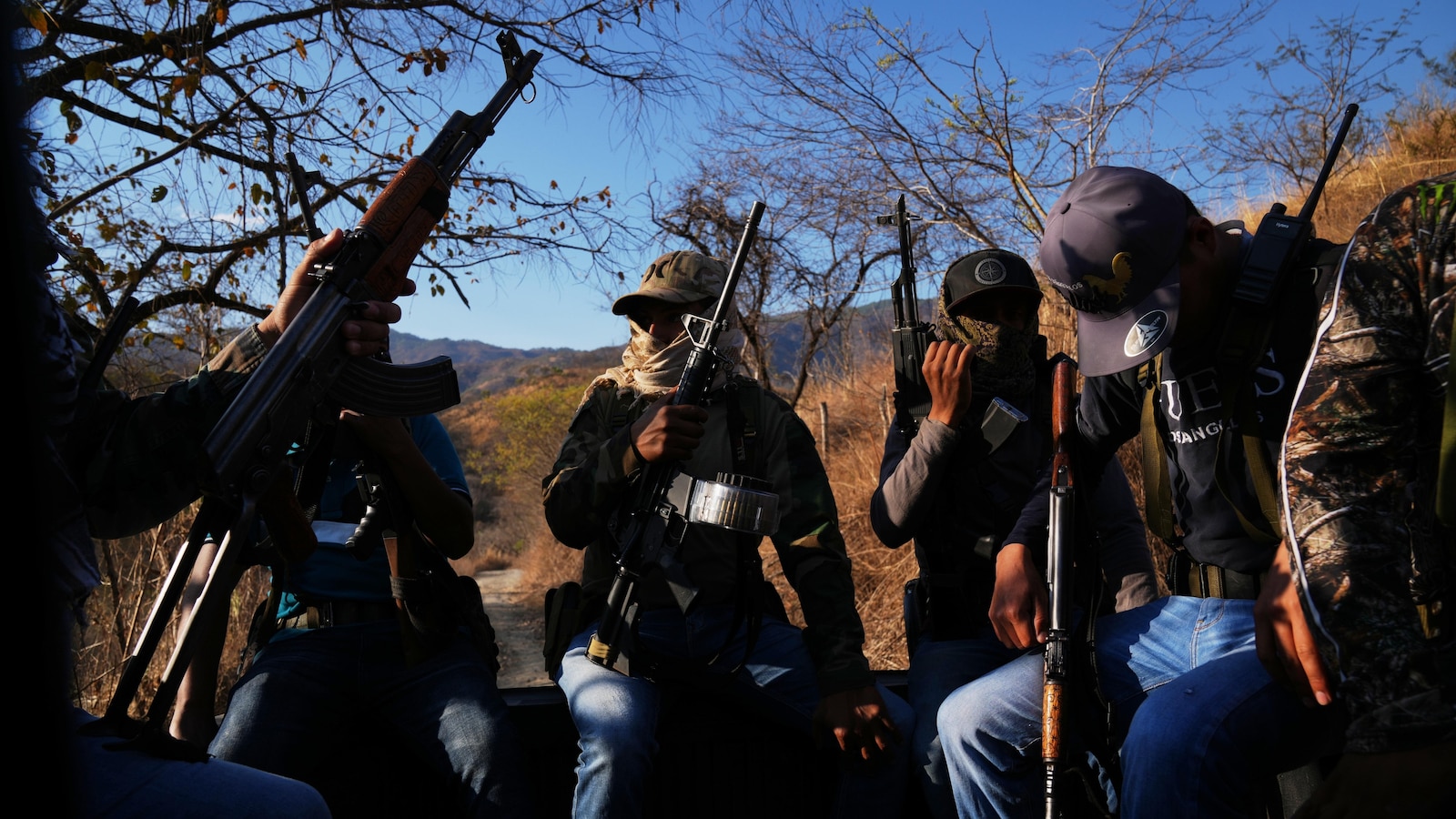
Deep in the mountains of Guerrero state, Mexico, Jesús Domínguez navigates dense brush with an AK-47 strapped across his shoulder and a grenade attached to his leather belt. The 34-year-old is part of a 50-man vigilante force patrolling the rugged terrain, not as criminals, but as desperate residents protecting their homes from one of Mexico’s most dangerous drug cartels. These men, dressed in military camouflage and armed with weapons smuggled from the United States, represent one of dozens of “autodefensa” or self-defense groups that have emerged across Mexico over the last decade. Their existence speaks to a harsh reality: in remote areas far from government reach, ordinary citizens have been forced to take up arms against increasingly powerful and sophisticated criminal organizations. From a lookout post surveying the mountainous landscape, Domínguez explains their situation simply: “The government doesn’t care about us, and it’s impossible for our arms to compete with the cartel’s. They come at you with a ton of force, so you need to respond with force. If you don’t, they’ll overwhelm you.” These aren’t professional soldiers or police officers—they’re farmers, fathers, and community members who saw no other option but to defend themselves when the state failed to protect them.
A Community Under Siege
The vigilante group in Guajes de Ayala was born out of necessity in 2020 when the cartel La Nueva Familia Michoacana attempted to seize control of seven isolated mountain communities. These villages sit along a strategic corridor connecting drug trafficking organizations to Acapulco, the port city where narcotics and illegal goods flow in and out of Mexico. The Trump administration designated this cartel as a foreign terrorist organization, but for the people of Guajes de Ayala, the threat was immediate and personal. The cartel began illegally logging their ancestral lands and tried to force residents into fighting against rival gangs. When Mexican military and police forces failed to intervene, locals made the difficult choice to arm themselves. What followed was nearly a year of intermittent gunfights that devastated these communities. Families fled on foot through treacherous mountain passes, carrying nothing but the clothes they wore. Villages that once housed 1,600 people shrank to barely 400 residents as people abandoned their homes out of fear. After a brief respite, violence returned in October when the Nueva Familia Michoacana renewed their territorial push, establishing fentanyl production laboratories in the area and using surveillance drones to monitor the region. The group’s leader, Javier Hernández, explains that his men now guard their towns from mountain lookout posts and use their own drones to watch approximately 100 cartel gunmen positioned just miles away. “We don’t want to be part of their ranks and we don’t want to leave our lands,” Hernández states firmly. “We don’t want to be slaves to any cartel.”
A Complex Web of Armed Groups
Guerrero state has a particularly complicated and violent history that extends back to guerrilla movements in the 1960s. The situation has become exponentially more complex as major cartels have splintered into competing factions, creating a dramatically different landscape than decades past when single organizations held consolidated control over territories. According to a 2025 Drug Enforcement Administration report, five separate cartels currently operate in Guerrero, alongside numerous local gangs and vigilante groups—many of which have formed alliances with the larger criminal organizations. Mónica Serrano, a professor at the Colegio de Mexico who studies violence in Guerrero, describes the situation as “a kaleidoscope of armed groups” that represents “one of the most vexing challenges facing the country and is at the root of the violence.” Self-defense forces began proliferating in the states of Michoacan and Guerrero around 2013, emerging as desperate responses from communities caught in the crossfire of warring cartels. However, in regions where criminal organizations wield more power than law enforcement, nearly every vigilante movement has either been co-opted by rival cartels or violently eliminated. The Mexican government itself has been inconsistent in its approach, unable to decide whether to engage with these groups as legitimate community defenders or prosecute them as criminals. Some vigilante groups have essentially become paramilial forces for cartels, enriched with drug money and terrorizing the very communities they claimed to protect. In other cases, cartels have deliberately armed local citizens to create proxy forces against rival organizations. As Domínguez explains, “They corner you and you can’t do anything. That’s how what’s been created—which began as autonomy—is corrupted. People end up joining criminal groups just to survive.”
Questions About Independence and Support
The vigilantes of Guajes de Ayala insist they remain independent, but their equipment raises questions about their funding sources and potential connections. These rural farmers possess sophisticated technology far beyond what their agricultural income could support, including drone detection systems, radio frequency monitoring equipment, and high-end DJI surveillance drones worth thousands of dollars. Their arsenal includes AK-47s and AR-15s bearing stamps reading “MADE IN USA” with manufacturer names from Florida, South Carolina, and even Poland. Because Mexico maintains strict gun control laws, the overwhelming majority of weapons in the country are smuggled across the border from the United States by the very cartels these vigilantes claim to fight. One gunman acknowledged that the group purchases firearms from cartels, though he refused to identify which organization supplies them. Another vigilante admitted he previously belonged to the Jalisco New Generation Cartel (CJNG) and was actually paid to join the self-defense force. Yet another wore a hat reading “El Señor de los Gallos,” a nickname for Nemesio Oseguera Cervantes, the powerful CJNG leader who was killed by Mexican military forces in February. The group’s survival also depends on cooperation with two local criminal gangs currently fighting against the Nueva Familia Michoacana, which allow Guajes de Ayala residents to transit through their territories. At the same time, leader Hernández claims he provides intelligence about rival cartel activities to law enforcement and that his group rejected alliance offers from other vigilante organizations known for victimizing civilians. This complex web of relationships illustrates how difficult it is to maintain genuine independence in regions where armed criminal groups dominate.
Challenges for Mexico’s Government
The proliferation of armed groups throughout Mexico presents a significant challenge for President Claudia Sheinbaum as she navigates threats from the Trump administration, including potential U.S. military intervention. Under Sheinbaum’s leadership, Mexican security forces have taken a more aggressive approach toward criminal organizations than previous administrations, and government figures show that homicides have dropped sharply to their lowest levels in a decade since she took office. However, Hernández dismisses these statistics as propaganda that doesn’t reflect reality on the ground. “It’s a lie. They say the government is doing wonders, but it’s nothing but propaganda,” he insists. The recent killing of “El Mencho,” leader of Mexico’s most powerful criminal enterprise, was celebrated as a major victory, but experts and community members in places like Guajes de Ayala worry it could actually fuel increased violence. The power vacuum may trigger violent struggles as other criminal groups attempt to seize territory, or internal warfare as rival CJNG factions battle for control. One Marine captain stationed in Guerrero, speaking anonymously due to security concerns, said his forces are “preparing for a possible reorganization of these groups.” He defended the military’s efforts, insisting that Mexican forces haven’t abandoned communities like Guajes de Ayala and do respond to calls for help from rural areas. However, the reality on the ground suggests that government presence and support remain insufficient to address the security crisis facing these isolated mountain communities.
The Human Cost of Mexico’s Drug War
The villages of Guajes de Ayala have been transformed into ghost towns filled with empty homes, silent testimony to families too frightened to return. Marisela Mojica, Domínguez’s mother, made the heartbreaking decision to send six of her children and grandchildren away after her daughter was kidnapped by people claiming to represent the Nueva Familia Michoacana. “If they come to kill us all, I want one of us to still be alive,” she explains. Mojica hasn’t seen her family in six years and has never met two grandchildren born after they fled—and she doesn’t know if she ever will. The breakdown of security has devastated basic services and infrastructure. Teachers, too frightened to cross between territories controlled by different armed groups, stopped coming to schools in October, leaving educational facilities abandoned. Government medical clinics have closed their doors, leaving residents without access to healthcare. As Hernández drives through patrol routes with his gunmen, he counts the ruined homes scattered across the rolling peaks and valleys that surround them. The physical destruction reflects a deeper tragedy—the collapse of normal life for people who simply want to farm their land, raise their families, and live in peace. “These mountains are a place of silence,” Hernández reflects. “You have no voice, and no one hears you.” His words capture the profound isolation and abandonment felt by communities caught in Mexico’s ongoing drug war, where citizens are forced to choose between submission to cartels, fleeing their ancestral homes, or taking up arms in a desperate fight for survival that offers no guarantees and no clear path to peace.