

Rescue Mission Succeeds in Freeing Stranded Whale from German Baltic Coast
A Dramatic Overnight Escape After Days of Struggle
In a heartwarming display of human determination and compassion, a humpback whale that had been trapped for days on a sandbank in shallow Baltic Sea waters near a popular German resort town has finally managed to swim free. The massive marine mammal, measuring between 12 and 15 meters (roughly 39 to 49 feet) in length, made its escape overnight Thursday into Friday after rescue teams spent an exhausting day digging an emergency channel through the sand. Marine biologist Robert Marc Lehmann, who was intimately involved in the rescue operation, confirmed on Friday morning that the whale had successfully navigated through the specially-constructed escape route. However, he was quick to temper celebrations with a sobering reality check: while this represents encouraging progress, the whale’s ordeal is far from over. The animal still faces a perilous journey of several hundred kilometers through German and Danish waters if it hopes to reach its ultimate destination—the North Sea, and eventually the Atlantic Ocean, where it truly belongs. This rescue effort has captured the hearts of people across Germany and beyond, serving as a powerful reminder of our connection to the natural world and our responsibility to protect creatures that find themselves in distress.
The Discovery and Initial Rescue Attempts
The whale’s predicament first came to light on Monday morning when residents and early beachgoers at Timmendorfer Strand, a beloved resort destination along Germany’s Baltic coast, spotted the enormous creature stuck on an underwater sandbank. The sight of such a magnificent animal in obvious distress immediately triggered concern among locals and prompted swift action from authorities. Initial rescue attempts proved frustratingly unsuccessful, highlighting the unique challenges posed by the Baltic Sea’s particular characteristics. Teams from the coast guard and local fire departments tried various creative approaches, including using their boats to generate large, powerful waves in hopes that the resulting water movement might dislodge the whale and help push it back toward deeper waters where it could swim freely. Unfortunately, these early efforts didn’t achieve the desired result. The fundamental problem was the Baltic Sea itself—unlike ocean coastlines where strong tides naturally ebb and flow twice daily, potentially providing natural assistance in such situations, the Baltic lacks these dramatic tidal movements. This meant the whale wouldn’t receive any help from natural forces and would remain stuck unless human intervention could find a solution. As Monday turned to Tuesday, and then Wednesday, the situation became increasingly urgent, with concerns mounting about the whale’s health, stress levels, and ability to survive much longer in such unsuitable conditions.
The Last-Ditch Excavation Effort
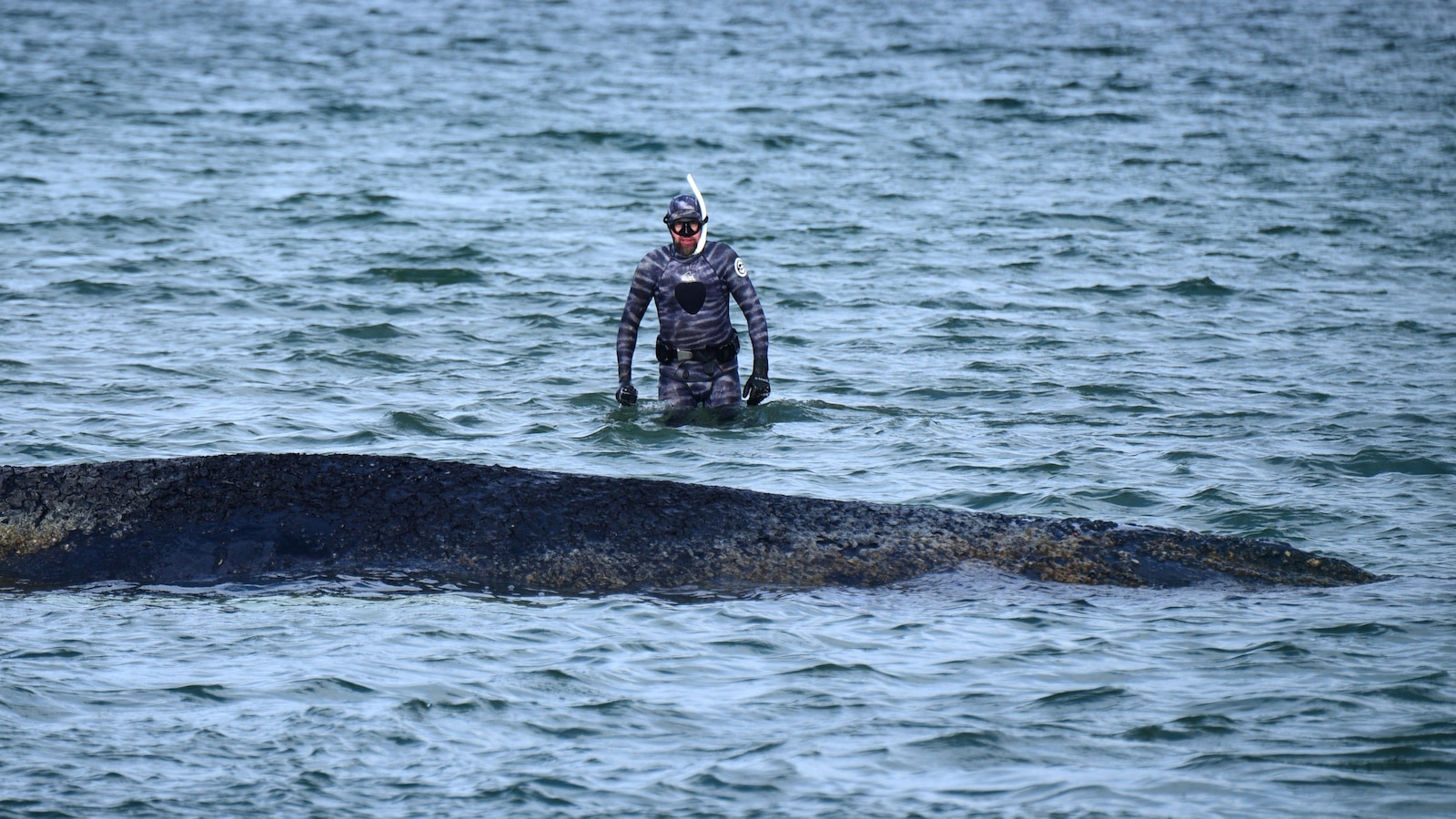
By Thursday morning, with the whale still trapped and traditional rescue methods having failed, authorities decided to attempt a more dramatic and unconventional approach. They brought in heavy construction equipment—specifically excavators—to quite literally dig the whale out of its predicament. This ambitious plan involved creating a trench or channel directly in front of the whale’s head, essentially carving out a waterway that the animal could follow toward deeper water. Marine biologist Robert Marc Lehmann took on the incredibly brave and delicate task of approaching the whale directly in the water, positioning himself to guide the excavator operators in their precision digging work. This required not only courage but also intimate knowledge of whale behavior and a deep understanding of how to work near such a massive creature without causing additional stress or harm. The rescue team worked tirelessly throughout Thursday, continuing their excavation efforts well past sunset, illuminated by artificial lights as darkness fell over the Baltic coast. Despite their exhaustion and determination, they hadn’t quite managed to complete the channel sufficiently for the whale to escape by the time they were forced to stop work for the night. The team members must have gone home with mixed feelings—pride in their efforts but anxiety about whether their work would be enough, and whether the whale would have the strength and instinct to use the escape route they’d created.
Freedom at Last, But the Journey Continues
The news that greeted rescuers and concerned observers on Friday morning was the best possible outcome: the whale had made its move during the overnight hours, swimming through the carefully excavated channel and heading out of Lübeck Bay, the body of water where Timmendorfer Strand is situated. Stephanie Gross, representing the Institute of Terrestrial and Aquatic Wildlife Research, confirmed the whale’s escape and provided details about its current status. By early Friday, the magnificent creature was approximately 300 meters (nearly 1,000 feet) from the coastline, with its movement being carefully monitored and accompanied by a coast guard ship and several smaller boats. This protective escort serves multiple purposes: the vessels can track the whale’s progress, ensure it continues moving in the right direction, potentially intervene if new problems arise, and also help prevent boat traffic from disturbing or endangering the animal as it makes its way through busy maritime areas. Experts involved in the rescue operation believe the whale is a young male, a conclusion they’ve reached based on migration patterns, since male humpback whales, unlike their female counterparts, tend to undertake long migratory journeys more frequently. Adding another interesting dimension to this story, researchers also believe this may be the same individual whale that had been spotted on multiple occasions in recent weeks around the port of Wismar, located east of Timmendorfer Strand, suggesting this particular animal had been wandering these waters for some time before becoming stranded.
The Mystery of Why and What Comes Next
One of the most puzzling aspects of this entire incident is that nobody can definitively explain why this humpback whale was in Baltic waters in the first place, or what specific circumstances led to it becoming stranded on that particular sandbank. Humpback whales are not native to the Baltic Sea—these waters are not part of their normal habitat or migration routes. The presence of such a large whale in these relatively shallow, enclosed waters represents an unusual occurrence that has left marine biologists scratching their heads and searching for explanations. Was the whale disoriented? Did it follow prey into these unfamiliar waters and then become confused about how to exit? Is there something about changing ocean conditions, water temperatures, or marine ecosystems that might have contributed to this geographical confusion? These questions remain unanswered for now. What is certain, however, is that the whale now faces an extraordinarily challenging journey ahead. To reach safety—defined as the open waters of the North Sea and ultimately the Atlantic Ocean where humpback whales naturally thrive—this animal must navigate several hundred kilometers through a complex maze of German and Danish territorial waters. This journey will take the whale through narrow passages, busy shipping lanes, areas with varying water depths, and regions where human activity is constant. The path is fraught with potential dangers, from boat strikes to additional underwater obstacles to the simple challenge of finding enough food to sustain itself during this unexpected detour.
A Community United in Hope and Conservation
This rescue story has resonated deeply with people throughout Germany and across Europe, serving as a powerful example of what humans can accomplish when we choose to help rather than harm the natural world. The image of exhausted rescue workers operating heavy machinery after dark, working desperately to save a creature so different from themselves, speaks to the best impulses of human nature. Marine biologist Robert Marc Lehmann and his team, along with the coast guard, fire services, local authorities, and countless volunteers who contributed to this effort, demonstrated extraordinary dedication and creativity in solving a problem that had no obvious solution. Their success in freeing the whale represents just the first chapter in what everyone hopes will be a complete survival story. In the days and weeks ahead, marine researchers will continue monitoring the whale’s progress whenever possible, hoping to confirm that it successfully navigates through the Danish straits and reaches the North Sea. The story also raises important broader questions about marine conservation, climate change’s effects on ocean ecosystems, and how human activity might be influencing whale behavior and migration patterns. Perhaps this stranded whale’s journey will inspire renewed commitment to protecting marine environments and the magnificent creatures that inhabit them. For now, though, there is cautious celebration that one young whale, against considerable odds, has been given a second chance at life—and a long swim home.