
Bringing the Past to Life: AI Reconstructs the Face of a Pompeii Victim
A Revolutionary Approach to Understanding Ancient Tragedy
For nearly two thousand years, the story of Pompeii has captivated historians, archaeologists, and curious minds around the world. The ancient Roman city, frozen in time by the catastrophic eruption of Mount Vesuvius in AD 79, has yielded countless treasures and insights into daily life during the Roman Empire. Now, researchers at the Pompeii Archaeological Park have taken a groundbreaking step forward by using artificial intelligence to digitally reconstruct the face of one of the eruption’s victims. This innovative approach represents more than just technological advancement—it’s a deeply human effort to connect with the real people who lived through one of history’s most devastating natural disasters. By combining cutting-edge AI technology with traditional archaeological methods, researchers are creating a bridge between the ancient world and our modern understanding, transforming skeletal remains and scientific data into a relatable human face that helps us comprehend the very personal tragedy that unfolded on those terrible days in 79 AD.
The Story Behind the Face
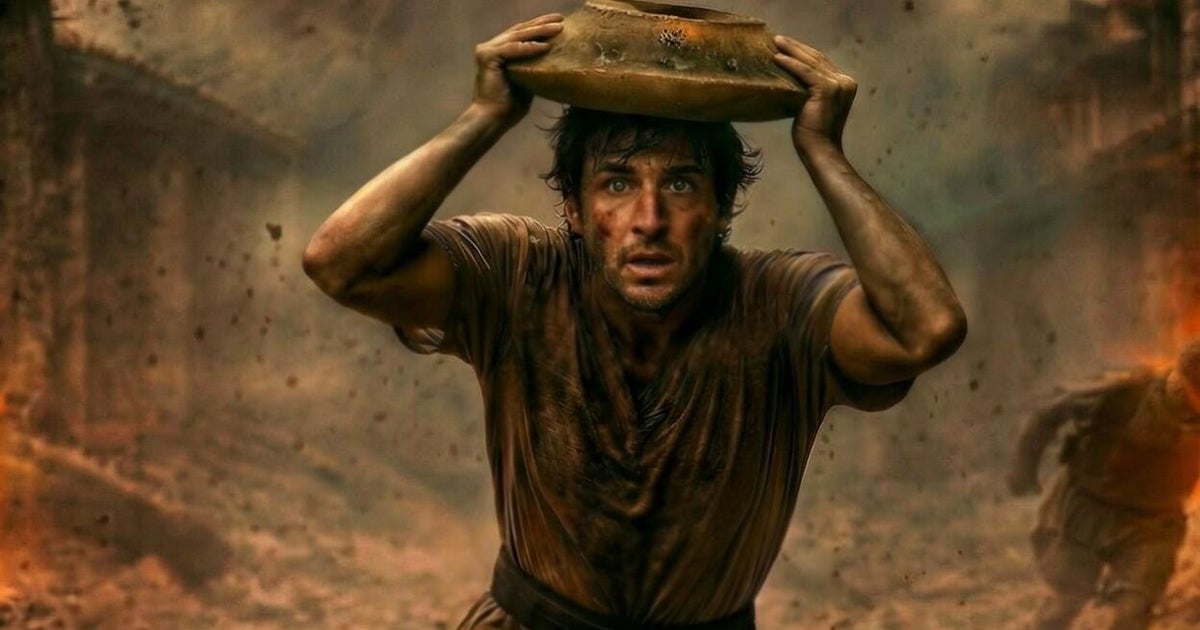
The digital portrait reveals the features of an older man who died during his desperate attempt to escape the doomed city. Discovered near the Porta Stabia necropolis just outside Pompeii’s ancient walls, this man was one of two victims found together, both trying to reach the coast when disaster struck. What makes his story particularly poignant are the details that archaeologists uncovered alongside his remains. In his final moments, this man clutched a terracotta mortar above his head—not as a kitchen tool, but as an improvised shield against the deadly lapilli, the small volcanic stones that rained down from the sky during the eruption. This desperate act of self-preservation speaks volumes about the terrifying reality faced by Pompeii’s residents as their world literally fell apart around them. He also carried with him an oil lamp to light his way, a small iron ring perhaps worn as jewelry or a symbol of status, and ten bronze coins—likely everything of value he could gather in his rush to escape. These personal belongings weren’t just archaeological artifacts; they were the last possessions of a real person making life-or-death decisions in moments of unimaginable chaos.
Technology Meets Archaeology
The creation of this digital portrait represents a fascinating collaboration between the Pompeii Archaeological Park and the University of Padua, bringing together experts in archaeology, anthropology, and computer science. The process involved sophisticated AI algorithms and photo-editing techniques that could translate dry skeletal measurements and archaeological survey data into something remarkably human—a face that once lived, breathed, and experienced joy and fear just like any of us. This isn’t simply about creating a pretty picture; it’s about using technology responsibly to extract maximum insight from the wealth of data that archaeologists have painstakingly gathered over decades of excavation. Gabriel Zuchtriegel, the director of the Pompeii Archaeological Park, emphasized this point in his statement about the project: “The vastness of archaeological data is now such that only with the help of artificial intelligence will we be able to adequately protect and enhance them.” His words highlight a crucial challenge facing modern archaeology—there’s simply too much information for traditional methods alone to process and interpret effectively. When used thoughtfully and ethically, AI can breathe new life into classical studies, making them more relevant and accessible to contemporary audiences while maintaining rigorous scientific standards.
Echoes of Ancient Testimony
The archaeological evidence discovered with this victim aligns remarkably well with eyewitness accounts from the actual eruption. Pliny the Younger, a Roman writer who observed the disaster from a distance, documented how Pompeii’s residents desperately tried to protect themselves using whatever objects they could find as ash and volcanic debris rained down upon them. Finding this man with a terracotta mortar held above his head provides physical confirmation of these ancient descriptions, transforming written testimony into tangible reality. This convergence of literary and archaeological evidence creates a more complete picture of what those final hours must have been like—the panic, the improvisation, the slim hope that somehow, if they could just make it to the boats at the coast, they might survive. The location where these victims were found also tells an important story. Archaeologists specifically noted that many people likely died outside the city walls while attempting to reach safety at the coastline. This suggests that the disaster’s toll may have been even greater than the number of bodies found within Pompeii itself, with countless victims potentially lost to the sea or buried in locations that have yet to be excavated.
Pompeii’s Ongoing Revelations
The UNESCO World Heritage site near Naples continues to be one of the most productive archaeological locations in the world, regularly yielding new discoveries that reshape our understanding of Roman life and the eruption itself. Just this year, archaeologists announced the discovery of a 2,000-year-old love note and illustrated gladiator fight scenes on a wall within the city—reminders that Pompeii was a living, vibrant community filled with people who loved, fought, entertained themselves, and went about their daily lives never imagining that history would remember them in such tragic circumstances. Perhaps even more surprisingly, excavations conducted last year revealed evidence that some survivors actually returned to Pompeii after the eruption and attempted to rebuild their lives among the ruins. This discovery challenges the long-held assumption that the city was completely abandoned after the disaster. The reason some returned, researchers believe, was heartbreakingly practical: they simply couldn’t afford to start over somewhere else. These were people so attached to their home, or so economically devastated by the catastrophe, that living amid the destruction seemed preferable to facing an uncertain future in an unfamiliar place.
The Human Connection That Matters Most
Italian Culture Minister Alessandro Giuli praised the project, noting that “Pompeii is perhaps the most prestigious place in the world for archaeological research where every new discovery illuminates enthusiastically the plot of ancient life.” His statement captures something essential about why we remain so fascinated with this ancient tragedy—it’s not just about understanding historical events or appreciating archaeological techniques, but about connecting with the actual human experiences behind the artifacts and ruins. The researchers behind this AI reconstruction emphasized that their goal wasn’t merely academic; they wanted to make archaeological research more emotionally engaging and accessible to the general public while maintaining scientific integrity. There’s something profoundly moving about seeing a face emerge from skeletal remains, about recognizing in those digitally reconstructed features a person who lived, hoped, feared, and ultimately perished in one of history’s most famous disasters. This man with his makeshift helmet and his few precious belongings wasn’t a historical footnote or a museum exhibit—he was someone’s father, perhaps, or friend, or neighbor, someone who had favorite foods and inside jokes and plans for the future that would never come to pass. By using artificial intelligence to reconstruct his appearance, researchers have given us the gift of recognition, a reminder that history isn’t just about dates and events but about countless individual stories, most of which will never be fully known but all of which deserve to be remembered with dignity and respect.