
Historic Moment: Sumatran Orangutan Uses Man-Made Bridge to Navigate Fragmented Habitat
A Groundbreaking Conservation Achievement
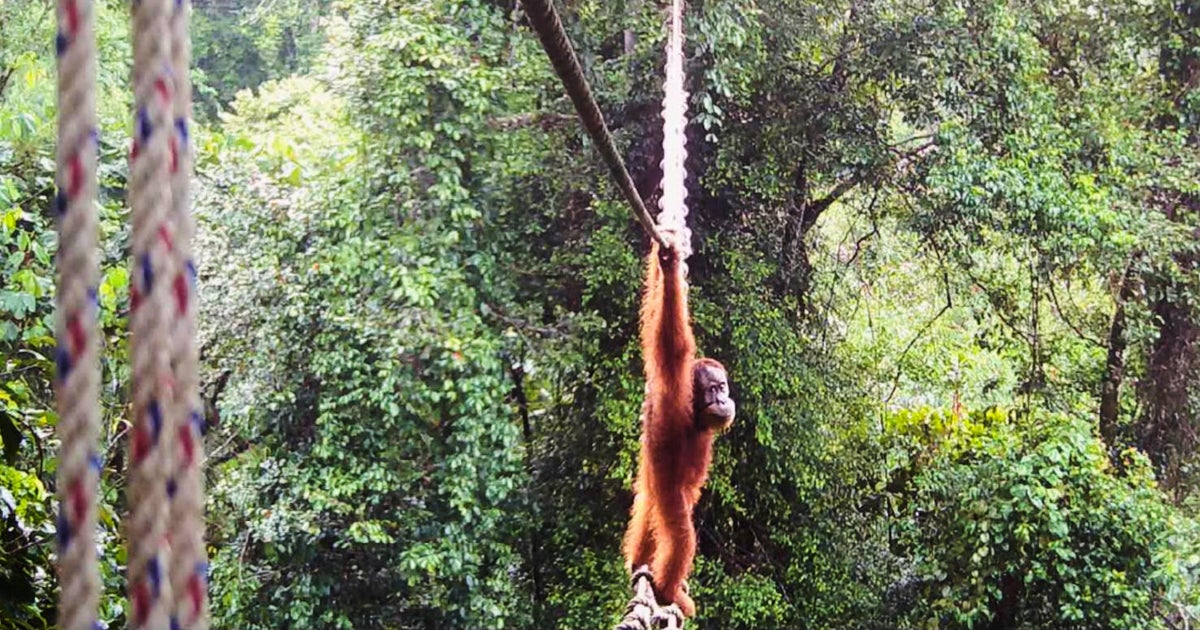
In a remarkable victory for wildlife conservation, a young Sumatran orangutan has become the first of its species ever recorded using a human-made canopy bridge to cross a public road. This historic moment, captured by motion-sensitive cameras in Indonesia’s Sumatra island, represents more than just an animal crossing a street—it’s a beacon of hope for one of the world’s most critically endangered great apes. The footage shows the orangutan approaching the forest’s edge with visible caution, carefully gripping the rope with its powerful hands before venturing out into the open air above the road. Midway through the crossing, the young male paused thoughtfully, glancing down at the traffic below before—in what conservationists playfully described as a “cheeky glance” toward the camera—continuing confidently to the other side. This single crossing, though brief, marks a watershed moment in the ongoing battle to save these magnificent creatures from extinction. According to the Sumatran Orangutan Society (SOS), this is the first documented instance anywhere in the world of a Sumatran orangutan using an artificial bridge to cross a busy public road that had divided its natural habitat.
The Challenge: Development Versus Conservation
The story behind this achievement highlights one of conservation’s most persistent challenges: balancing human development needs with wildlife protection. The bridge spans the Lagan-Pagindar road in Pakpak Bharat district, a crucial transportation corridor that connects remote villages to essential services like schools, healthcare facilities, and government offices. For the local human population, this road is a lifeline—but for the estimated 350 orangutans living in the surrounding forests, it has become a dangerous barrier. The road cuts directly through prime orangutan habitat, effectively splitting the population into two isolated groups: those in the Siranggas Wildlife Reserve and those in the Sikulaping Protection Forest. When the road underwent upgrades in 2024, the situation worsened dramatically. The widening process eliminated natural crossing points in the forest canopy, leaving tree-dwelling wildlife with no way to safely navigate between the two forest areas. Erwin Alamsyah Siregar, executive director of the Indonesian conservation group Tangguh Hutan Khatulistiwa (TaHuKah), explained the dilemma perfectly: “Development was necessary for people, but without intervention, it would have left orangutans trapped on either side.” This encapsulates the modern conservation challenge—finding ways to allow human communities to thrive while preserving the wildlife that shares the landscape.
An Innovative Solution Takes Shape
Faced with this increasingly dire situation, TaHuKah partnered with the Sumatran Orangutan Society and various local and national government agencies to implement an innovative solution: rope bridges suspended high between trees, allowing arboreal animals to cross safely above the traffic. The concept itself wasn’t entirely new—similar structures have been used elsewhere for orangutans crossing rivers or traversing private industrial forest roads—but applying this solution to a busy public road presented unique challenges. Public roads are noisy, unpredictable, and filled with human activity, creating an environment that wildlife typically avoids. The conservation team installed five separate canopy bridges across the road, each carefully positioned based on extensive surveys of orangutan nests, forest cover patterns, and animal movement corridors. The structures had to be engineered specifically to support the substantial weight of orangutans, which are the world’s largest tree-dwelling mammals, with adult males weighing up to 200 pounds. Each bridge was equipped with camera traps to monitor usage and document which animals were brave enough to attempt the crossing. The careful planning paid off when smaller species began using the bridges first—squirrels, langur monkeys, macaques, and eventually gibbons all made successful crossings, proving the bridges were structurally sound and could potentially work for the larger, more cautious orangutans.
The Patient Wait and the Triumphant Crossing
After the bridges were installed, conservationists faced an anxious two-year wait before achieving their ultimate goal: an orangutan crossing. During this period, the team maintained regular patrols to prevent forest encroachment and monitored the camera traps religiously, hoping to catch that first historic moment. The orangutan’s approach to the bridge revealed fascinating insights into these animals’ intelligence and cautious nature. Unlike the smaller species that had used the bridges earlier, the orangutan didn’t simply swing across on first encounter. Instead, camera footage showed a methodical process of familiarization: building nests near the bridge, lingering at its edges, testing the ropes tentatively, and then retreating to observe from a distance. “They observe,” Siregar explained. “They don’t rush. They watch, they try, they retreat. Only when they’re certain it’s safe do they move.” This behavior demonstrates the sophisticated cognitive abilities that make orangutans so special—and so vulnerable. They’re thoughtful, careful creatures who take time to assess risks, a trait that serves them well in the forest but can be a disadvantage in rapidly changing environments. Then, after months of observation and testing, the young male finally made the full crossing—a moment that represents not just a personal triumph for one animal, but a potential turning point for the entire population of Sumatran orangutans struggling to survive in increasingly fragmented forests.
Why Connectivity Matters for Survival
The significance of this single crossing extends far beyond one orangutan’s journey from one patch of forest to another. For wildlife populations, especially those of endangered species, connectivity between habitat fragments is literally a matter of survival. When animal populations become isolated from one another, they face a cascade of problems that can lead to extinction. Isolation prevents genetic mixing, which over time leads to inbreeding, genetic weakening, and reduced resilience to diseases and environmental changes. Small, isolated populations are also more vulnerable to local disasters—a fire, disease outbreak, or food shortage that might be survivable for a larger, connected population can wipe out an isolated group entirely. For the 350 orangutans divided by the Lagan-Pagindar road, the canopy bridges offer something precious: options. Young males can now potentially cross to find mates, reducing inbreeding. Animals can access a wider range of food sources and nesting sites. If one forest area experiences problems, orangutans aren’t trapped there—they can move to better habitat. As Siregar emphasized, “These bridges allow orangutans to move, to mix, to maintain healthy populations. It reduces the risk of extinction.” This approach to conservation—restoring connectivity rather than simply protecting isolated patches—represents a crucial evolution in how we think about saving endangered species in landscapes increasingly dominated by human activity.
The Urgent Race Against Time
The stakes couldn’t be higher for Sumatran orangutans and their relatives. These magnificent great apes, once widespread across southern Asia, now survive only on the islands of Sumatra and Borneo, with their populations plummeting at an alarming rate. Current estimates paint a grim picture: fewer than 14,000 Sumatran orangutans remain in the wild, alongside just 800 Tapanuli orangutans (recognized as a separate species only recently) and approximately 104,700 Bornean orangutans. Rapid development continues to shrink their jungle habitat year by year, and fatal conflicts with humans are increasing as orangutans are forced into closer contact with farms and villages. The International Union for Conservation of Nature lists Sumatran orangutans as critically endangered—the most serious classification before extinction in the wild. While the successful bridge crossing offers genuine hope, conservationists are realistic about the challenges ahead. As SOS noted in their statement, “One orangutan has crossed, but a population of 350 still remains isolated.” The team hopes that this pioneering individual will serve as an example for others, demonstrating that the bridges are safe and usable. The closely monitored program continues, with conservationists analyzing camera trap footage and conducting regular patrols while waiting—and hoping—for more crossings. This breakthrough demonstrates that with creativity, collaboration, and commitment, it is possible to mitigate some of the damage human development inflicts on wildlife. As SOS celebrated, “Seeing this young male orangutan confidently cross the road is a huge milestone for conservation—proving that it is possible to stitch fragmented forests back together.” In our rapidly changing world, such innovative solutions may be the key to ensuring that orangutans and countless other species don’t simply survive, but thrive alongside human communities.