



American Military Aircraft Downed During Iranian Conflict: Understanding the F-15E and A-10
Incident Overview: American Jets Hit by Iranian Fire
In a significant escalation of military tensions, at least two American military aircraft have been shot down by Iranian forces, according to officials speaking with ABC News. The incidents involved two of the U.S. Air Force’s most reliable and battle-tested aircraft: an F-15E Strike Eagle and an A-10 Thunderbolt II, affectionately known as the “Warthog.” The downing of these aircraft represents a serious moment in the ongoing conflict, with rescue operations immediately launched to recover the crew members involved.
The F-15E Strike Eagle, which requires a two-person crew, was struck by Iranian fire, resulting in one crew member being successfully rescued while search and rescue operations continued for the second member. In a separate but related incident, an A-10 Thunderbolt II was also hit by Iranian fire but managed to stay airborne long enough to reach Kuwait, where the pilot was successfully rescued. Officials have not yet released information regarding the medical conditions of any of the crew members involved in these incidents. These events underscore both the dangers faced by American service members in combat zones and the capabilities of these aircraft to withstand damage, particularly in the case of the A-10, which managed to fly to safety despite being hit.
The F-15E Strike Eagle: A Legendary Air Superiority Fighter
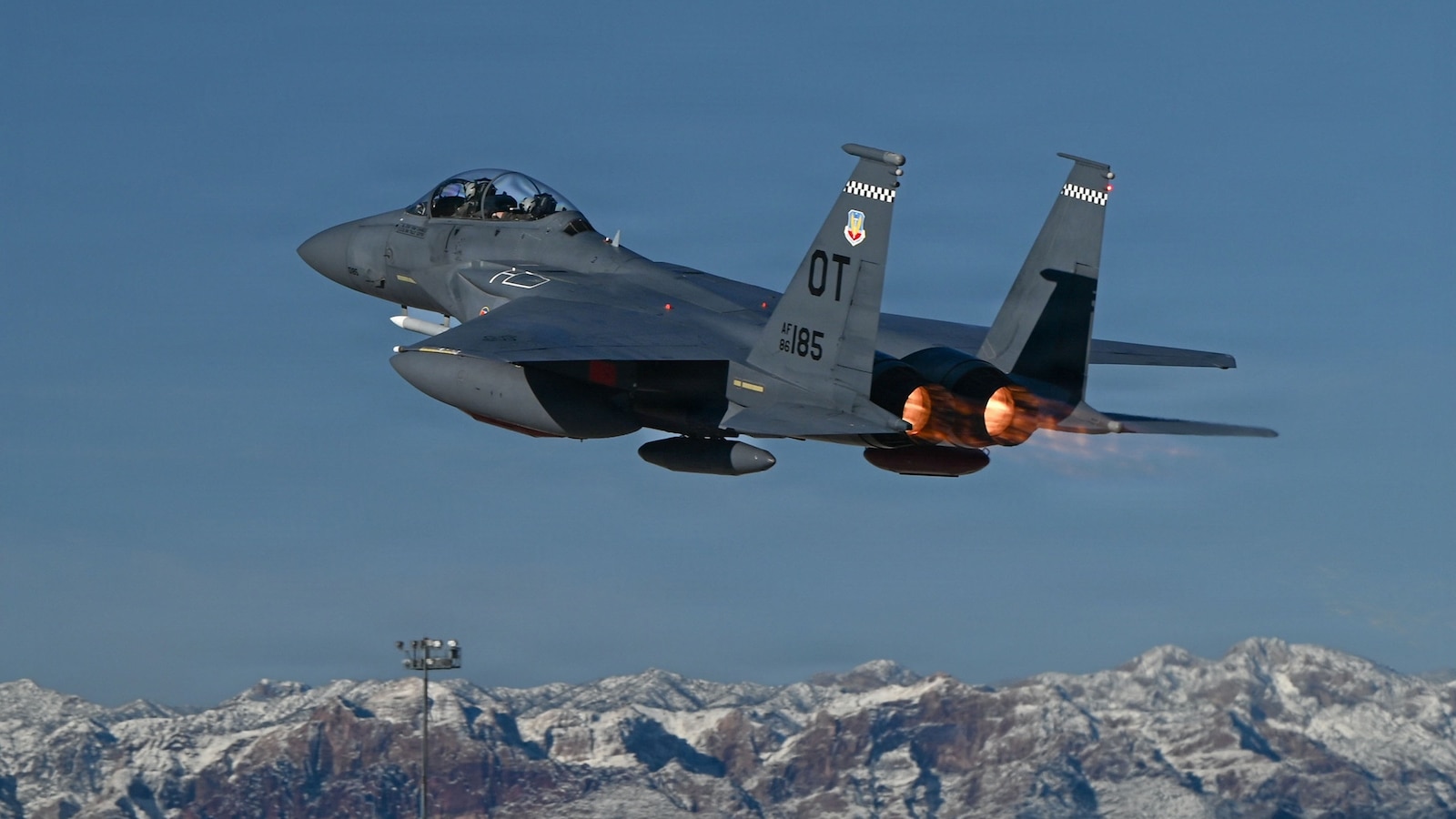
The F-15E Strike Eagle represents one of the most successful and enduring fighter aircraft designs in aviation history. The F-15 family’s story began more than five decades ago when the original F-15A completed its maiden flight in July 1972. Since then, the aircraft has evolved through several variations, including the B model, followed by the single-seat C version and the two-seat D model, which entered service in 1979. The E variant, which represents a significant evolution of the platform, first arrived at Luke Air Force Base in April 1988, marking a new chapter in the aircraft’s distinguished service record.
What makes the F-15E particularly remarkable is its exceptional performance characteristics and versatility. The aircraft features an extraordinarily high engine thrust-to-weight ratio, giving it the unusual capability to accelerate even while climbing vertically—a feat that few aircraft can accomplish. This raw power is complemented by tremendous maneuverability, allowing the F-15E to execute tight turns without bleeding off airspeed, a critical advantage in air combat situations. These characteristics have made the F-15 family one of the most feared air superiority fighters in the world, with an unmatched combat record.
The E variant was specifically designed as a dual-role fighter, capable of performing both air-to-air combat missions and air-to-ground strike operations in all weather conditions. This versatility makes it an invaluable asset for military commanders who need an aircraft that can adapt to rapidly changing battlefield conditions. The cockpit design reflects this dual-role capability, with a rear seat for the weapons system officer equipped with four multi-function displays that can show various types of tactical data. Meanwhile, the pilot benefits from a glass heads-up display that projects critical flight and weapons information directly in the pilot’s line of sight, eliminating the need to look down into the cockpit to check weapon status or other vital information—a feature that can mean the difference between life and death in combat.
In terms of raw performance, the F-15E is genuinely impressive. It can reach speeds of 1,875 miles per hour—well over twice the speed of sound—and has a service ceiling of 60,000 feet, allowing it to operate at altitudes where many threats cannot reach. The aircraft’s weapons capability is equally formidable, able to carry various air-to-air and air-to-ground missiles, along with a 20mm internal cannon loaded with 500 rounds of ammunition for close-range engagements. This combination of speed, altitude capability, maneuverability, and firepower has kept the F-15E relevant and deadly effective despite being in service for nearly four decades.
The A-10 Thunderbolt II: The Indestructible “Warthog”
While the F-15E represents the pinnacle of air superiority and strike capability, the A-10 Thunderbolt II, universally known by its nickname “Warthog,” embodies a completely different philosophy of aircraft design. The A-10 was purpose-built to support ground operations at low altitudes, providing close air support to troops engaged in combat. Unlike sleek, fast fighters designed to dominate the skies, the Warthog was designed with one primary mission: to destroy enemy ground forces, particularly armored vehicles, while operating in the most dangerous environments imaginable—right above the battlefield where enemy fire is heaviest.
The A-10’s top speed of just 420 miles per hour might seem unimpressive compared to supersonic fighters, but speed was never the point of this aircraft’s design. Instead, the A-10 was built to be nearly indestructible, capable of absorbing tremendous damage and continuing to fight. The Air Force designed the aircraft with survivability as the paramount concern, knowing that it would be operating in environments where being hit was not a matter of if, but when. According to Air Force specifications, the A-10 can survive direct hits from armor-piercing and high-explosive projectiles up to 23mm in caliber—a testament to its rugged construction.
The aircraft’s fuel system exemplifies this design philosophy, with self-sealing fuel cells protected by both internal and external foam to prevent catastrophic fires or explosions when punctured. The flight control systems feature multiple redundancies, with manual backup systems that allow pilots to maintain control even when hydraulic power is completely lost—a situation that would render most aircraft unflyable. Both the pilot and the critical flight control systems are protected by titanium armor plating, providing protection against ground fire that would destroy less robust aircraft. The aircraft’s survivability is further enhanced through redundant primary structural sections, meaning that even if one part of the aircraft is severely damaged, other sections can continue to perform their functions.
Beyond its legendary toughness, the A-10 was designed for practicality and ease of maintenance in field conditions. It can operate from relatively short runways and can land in a variety of challenging conditions that would ground more delicate aircraft. The aircraft’s design includes interchangeable parts on both sides, simplifying maintenance and reducing the time needed to repair battle damage or perform routine servicing—crucial factors when operating in forward combat areas with limited resources.
The A-10’s primary weapon is perhaps the most fearsome gun ever mounted on an aircraft: a GAU-8/A Avenger 30mm seven-barrel Gatling gun that can fire an astounding 3,900 rounds per minute. This weapon was specifically designed to destroy tanks and armored vehicles, firing depleted uranium armor-piercing rounds that can penetrate the thickest armor. The gun is so powerful and so central to the aircraft’s mission that engineers essentially built the aircraft around it. Combined with the A-10’s ability to carry a variety of air-to-surface weapons, including missiles and bombs, the Warthog represents the ultimate ground attack platform. Its combat record speaks for itself: during the 1991 Gulf War, A-10s flew over 8,000 sorties and maintained an incredible 95.7% mission-capable rate, proving both its effectiveness and reliability under intense combat conditions. The fact that the A-10 hit by Iranian fire managed to fly all the way to Kuwait for a safe landing perfectly illustrates why this aircraft has earned such fierce loyalty from the pilots who fly it and the ground troops it protects.