


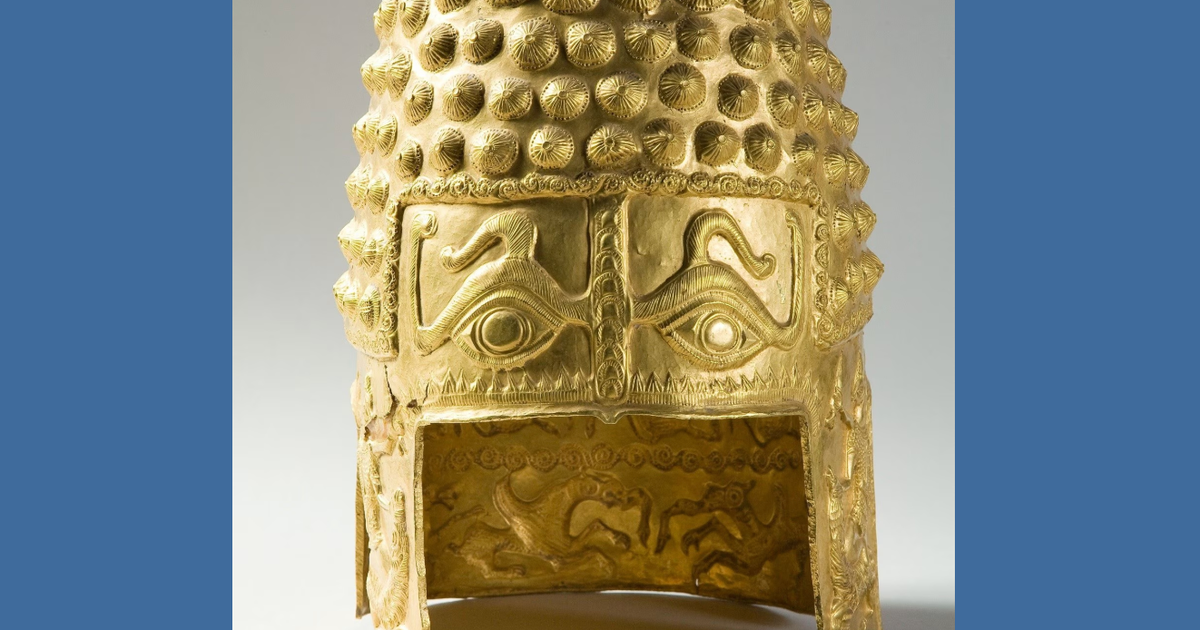

The Recovery of Romania’s Priceless Golden Helmet: A Testament to Perseverance and Art Detective Work
A Daring Museum Heist Shocks Two Nations
In January 2025, the quiet halls of the Drents Museum in the northern Netherlands became the scene of a brazen and meticulously planned robbery that would send shockwaves through both Dutch and Romanian cultural institutions. Using firework bombs as their tools of destruction, a gang of thieves forcibly broke into the 170-year-old museum, shattering the peaceful sanctuary where some of Europe’s most precious artifacts were displayed. Once inside, the robbers smashed through protective display cases with alarming efficiency, making off with treasures that had survived millennia only to fall victim to modern criminality. Among the stolen items were three gold bracelets and the crown jewel of the Romanian collection—the Helmet of Cotofenesti, a magnificent golden artifact dating back to the 5th century BC, making it approximately 2,500 years old.
The theft represented more than just a loss of valuable objects; it was an assault on cultural heritage itself. Harry Tupan, the general director of the Drents Museum, captured the gravity of the situation when he described it as “a dark day,” noting that in the museum’s impressive 170-year history, no incident of such magnitude had ever occurred. The stolen helmet wasn’t merely an ancient piece of metalwork—it was a symbol of Romanian national identity and pride, a tangible connection to ancestors who lived when the classical world was at its height. The artifact’s disappearance triggered outrage in Romania, where citizens viewed the theft as an attack on their national treasures, items that belonged not just in a museum case but in the collective memory and heritage of an entire nation. The Dutch government, recognizing the severity of the situation and the likelihood that insurance claims would need to be honored, set aside a staggering 5.7 million euros (approximately $6.5 million) to cover potential payouts related to this audacious theft.
Enter the “Indiana Jones of the Art World”
When priceless artifacts vanish into the shadowy underworld of art theft, law enforcement agencies often find themselves at a disadvantage, unable to penetrate the closed networks where stolen treasures change hands. This is where Arthur Brand enters the picture—a Dutch art detective who has earned the colorful nickname “Indiana Jones of the Art World” through his remarkable track record of recovering stolen masterpieces and artifacts that others had given up for lost. On Thursday, Brand delivered news that many had hoped for but few expected: the Helmet of Cotofenesti had been found. “It’s amazing. It’s the best news we could have got,” Brand told AFP, confirming that the lost treasure had been successfully recovered. Prosecutors prepared to make an official announcement later that same day, validating what Brand’s unique investigative methods had accomplished once again.
Brand’s approach to art recovery sets him apart from traditional law enforcement and has made him a legendary figure in the specialized world of cultural property crimes. His methods involve positioning himself as a bridge between two worlds that typically never communicate: on one side, the legitimate realm of police, insurance companies, museums, and collectors; on the other, the criminal underground populated by art thieves, forgers, mafia members, and even terrorist organizations. “So there are two different kind of worlds, and they do not communicate. So I put myself in the middle,” Brand explained in a 2017 interview with CBS News. This willingness to navigate the gray areas, to broker deals with unsavory characters while maintaining his integrity and ultimate goal of returning stolen art to its rightful owners, has made Brand uniquely effective where traditional approaches fail. He operates in the shadows where stolen art resides, speaking the language of criminals while serving the interests of justice and cultural preservation.
A Career Built on Extraordinary Recoveries
The recovery of the Helmet of Cotofenesti represents just the latest triumph in Arthur Brand’s remarkable career, which reads like a adventure novel filled with international intrigue and cultural redemption. His list of accomplishments would be the envy of any detective, but in the specialized field of art crime, his successes are nothing short of legendary. In July 2025, just months before recovering the Romanian helmet, Brand achieved another stunning victory when he recovered a priceless collection of stolen documents spanning from the 15th to the 19th century. This treasure trove of historical papers included several archives that had been designated by UNESCO as items of world heritage significance, including documents from what historians consider the world’s first multinational corporation—items that provide irreplaceable insights into the development of global commerce and human organization.
A few months prior to that achievement, Brand played a crucial role in helping Dutch police solve one of the art world’s most enduring mysteries: the disappearance of a Brueghel painting from a Polish museum more than five decades ago. The painting had vanished so completely that many had assumed it destroyed or lost forever, yet Brand’s investigative tenacity and unique connections allowed him to crack a case that had baffled authorities for over 50 years. In 2023, he successfully returned a Vincent van Gogh painting to a museum more than three years after it had been stolen, once again demonstrating that even when trails grow cold and hope fades, Brand’s unconventional methods can yield results. The previous year, in 2022, he returned a Roman statue that had been missing since 1973—an artifact that had been stolen from the Musee du Pays Chatillonnais and had been lost for nearly half a century before Brand tracked it down.
Brand’s recoveries span artistic movements, historical periods, and levels of controversy. He has returned Salvador Dali’s “Adolescence,” proving his capability in tracking modern art as well as ancient artifacts. He recovered a Picasso painting, adding one of the 20th century’s most influential artists to his resume of successful cases. Perhaps most controversially, Brand also recovered “Hitler’s Horses,” sculptures that once stood outside Adolf Hitler’s chancellery in Berlin—items of immense historical significance despite their association with one of history’s darkest chapters. Each recovery represents not just the return of a valuable object, but the restoration of cultural heritage, the closing of painful chapters for institutions that lost precious items, and the preservation of human creativity and history for future generations.
The Dangerous Dance Between Legitimate and Criminal Worlds
What makes Arthur Brand’s work particularly fascinating—and dangerous—is his willingness to engage directly with the criminal underworld in ways that traditional authorities cannot. The recovery of stolen art requires more than detective work and legal procedures; it demands an understanding of criminal psychology, black market economics, and the complex motivations that drive people to steal and trade in cultural property. Brand has brokered deals with terrorist organizations who fund their operations through art theft, negotiated with mafia families who view stolen masterpieces as currency and status symbols, and convinced a “slew of shady characters” to part with stolen goods by offering them paths that avoid prosecution or provide financial compensation less than the art’s true value but more than they could safely obtain on the black market.
This dangerous balancing act requires Brand to maintain relationships with criminals while never crossing the line into criminality himself. He must be trusted by thieves and fences while remaining trustworthy to the museums, collectors, and law enforcement agencies who depend on his services. The art underworld operates on its own rules, and stolen masterpieces often pass through multiple hands, each transaction moving the piece further from its origins and deeper into networks that law enforcement struggles to penetrate. Brand’s unique position allows him to send messages into this world, to make it known that certain stolen items are “too hot” to sell, to offer face-saving solutions that allow criminals to divest themselves of dangerous property, and to create pathways for art to return home without necessarily leading to arrests—a pragmatic approach that prioritizes recovery over prosecution.
The Broader Significance of Art Recovery
The theft and recovery of the Helmet of Cotofenesti illuminates larger issues surrounding cultural heritage in our globalized world. Museums routinely display treasures from other nations, creating opportunities for people worldwide to experience artifacts they might never see otherwise. The Drents Museum’s exhibition of Romanian treasures served educational and cultural exchange purposes, allowing Dutch citizens and international visitors to connect with ancient Romanian civilization. However, such arrangements also create vulnerabilities, as the theft demonstrated. The incident became headline news not just in the Netherlands but internationally, reflecting growing awareness of cultural property crimes and their significance beyond mere monetary value.
For Romania, the helmet’s theft represented a violation that went deeper than the loss of a valuable object. National treasures carry symbolic weight that transcends their material worth; they embody national identity, historical continuity, and collective memory. When such items are stolen, entire nations feel the loss personally. The outrage expressed by Romanian citizens reflected this deeper meaning—the helmet wasn’t just an ancient piece of gold crafting, but a connection to ancestors, a symbol of cultural achievement, and a source of national pride. Its recovery, therefore, represents more than the return of stolen property; it signifies respect for cultural sovereignty, the triumph of heritage preservation over criminal greed, and the possibility that even in our fractured world, some things remain sacred enough to fight for. Arthur Brand’s work serves this higher purpose, reminding us that art and artifacts don’t merely represent monetary value but embody the human story itself, deserving protection and recovery regardless of the challenges involved.